Posts

Showing posts with the label pattern

Hyde Hall Planning: 1830s Chemises

Image
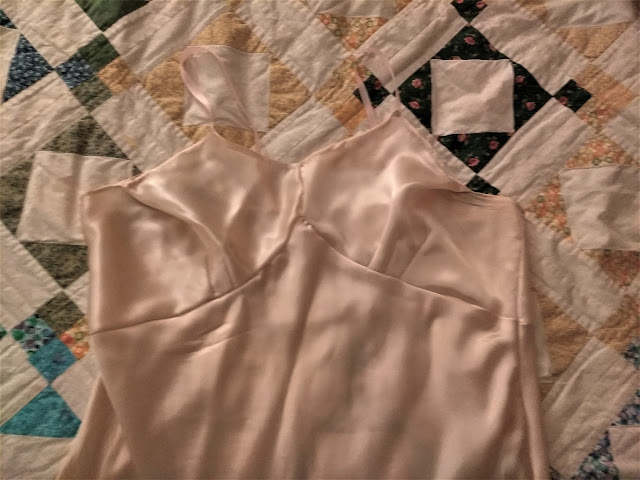
The chemise is the first thing you put on, so it's the first garment I'll be discussing. As in other eras, the chemise was used as an underlayer to soak up the wearer's oils and sweat and protect the rest of the clothing. Throughout history, they have tended to be pretty shapeless, but there are typically various features that reflect contemporary fashion. In this period, that typically means higher and wider necklines, and short but full sleeves. Fabrics This period marks the early years of the Industrial Revolution, and the transition from linen to cotton as the basic utility fabric. Linen required a significant investment of time for processing (you have to let the harvested plant sit around in water for weeks to rot the stems and loosen the fibers), while cotton could be cleaned, carded, and spun pretty much immediately, which is part of the reason for this transition. Both linen and cotton were used for undergarments at this time. The Workwoman's Guide,  fi...
Transitional Stays Pattern

Image
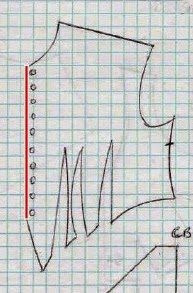
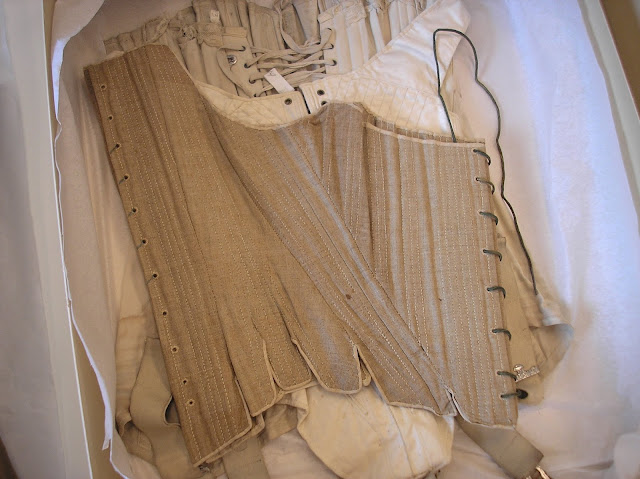
Hello, strangers! I'm back to post again about those underbust stays from the pre-Regency, in preparation for the Short Stays Sew-Along . I saw these, as the label suggests, at Historic Cherry Hill in Albany, NY. (I don't believe there was any definite provenance, but the house was owned by the Van Rensselaers and most if not all of the collection is original to the family.) They're quite simple to put together. The above pattern is 1" per grid box, and drawn without seam allowances. Here's my guide for scaling up patterns!  The marks at the bottom of the seams should be lined up, and the seams only run down to them. Materials used in the original: unbleached linen canvas linen tape (off-white, but not unbleached) - cotton twill tape is an acceptable substitution linen thread (off-white, but not unbleached) whalebone - cane or plastic are acceptable modern substitutes Process (requires hand-sewing): 1. The two side pieces are cut out of two...

Mimic of Modes Historic Patterns

Image
At last, Julie and I have basically wrapped up all of the rewards for that Kickstarter campaign we ran some time ago! But whatever the roadblocks, all of the sewn rewards have been distributed, all of the digital patterns have been sent out, and I have passed on all of the ones meant to be printed to Julie and contacted anyone who filled out the survey as needing help. Many, many, many thanks to everyone who supported us. Going forward, however, I will not be with Dragonrose Historic Patterns, but will instead be running Mimic of Modes Historic Patterns . This really doesn't make much of a difference to you - I can still fulfill the "future pattern" rewards, and the overarching ethos of my patterns will still be the same: they'll be based on actual garments from museum or personal collections, some that are representative of the "average" and some that are interesting variations. I do plan to have standard sizes available as well as the custom sizi...

Fabulous Full-Slip (and the Haslam System)

Image
When I posted about my half-slip , I linked to some information about the Haslam System of Dresscutting but didn't really get into it. Let me rectify that now! The Haslam System is a method of creating patterns for anyone, at any size within a particular range. Where a paper pattern comes at full size in a range of set measurements, and a gridded pattern à la  Janet Arnold comes in one particular size, Haslam patterns were printed to scale, roughly, with information on how to make them full size depending on an individual's measurements. The way this works is through the use of a two-sided chart . (The one at the link is prepared to be printed on A4 paper, so if you're American it will cut off some of the edges, but it's fixable.) Each side helps you draft the top of the back and front of a bodice sloper specific to any individual: the chart is perforated to allow you to plot points based on your neck, shoulder, and bust measurements, and on one side there are a few...

Kickstarter - Fully Funded!

Image
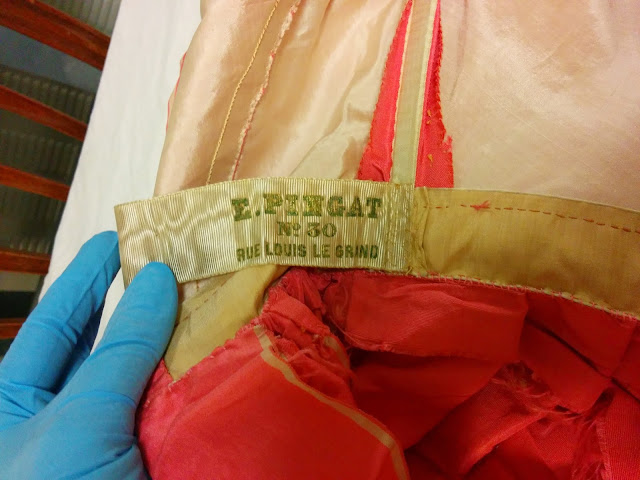
Hooray! After just a few days, Dragonrose Historical Patterns has been fully funded and then some. I must give a great big thank-you to everyone who supported us, either for a preordered pattern or without reward, and another big thank-you to Lauren of American Duchess for sharing a link for us on Facebook. Look, it really is a Pingat! Our total is still climbing. Julie and I discussed it, and decided to add a few stretch goals. $3,400 - We're already almost to this one (and may hit it while I'm typing). When we hit it, we can purchase a module to allow us to create standard-sized, preprinted patterns, in addition to our custom-sized patterns for individuals. $13,500 - I know, it sounds like a lot! It is  a lot! But the extra $11,000 would allow us to buy a 72" Ioline Flex-Jet E commercial printer, which would let us print Dragonrose patterns much more cheaply and therefore sell them to you more cheaply. We would also be able to sell them to distributors wholes...

Kickstarter - Dragonrose Historical Patterns

Image
This is finally happening! Julie  (or should I link here ?) and I have been tossing around these plans for starting a line of historical patterns for a long time. I'm not quite sure how long. I've been merrily taking pattern after pattern for a couple of years so that once the infrastructure is in place, we can start putting them into the computer program and working on the grading, making test samples, etc. But first we need the computer program and associated modules, hence the Kickstarter. Our first pattern, which we're making available for pre-order as the basis for the Kickstarter , is for the 1867 pink evening gown by Emile Pingat in the collection of the Albany Institute of History and Art. Evening dress, Pingat, ca. 1867; AIHA 1972.95.2 Julie actually made the first version of the pattern and took it to the Costume Society of America conference in Cleveland this year, where it won the CSA Designer Showcase. (I'm going to be making my own soon as well.)...

Swirl Housedress, 1950s

Image
The housedress as we know it - a very informal garment to wear at home while lounging or working, loosely-fitted and easy to wash - seems to date to the early twentieth century. Previously, the term could be used to refer to more elaborate  and structured clothing, essentially what I'd label "day dress", made of less expensive fabric for the morning and more expensive fabric for the afternoon; around 1910 a shift in usage  occurred where people started to label much less formal wrappers, kimonos, and tea gowns as house dresses - although it most commonly seems to have been applied to plain wash dresses (ie, dresses that could be fully laundered). Basically, the nineteenth century housedress was something you were considered "dressed" in, and the twentieth century housedress was coming to be something that was more suitable for doing the morning housework, or just sitting around in. From the Dry Goods Reporter , July 1915 I forget how I first found out abou...

Ardis's Graduation Dress (Historical Sew Monthly #8, Heirlooms & Heritage)

Image
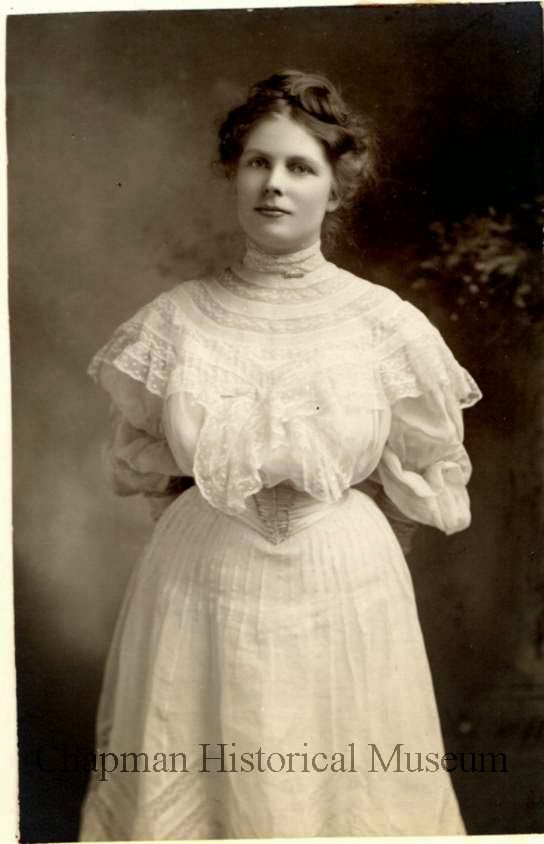
Originally, I was going to write about lingerie dresses in general, as they make up a large portion of heirlooms everywhere, and especially of my small collection of antique clothing. But then I remembered - I can do better! A long time ago, I posted some photos of ancestors of mine, including one of the following portraits: This is my great-grandmother, Ardis Burdick Allen Luce, in 1919 - although at the time, she was just Ardis Burdick. Like pretty much all young women in the late 19th and early 20th century, when she graduated high school, she wore a white cotton commencement dress. It's not exactly cutting edge, but it is  fashionable for the time - raised waistlines could be found even in the Gazette du Bon Ton through 1921 - and it was probably made for the occasion, perhaps by someone in her family. (Her maternal grandmother worked in the clothing industry for most of her life, as a dressmaker and then as a saleslady/merchant.) Ardis kept this dress and passed it...

Scaling Up Patterns: A Guide (HSM #6)

Image
It was hard for me to figure out what to write for "Out of Your Comfort Zone". My comfort zone is pretty wide, and what's outside of it - the later twentieth century - is also outside of the limits of the Historical Sew Monthly. So I tried to think more broadly about what I'm comfortable with. What makes me uncomfortable? Tutorials, definitely, because I don't do  that much when it comes to historical sewing, Another thing that makes me uncomfortable is self-promotion in anything other than short bursts, and this post is essentially shameless begging for you to buy my book - Regency Women's Dress , out this autumn! - even if you normally rely on individual, full-size patterns. This can also be seen as helping other people move out of their  comfort zones. Thinking OUTSIDE the box! --- When it comes to making historical clothing, I prefer to use patterns taken from extant garments rather than full-size ones graded for different sizes. There are a number of...

A Practical Wedding Dress (HSM #5)

Image
Practicality. This was a difficult topic for me, as much of my research is done through fashion plates and the like, and I had no idea where to begin. (There is the  Ouvrières de Paris  series of plates I posted to Tumblr, but I couldn't think of anything substantial to say about them except to note all the black aprons. Note all the black aprons!) But then I considered all the patterns from the Chapman that I still have to post about, and came across this one: Wedding suit, 1906;  CHM  1983.77.4a-d (The jacket has a skirt and a belt; the pattern for all pieces is available at the link.) This was worn by Elizabeth Callahan (1882-1953) on her marriage to Patrick Herlihy (1875-1958) on April 30, 1906. Doesn't look like a wedding outfit, does it? I admit that I wouldn't have guessed that this was worn to a wedding, and ordinarily I might have questioned the attribution and put it as the traveling suit, but the hard copy file contained the wedding announcement, w...

Day Dress (1865-1868)

Image
Day dress, 1865-1868; CHM 1990.56.1 (pattern available at link) It's been a little while since I've shown a patterned garment from the Chapman, so I thought I would give you another. This one also goes very well with my previous post From Hoop to Bustle , as it comes from the years when women wore the elliptical hoop at its widest: as you can see in the pattern , the skirt panels are quite flared. I might have made the date range a little wide - 1865 is a little early. The center back is cartridge pleated, which is characteristic of the end of the 1860s; earlier gored skirts (1860-1865) were more usually pleated all the way around. At the end of the 1860s dresses most usually had a short overskirt, but as you can see in the wonderful comparandum plate below, this was not a requirement. Fashion plate, probably from Peterson's Magazine , 1868; NYPL 803083 The thing I love about this dress is that it strikes me as an attempt to get at a princess-cut gown, which was...

A Delphos Dress

Image
"Delphos" dress, Mariano Fortuny, 1910-1930; CHM 1997.68.1 (pattern available at link) Mariano Fortuny y Madrazo (1871-1949) is best remembered for two things: vibrantly patterned silks and velvets, and the Delphos gown, inspired by ancient Greek chitons (themselves imported from Asia Minor), which were made from a single rectangular panel of linen or silk sewn into a tube, the top edge fastened with brooches down the length of the arms, and belted to fit to the body. The Neoclassical revival had already begun in the decorative arts by 1907, when Fortuny developed the Delphos, and high fashion was beginning to show its influence as well - but this was much more extreme than anything else in existence at the time. Not only was it originally intended to be worn without a corset at home (corsetless teagowns had been worn for some time already), there was absolutely nothing about its design that hid that fact. The straight, clinging line would soon become mainstream fashion,...

Jennie Goodman's Wedding Dress (1878)

Image
I've been sitting on this pattern for a while because this is, frankly, one of my favorites of the dresses I put online at the Chapman. CHM 1971.38.1 (pattern available at link) Now, the photo is not great. It's a decent view of the bodice, but you don't get a good sense of the elaborate drapery and the classic early Natural Form train. There are a few other shots on the website, but there's nothing like seeing a dress on a mannequin. Unfortunately, this gown has some structural issues, possibly due to being on a hanger for a long time (though it was in a box when I got there), and can probably never be dressed, which is one reason I wanted to pattern it. The slender princess line would make this tricky to fit, which is why I haven't tried to make it yet (as well as the utter confusion of the pattern itself, which was phenomenally difficult to take and had me contemplating just putting the dress back several times). It's very close-fitting from the neck...

Wedding Dress, 1905

Image
Wedding photo of Grace Louise Fenton Ross, 1983.15.7 (Dress itself is 1983.15.4a-b , pattern at link.) It's possible that a lot of lingerie dresses in collections were worn as wedding dresses - around the turn of the century, they were very popular for that use. Being white, they fit into the already-established but mainly upper-class wedding dress tradition, but being cotton, they were more affordable. Additionally, these white cotton dresses were fashionable and could be worn after the wedding, just as most women had done in earlier decades with colored gowns. The belt from this one is gone, but the rest of the dress is in wonderful shape, apart from some yellowing. It is full of time-consuming details - lace insertion, pintucks - but because the fitting is achieved through the waistband and large pleats on either side of the back (the bodice is very loose and tucks into the skirt), it was a style ideal for the dawning of the age of ready-to-wear. Judging by the photogr...

Drawers, 1930s

Image
CHM 1992.5.4  (pattern available at link) These drawers - tap pants, they're more commonly called now - were made by a Mrs. Shattuck who ran a "sewing room" in downtown Glens Falls . (The information came from the donor; there's nothing at all about Mrs. Shattuck that I can find online, although there was a local Shattuck family.) Made of a slippery silk or rayon, they're entirely hand-sewn with grey silk thread. I've actually used this pattern twice now to make tap pants for myself as part of my new home sewing regimen. The first time, I used a very nice, heavily patterned rayon charmeuse and I sewed them by hand. The only changes I made were to widen them a bit, leave off the lace, and hem the edges instead of binding them. And I used snaps instead of buttons. Some of these were bad choices! The pants are meant to sit at the waist, not on the hips, so I shouldn't have widened them so much; the snaps have a tendency to pop when I move, although that...

Evening Dress, 1911-1913

Image
Evening dress, 1911-1913; CHM 1975.95.28 , pattern available at link For the most part, I stuck to objects of definite provenance while working on the digitization project, but I had to make an exception for this one. The bright fuschia of the silk twill really stands out, and it's in spectacular condition. As you can see from the pattern, it was made for a very small woman (the 25.5" waist measurement on the object page is actually for the underbust waistline) - but the pieces are so simple that it shouldn't be difficult to size up. With no set-in sleeves, there should also be no sleevil!

Isabelle Sloan Rohlfs, 1916

Image
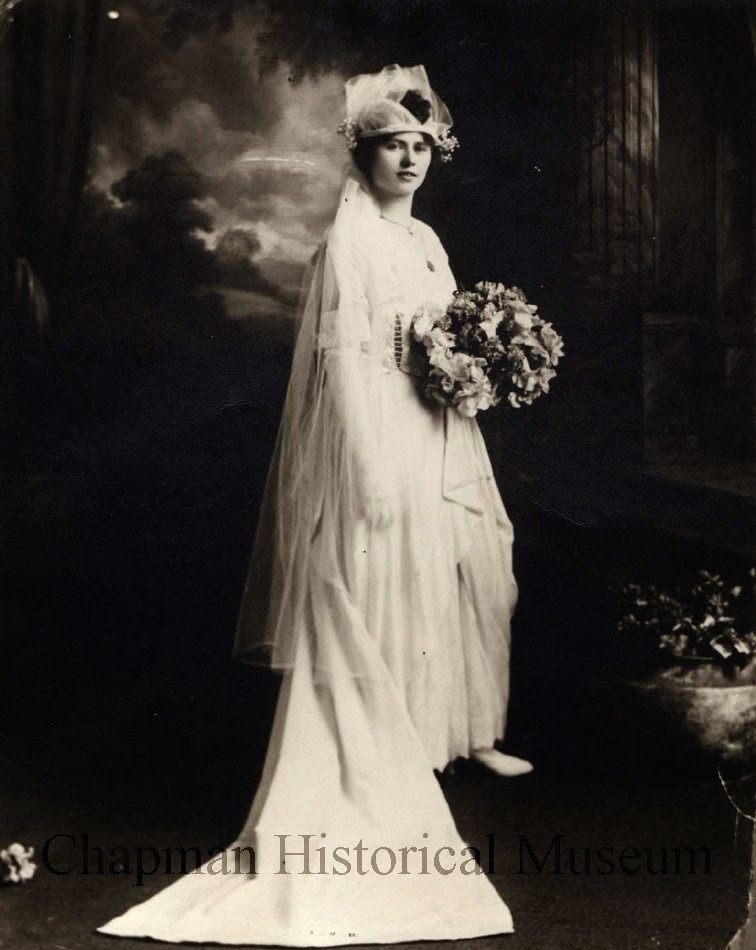
Isabelle Sloan Rohlfs on her wedding day, 1916, 1984.24.3 ; gown is 1984.24.1 (pattern at link) This wedding dress is a great example of its period in several ways. The layered closures, snapping to cover each other, all covered with a tunic layer that fastens on the side and at the shoulder; the loose bodice and slight shaping at the waist. The skirt is rather long and narrow, but conservatism in wedding dress is not a strange thing. The pattern for the crepe top layer of the skirt is somewhat confusing, but the piece is simply so big that it wouldn't fit without abbreviation. Basically, the wavy bottom edge is mirrored on the other side, but it stops where the front edge - continuing in the same straight line - hits it. (The top edge is the same length from center back to center front on both sides.) This era is a very confusing one for patterning: while the foundation layers are usually fitted, most of the outer ones seem to have been draped over the linings on a dress fo...

Mrs. Joseph Mead's Slippers, 1856

Image
Wedding slippers, 1966.21.3a-b  (pattern available at link) Unfortunately, I don't know anything about Joseph Mead's unnamed wife. And her wedding gown either no longer survives or is being held somewhere else. The attribution might not even be correct - it's based on a handwritten note placed inside one shoe (the handwriting does look to be Victorian, however, so I tend to think it was done by someone with first-hand knowledge). I wish the gown did  survive - not just because every surviving gown is a victory against entropy and the Lone Power, but because that fabric is pretty amazing, and I would love to see it stretching over the yards and yards of an 1850s skirt. However, these slippers are in good condition, and it's good to have them! The construction is very simple, and anyone who wants to have slippers to match her gown should be able to use the pattern to make them.

Isabel Elsey's Wedding Dress, 1934

Image
Wedding Dress, 1973.11.1  (pattern available at link) This dress. Oh, this dress. Bias cuts are tricky to pattern, because patterning requires following the grain and measuring the rise and run to get the slope of a diagonal or curve, usually using the center front or back when they're cut on the straight. Satin also makes it difficult, since the sheen and thin warp threads get in the way. Satin cut on the bias combines these issues, plus the heavy fabric hanging on the bias pulls out of shape easily, making the warp and weft not sit at right angles. I was very happy when this one was finished. I tend not to be too involved with the mid-20th century sewing community, but I'd love to see this one tried out - either as a full gown with a train, or maybe as a modified version for summer wear, with no sleeves and a knee-length skirt. Think about it.

Mary DeLong West's Wedding Dress, 1896

Image
1976.139.2 , pattern available on site As it says at the site, this was "w orn by Mary DeLong in 1896 when she married Charles F. West." And you can see it on Mary as well - in the photograph, there's some beaded trim running around the middle of the collar and on the edges of the cuffs, and a large bow on the back of the collar, but that hasn't survived. Personally, I think it looks better without the trim. The chiffon overlayer is not included on the pattern, but it's just rectangular blocks with slight curves cut for the neckline and armscye. Has anyone made an 1890s outfit with this sort of elastic in the skirt? That's the sort of detail that always makes me want to do a little experimental archaeology. There were two wedding dresses from the mid-1890s with provenance, but I went with this one because I love satin - it stays in such good condition. One of the 18th century gowns I patterned for my book is satin, and you'd have thought it was ...