Posts

Showing posts with the label gown

My First Bib-Front Gown

Image
Somehow, I'd never made a bib-front gown before. But when I was given a length of cotton by a new friend at the 2018 regional CSA symposium, I knew it was going to be for something from  Regency Women's Dress - and as that was the place where I realized that the awkwardly-fitting stays I'd made years before were actually transitional , I wanted to sew a transitional gown as well to wear over them. The one I eventually made is based on both bib-front patterns in  RWD : the bodice is from the one with long sleeves (at the Fenimore Art Museum, p. 42), and the skirt from the other (at Old Sturbridge Village, p. 46). Scaling and sizing it up was not too problematic - I think the trickiest part was figuring out the appropriate size for the bib. The sleeves I didn't even touch, as the sleeve head is very large and my forearms are slim, but the fit was ... very close. They're also long, cut to scrunch up on the arm, which I love Me and Katie Lovely ! Both of us in pr...
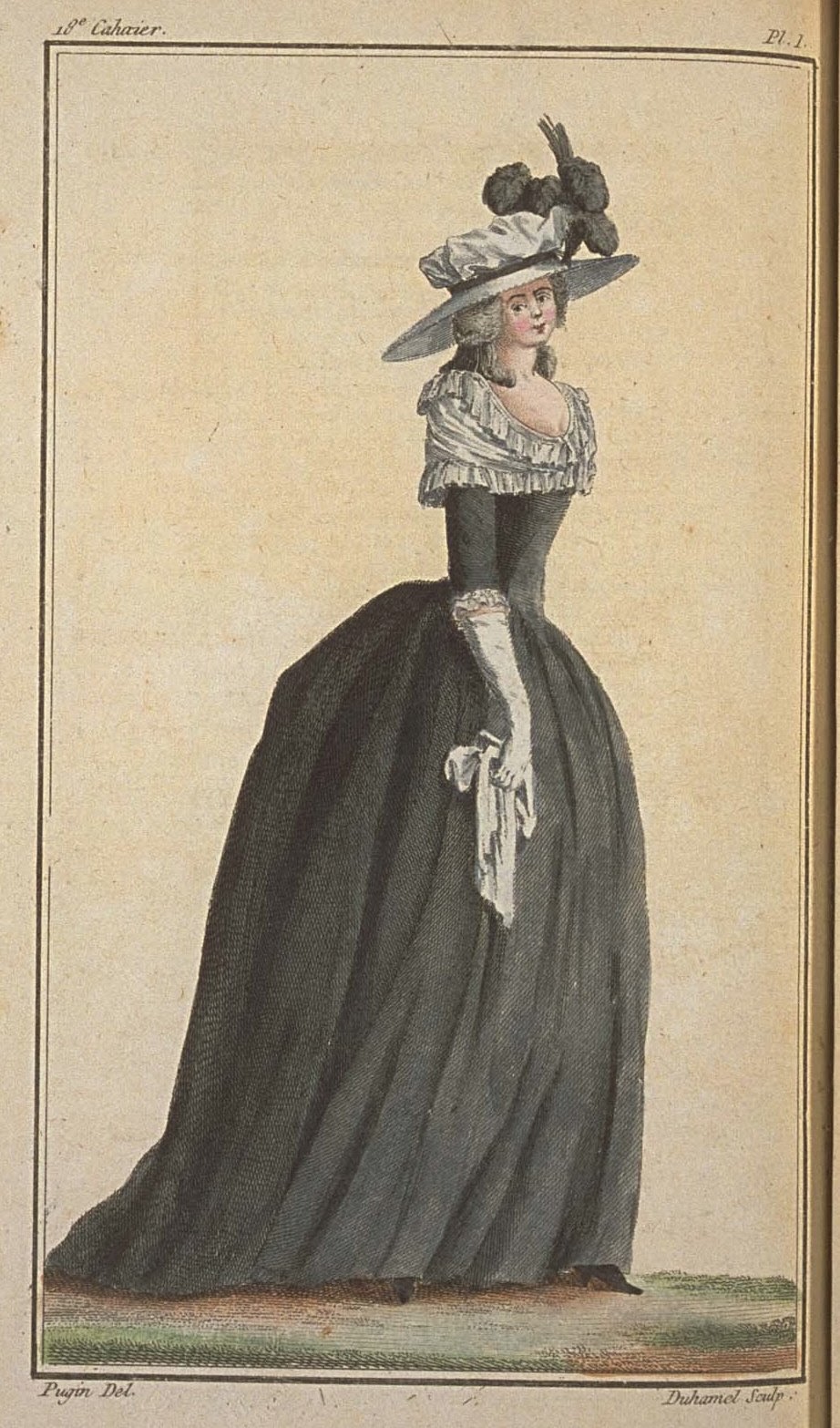
Cabinet des Modes, 18e Cahier, 1ere Figure

Image
August 1, 1786 It would be necessary on the occasion of a period of mourning to talk about its fashion: for the death of DON PEDRO , King of Portugal, we have furnished it. It has been worn for twenty-one days; we will say how when we have spoken of the periods of mourning according to our practice. Mourning (1), which is the mark of grief, and which draws its name from it, was worn and is worn by all civilized Peoples. It has not taken the same form in all; but in all it has the same object. The Women of Sparta and Rome wore it in white, and they varied it as we do, due to the temperaments that the times apportioned to sadness. It lasted an entire year. Men without a doubt wore their clothing in the same color; but they added other signs. The Greeks, in the manner of the Orientals, cut their hair; the Romans, to the contrary, grew theirs, with their beards. The Greeks did more; on the tombs of their parents and their friends, they not only cut their hair, but also the tails of t...

Galerie des Modes, 48e Cahier, 4e Figure

Image
The tender Aspasie* sits with an air of nonchalance following the pleasures that love made her taste, liked to meditate on those that her beauty has right to make her hope: she is coiffed with a hat à la nouvelle Omphale, gown of striped muslin with an elegant border. (1785) "The New Omphale , a comedy in three acts and in prose mixed with short arias, has been given for the first time at the theater of the Comédie italienne  on Thursday, November 22.  The words are by M. de Beauvoir, previously known under the name of M. l'abbé Robineau, attached to the King's Library; we owe him for The Love Seeker  and many other masterpieces which were and which will be performed for a long time by the delights of the theater of Nicolet and d'Audinot.**  The music is by Signor Floquet. "It is the story so well-known from Seneca, titled Camille  or the Manner of Escaping the Perfect Love , which has furnished the subject of the New Omphale .  In the story the...

Galerie des Modes, 47e Cahier, 6e Figure

Image
This English Beauty chilled by the poverty that she meets in Paris, but throwing a proud air, an indifferent regard over the beauties she sees in droves at the Palais Royal, walks with a tone of majesty dressed in a large winter pelisse made of satin trimmed with sable with a long gown with double trims and a long-haired muff. (1785) "Women coiffed à l'ingénue wear a straw hat whose edge is trimmed with a violet ribbon; the crown is high, à l'anglaise , trimmed with violet gauze; a pearl pin in the front; a bow or cockade on the back, whose ends, about two or three inches long, are hanging; on the hat, on the left side, a cluster of four white plumes, surmounted by a large violet plume, called a follette ; on the neck, a cord in the form of a necklace at the end of which hangs a medallion." Journal général de France , 6 December 1785 (later the Cabinet des Modes )

Galerie des Modes, 46e Cahier, 6e Figure

Image
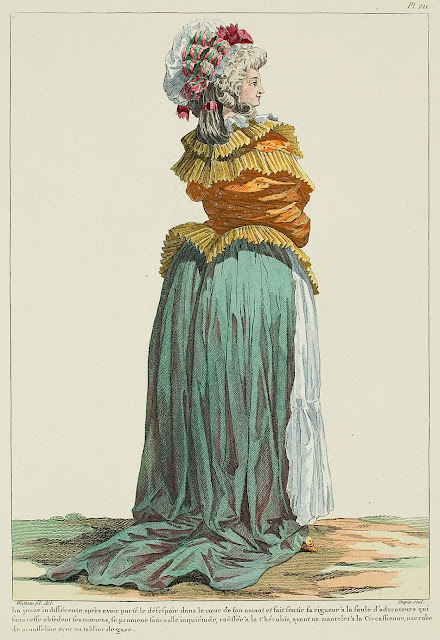
The young indifferent woman, after having carried despair into the heart of her lover, and made him feel her cruelty to the folly of adorers who obsess over moments without ceasing, walks with no inquietude, coiffed à la Cherubin, having a mantelet à la Circassienne, a muslin gown with a gauze apron. (1785) " Plain satins for gowns . - Violet and grape-green, mixed, glazed; violet and marigold, mixed, glazed; green and marigold, mixed, glazed; grape-green, plain; cashmere, plain. " Gauzes , of Italy, à la d'Artois , à la crème , anglaise , puffed." Journal général de France , 6 December 1785 (later the Galerie des Modes )

Galerie des Modes, 46e Cahier, 4e Figure

Image
Young Lady, aimless in appearance, having a tender air, in a public promenade, of the signals that announce what reduces her leisures and daily occupations: her coiffure is a hat à la Minerve and a pulled-up taffeta gown. (1785) " ... In effect, added my father, despite the estimation that I have for Ladies and the fondness that I have for you, I cannot refrain from criticizing their coiffures and yours: it is, in my opinion, entirely disagreeable and the most attractive face in the world would be disgraced by it.  One hardly sees your forehead: your hair offends your eyes and seems to make you squint; your cheeks are shaded and the curls which accompany them render your face square: on the rest I may be wrong; it is necessary that everything be beautiful, since one suffers it without finding to reduce it. "My lover stood aside to let my father leave and added further on this beautiful critique.  He told me obligingly that he only found me pretty, and that the new f...

Galerie des Modes, 39e Cahier (bis 2), 5e Figure

Image
Lady in solitary daydream, with Muslin Gown and Petticoat trimmed with striped Blonde, spotted Gauze Mantelet, large Kerchief of plain Blonde, coiffed with a Bastienne surmounted with a Plumed Hat, watching, over her Fan, the Object of her reflections. (1784) "Never have women dressed themselves with such simplicity.  No more rich gowns, no more trim on the gowns, no more three-row manchettes .  A straw hat with a ribbon, a plain handkerchief on the neck, an apron at home: no more curls, hérisson ,* these follies of coiffure, no more cul-de-Paris ,** gores, no more flounces ..." The little Tableau de Paris , 1783 * This has come up frequently, but I never translate it.  Hérisson translates to "hedgehog", and it's used in reference to the very constructed, tall hairstyles of the 1770s - not the teased puffs of the 1780s. ** Probably bum rolls/hip pads.

Galerie des Modes, 34e Cahier bis, 3e Figure

Image
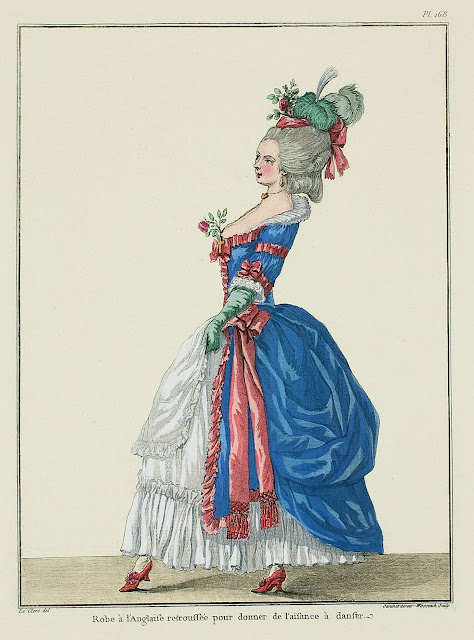
Robe à l'Anglaise, rétroussé to give ease in dancing. (1782) "In 1768, in its December issue, the Courrier de la Mode recommended as particularly favorable for balls, "English dress", with fitted sleeves, sabot cuffs trimmed with gauze, with a gauze apron without a bib* and bows on the shoes: such is still the costume of our dancer who has simply replaced the 'little English hat trimmed with flowers with a postilion**' with a tuft of plumes, an aigrette, and a bouquet." * Bibbed aprons being mainly a Continental style. ** I believe this means a turned-up brim in the back.

Galerie des Modes, 34e Cahier bis, 2e Figure

Image
I don't entirely understand this section, nor the next - the 34th, 38th, and 39th books are listed as having second versions that fit in, date-wise, after the 40th.  But as they are here, I will still show them.  (Except the ones which I can't find anywhere, such as the first in this section.) Full robe a la Sultane, closed in the front of the bodice and pulled up in drapery on the side with bows and tassels; it has  mancherons* like the Circassiennes; it differs from the ordinary robe a la sultane, which is open in front and without mancherons* like a Polonaise, the petticoat is coupé, the Coiffure is a turban . (1782) "There was a very appreciated gown trimming in the winter, of fur bands.  But outside of cloaks and mantelets (see plates 25, 59, 70, for example), they could hardly be applied on the surface of court gowns (plate 46).  The preference was for marten, black fox; squirrel, beaver; ermine had as much success, and in 17...

Galerie des Modes, 40e Cahier, 2e Figure

Image
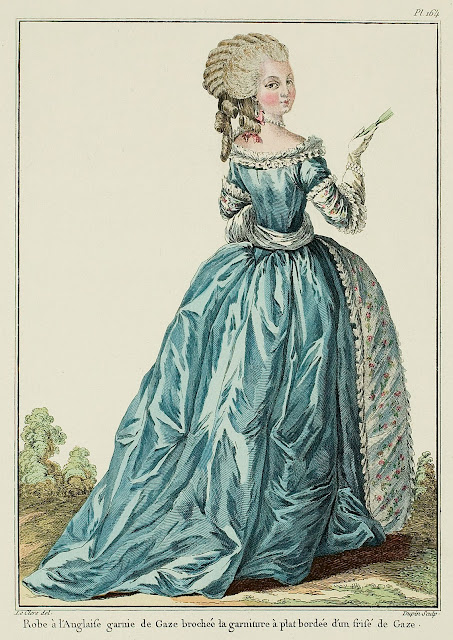
Robe à l'Anglaise trimmed with brocaded Gauze; the trimming is flat, edged with a Gauze frill. (1782) The transition from the grand, hooped gowns of the reign of Louis XV to the supple and fitted owns which marked the end of the reign of Louis XVI is grasped very exactly.  This evolution was begun over a long period of time and around 1768, the editor of Courrier de la Mode could write: "Women have succeeded from the grand paniers to simple elbows[?]*, have renounced multiple flounces; the tight gown trimmed with straight parements showing the elegance of their waist; all the too-awkward ornaments ... "In general, there is in the manner of dressing today something more picturesque and less stiff than in that of other times; we make each day some steps toward beautiful simplicity.  No true taste in the parure without this noble simplicity and without an analogy between a parure and the part of the body to which it is destined." Le Courrier de la Mod...

Muslin Gowns and Silk Coats

Image
I was looking for ruffles in eighteenth century fiction (as you do) when I came across one reference to a white muslin gown with a lilac petticoat in the Lady's Magazine for 1780. "A Series of Letters: Miss Wallis to Miss Greville", p. 143 Generally, in these periodicals, muslin is white and anything colored is silk.  I went looking for more references to fitted gowns (ie, not chemise gowns) of white muslin with or without contrasting petticoats - the muslin and silk combination is the most interesting to me and what I'd personally like to replicate at some point, but because white muslin is so often considered to have been introduced with the chemise gown, I also just wanted to look for more references to the gowns themselves.  But things will also get tangenty - think of this as a collection of interesting quotes that could lead to further research (or maybe clicks with something else you've read elsewhere, or inspires you in some way) rather than one of m...

Galerie des Modes, 28e Cahier, 6e Figure

Image
Dress à l'Insurgente: this gown is a robe à l'Anglaise with pagoda sleeves, which usage has been adopted by the Anglo-American women: it is pulled up as our robes à la Vestale were pulled up in the last Century .  The petticoat is trimmed with a band in the same color of the lining of the gown, edged with blonde lace and serving as a head for the gauze flounce: around the neckline of the gown a very fine scarf is attached, held in front by a ribbon bow, and which will recross itself finally at the bottom of the waist in the back, the ends of the scarf hanging and fluttering with enough grace wh en one walks.  The hat is of velvet, lined with white taffeta, trimmed with bands, plumes, and ribbon. (1780) ROBE A L'INSURGENTE ,* the points of the front pulled up and forming revers of a different color.  Flounced petticoat, trimmed on the head of the flounce with a band matching the revers of the Gown.  Sleeves in flared pagodes , held up with bows.  Amad...

Galerie des Modes, 23e Cahier, 3e Figure

Image
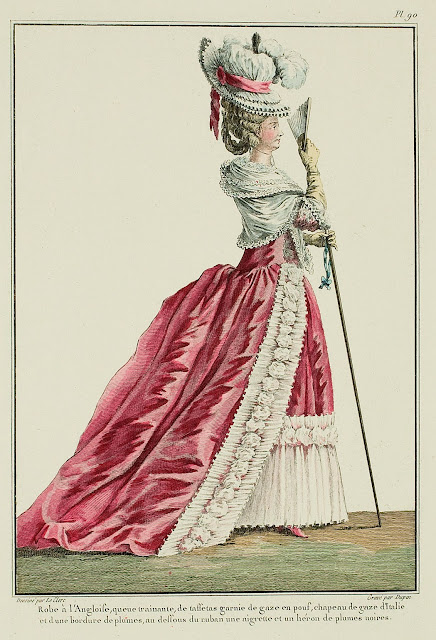
Robe à l'Anglaise, trained, of taffeta trimmed with gauze in poufs; hat of Italian gauze edged with plumes; below the ribbon is an aigrette and an héron of black plumes. (1779) ROBE A L'ANGLAISE.   Amiable Youth with slender waist, see here what makes her shine.  Women who mutter against the Polonaises because they leave the train-bearers idle, do not complain any more; the Robe à l'Anglaise satisfies all.  It unites graces, majesty, magnificence, and simplicity at the same time: such that it is, it never ceased to be beautiful. The elegance of the waist being the principle charm of these Gowns, they have declared war on mantelets with large hoods, flared points, and are only in agreement with round mantelets, such as that in the Print, with contis , or simply with bouillonné or trimmed fichus .

Painting Costume Analysis: Pamela Series, Part Five

Image
V: Pamela Leaves Mr. B's House in Bedfordshire, Joseph Highmore, 1743-4; Fitzwilliam Museum M.Add.7 Finally, finally , Pamela's starts and stops and Mr. B's waylayings result in Pamela climbing into his coach to be driven home.  But Letter XXXII begins with Pamela bewailing her fate, before taking a step back to the time when she thought she was being taken back to her parents. The long-hoped-for Thursday morning came, when I was to set out ... They all would have made me little presents, as tokens of their love; but I would not take any thing from the lower servants, to be sure.  But Mr. Longman would have me accept of several yard of Holland, and a silver-snuff-box, and a gold ring, which he desired me to keep for his sake; ... And when Mrs. Jervis told me with a sad heart, the chariot was ready with four horses to it, I was just upon sinking into the ground, though I wanted to be with you. ... But Harry carried my own bundle, my third bundle, as I was used to ca...

Galerie des Modes, 13e Cahier, 4e Figure

Image
Robe à l'Anglaise of apple-green Pekin, the trim of plain gauze with a garland of flowers, a pouf cap of Italian gauze bordered with flowers, the parfait Contentement Pink, the Shoes Pink, and the rosette white. (1778) Robe à l'Anglaise : the true robes à l'Anglaise have little knife pleats in the back, held at the waist and descending almost to the ground: thus the ladies in England wear them.  But in France, the little pleats of these gowns have been removed and been given more width in the tail; on the front they took a more graceful form, and would be better called "fitted-cut" gowns rather than robes à l'Anglaise. It is one of these changed gowns which the print offers.  The trim, in a band of box-pleated gaze de fantaisie , serves to act as a head for a flower garland, stripped of stems and leaves: the openings of the pockets and the sabot cuffs have a matching trim. Petticoat with a large volant , having for a head a band matching the trim...

Galerie des Modes, 12e Cahier, 3e Figure

Image
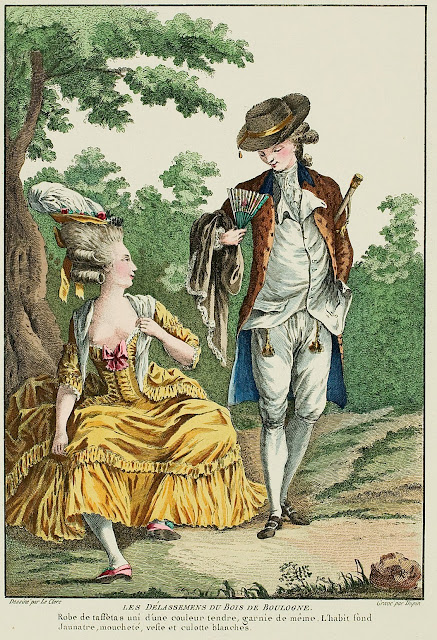
THE DELIGHTS OF THE BOIS DE BOULOGNE.  Gown of solid-colored taffeta in a soft color, trimmed with the same material.  The suit has a yellowish ground, dotted, with white vest and breeches. (1778) Open and low-cut petite robe , leaving the compere uncovered, topped with a parfait contentement ; trim matching the stuff of the dress in ruched bands; volant slightly raised, with a head caught in bouillons ; gauze kerchief, untucked to let the two "children of love" take the fresh air. Négligée coiffure, in chien couchant , with two curls; the brush is in the coque ; pouf cap of Italian gauze; solid papillon , separated with a flower garland.  A large ribbon in a bow, with two hanging points, occupies the back of the coiffure. The other Figure represents a young man in beverlet , with coupé collar; the ground is yellowish stuff, with large black and white spots; vest with open bavaroises ,* leaving the top of the jabot visible; drop-front breeches, matching the...

Painting Costume Analysis: Pamela Series, Part Two

Image
II: Pamela and Mr. B in the Summerhouse , Joseph Highmore, 1743-4; Fitzwilliam Museum M.Add.6 After the first letter, Mr. B began to make presents to Pamela of his late mother's clothes.  As the kind housekeeper, Mrs. Jervis (who is "a gentlewoman born, though she has had misfortunes"), told her that she was so pretty any future wife of Mr. B would never allow her to stay in the household, Pamela expected that she would leave to work for his sister, Lady Davers.  Unfortunately, one day while Pamela was sewing in the summer-house Mr. B approached and told her he wanted her to stay, then began to try to seduce/rape her.  She is pictured here resisting his advances.

Galerie des Modes, 11e Cahier, 2e Figure

Image
Middle class woman in a striped Satin Gown with a furred pelisse and a white muff. (1778) The pelisse is a type of winter overcoat that Ladies throw on their shoulders to protect themselves against the rigors of the season.  There are two types, the plain and the furred.  The former are worn by the unimportant middle class; the latter, of higher quality, are likely to be in the most brilliant colors and the most precious furs.  Among them, there are ones that are only bordered, or to use the true terms, only have a "cord"; the body is lined with a light cotton.  The others, without the cord, have a fur lining, but their weight and heat often render them uncomfortable.  The cord covers it all around the edges.  It surrounds the hood and finishes by outlining the pockets, or openings used to pass the arm through. Bright yellow, blue, pink, cerise, and in the second types, white are the favored colors for pelisses.  The furs are infinitely varied....

Galerie des Modes, 11e Cahier, 1e Figure

Image
Elegant seamstress going to sell her work . (1778) Elegant seamstress, going to sell her work; one expects that she is rushing her steps, and in order to keep from overheating, or for coquetry, she has taken off her mantelet with two tapered points and hung it over her arm. Her gown is of Indian taffeta, made with a frilled collar, trimmed with spotted linen and pulled up through the pockets.  Volant is all around the petticoat; the apron is of apple-green taffeta; sabot cuffs trimmed in three rows, overrunning the sleeves. She is coiffed with a medium "cock's comb" cap, with hanging lappets on a Swiss chignon , escorted by three curls; the black brush is placed according to taste or in the center of the coque . A gauze kerchief is knotted around the neck and trails under the contentement . This seamstress holds a panier with three hoops under her left arm; one of her apprentices accompanies her and carries the rest of the outfit.