Posts

Showing posts with the label Costumes Francois

Les Costumes François, Plate 9

Image
THE GARDENER AND THE PEASANT. Sages pretend that cultivating the ground is never an ordeal for a condemned man at work, but rather the joy and delight of a very happy one, also what there were greater among men had the taste for Agriculture and gardening. Solomon cultivated plants in his gardens, from hyssop, which grew in the walls, to Cedar of Lebanon; the Kings of the Orient found a real pleasure in cultivating their gardens. They used their own tools to move the earth with the same hands in which they held a Scepter. Scipio the African had a little field that he worked himself, and Q. Cincinnatus was holding the Plowshare at the same instant that a letter from the Senate came, which announced to him that he was just elected Dictator in the extreme need of the Republic. Finally, the cultivation of Vegetables is so agreeable that everyone hastens to have gardens; those who cannot have them in the Country try to have them in the City, and when neither one advantage nor the other ...

Les Costumes François, Plate 8

Image
ARTISANS. THE MASON AND THE LAUNDRESS. By Artisans one means a Class of Men who devote their lives to mechanical Arts; one of the most essential to society is the Mason. He builds our homes and works to shelter us from the bad weather of the seasons; those who prepare our Foodstuffs for us are at least as useful, but there are others who only work to content our luxury, and those, whether the richest, are not the most necessary to an estate. The rank of Artisans in the Civil Order is after the Merchant, their dress hardly distinguishes them from the Bourgeois , they nevertheless prefer strong colors for their suits, such as a Chestnut-colored coat and a red vest. We have represented here the Mason in a worker's dress, he is in a cap, vest, and apron, working to stir his mortar. Among the female Artisans, we have chosen by preference the Laundress. She is represented dressed following the people of her estate, carrying a basket loaded with linens and the beater in her hand....

Les Costumes François, Plate 7

Image
THE DOCTOR. "Honor the Doctor for necessity," says scripture, good reason, was the response, if the motives are only fear of being killed. This response is unjust, why not say that the desire of being healed is the motive which must engage us, and because of which one must wait for help, when one is infirm, if it is for a wise man, who has made a particular and deep study of the construction and the mechanics of the human body, who has observed all the alterations that the seasons, intemperance, excess of every kind, and the decrepitude of age can bring to health, who has made exact and painstaking research into the means that can be employed to repair it, that is a little cleared without a doubt, who say that the science of the Doctor consists of the uncertain opinions, accredited by experience, of which Patients flatter themselves to prolong their days by his advice, and that the knowledge that he has plants only serves to stun men and to trick them. The discoveries th...

Les Costumes François, Plate 6

Image
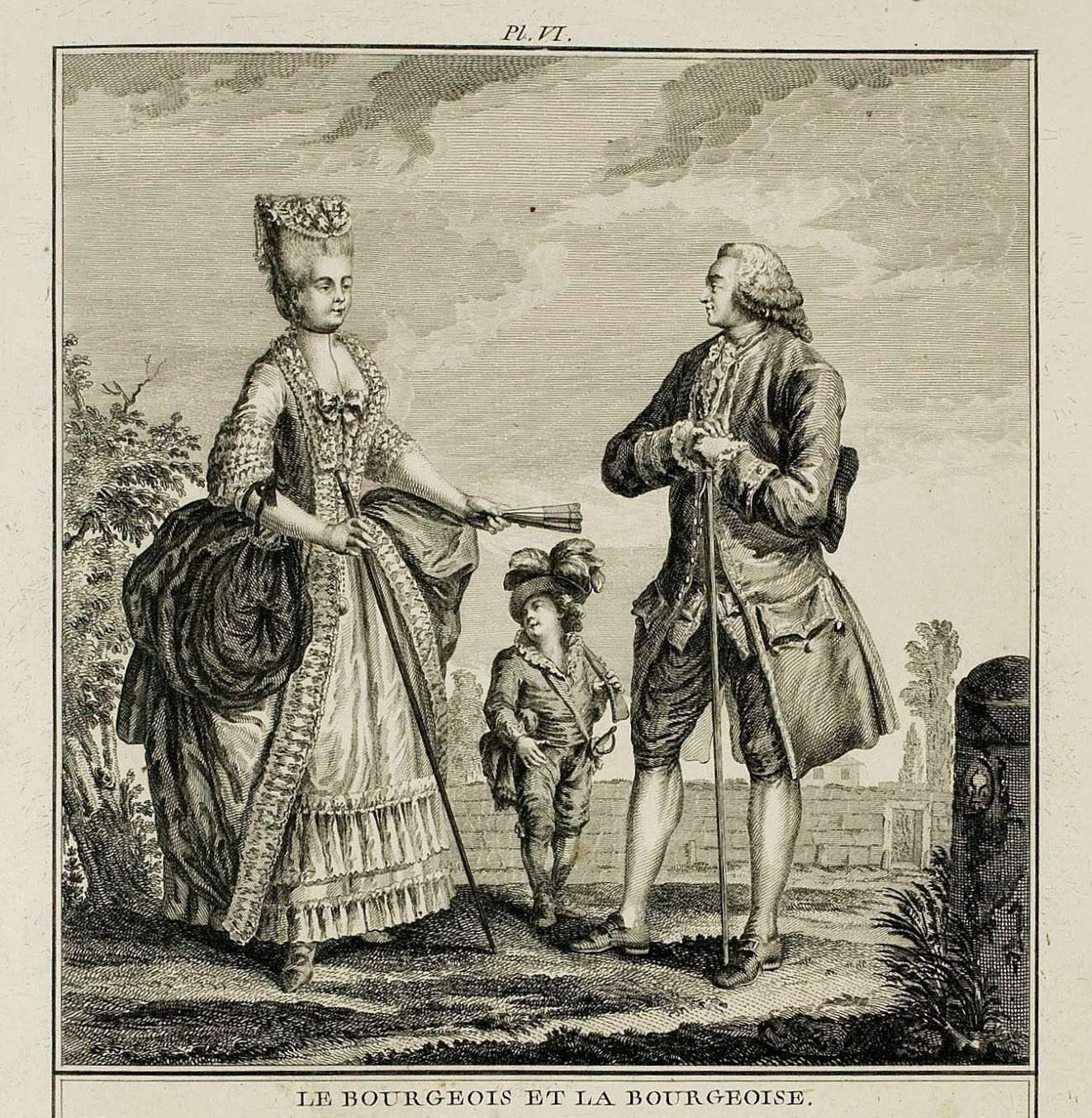
THE BOURGEOIS  AND BOURGEOISE . The bourgeoisie  is the most considerable estate in the Kingdom, insomuch as it is the most numerous. It is the bourgeoisie  that fills the coffers of the Sovereign and that peoples the Cities. An Empire is more or less flourishing according to the affluence of the Bourgeois . The Kings of France have made such a case of this part of their subjects, that they have exempted the Bouregois  of Paris and other great cities of the Kingdom from the rights of the Frankish fiefs, of the bank and back bank, and they have been permitted to bear Arms the same as the noble Knights; but let us see what are the qualities which constitute the bourgeois . In Paris, all the Merchants pass for such and nearly all the inhabitants of Paris take the quality, without which it is contested of them; however, the Merchants and people of matching estate are never regarded as noble. When even they will have acquired the right of nobility to be Aldermen, fro...

Les Costumes François, Plate 5

Image
THE FINANCIER AND THE ABBE. The name of Financier is given to a citizen charged with the collection of State revenues. A man of this type will be, without contradiction, very estimable, if he proportions the gains he makes to his place with his labors, but as he is persuaded that his administration is a beautiful machine, he believes himself the most important man and with the safety of a thousand efforts that he enjoys and which are unknown to the public, he often abuses his job. However, several Financiers are found in the Kingdom who distinguish themselves by their probity and their facetious manners. The Financier's clothes are rich; his magnificent apartments and the plumpness with which he is shown here announce his opulence. His luxury often effaces other people's, who by state are obliged to distinguish themselves from common men. Formerly protegés of people of rank, financiers want to become their rivals, and most often proud of their richness, some take a tone o...

Les Costumes François, Plate 4

Image
RELIGIOUS MEN AND WOMEN. The word Monk means alone: it was given in the early Church to Christians who lived far from the commerce of men, to be particularly sacred to God; several of these Monks, being united, lived under the government of a Superior, at which time they were no longer truly Monks; while the Benedictines and those who live in Abbeys, having kept this denomination, they are called Religious Men. Their dress consists of a Tunic and a Hood, the dress most conformed to the voluntary humility of their state. The Capuchins were not very removed from this manner of dress, as can be seen in the figure represented here: they are dressed in a large gown, a cloak, and a hood of a thick grey cloth; they have sandals, wear a beard and a crown of hair. Religious Men possess nothing, they live only on alms; Cloisters used to be protected in men's Monasteries, which had a hospice to receive strangers, in which secular people were allowed to go, but the prohibition has still ...

Les Costumes François, Plate 3

Image
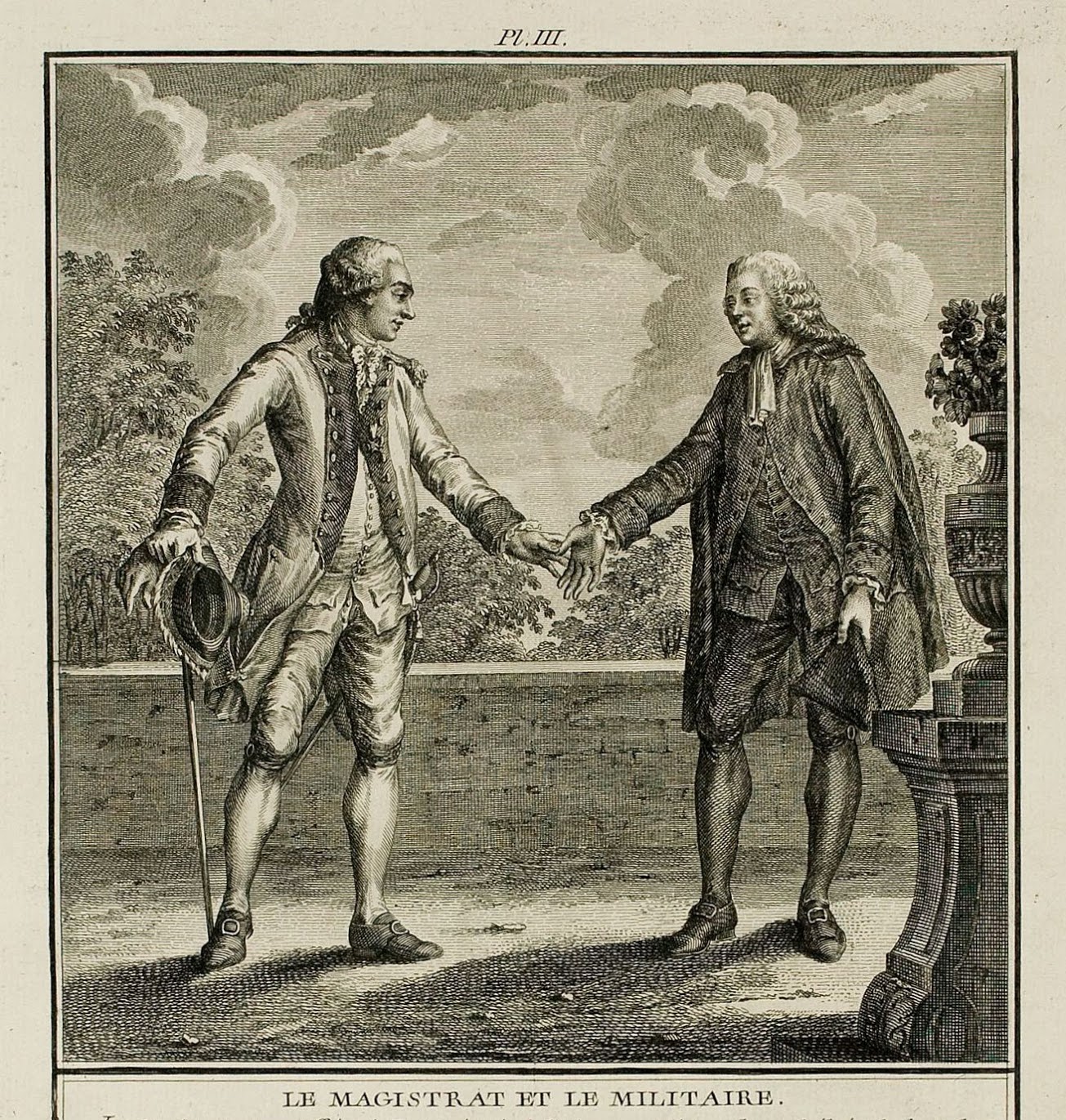
THE MAGISTRATE AND THE SOLDIER. The Magistrate is an Officer of the King, who has jurisdiction and authority over the people; he holds the laws, which protect the goods, the rights, and the freedom of Citizens; he daily ensures the wellbeing of the state. He must avoid balls, Spectacles, and in general all places which could affect the dignity with which he is clothed, in the area of his jurisdiction. On ceremony days, he has precedence over even gentlemen, because of the public authority in which he is clothed. His coat for the functions of his charge is a great trained closed gown, a type of uniform borrowed from universities, but elsewhere he is ordinarily dressed in black with a cloak and a collar or large cravat, as he is represented in this plate. The people of the court ordinarily treat the men of the palais  as bourgeois: without a doubt they are unaware that the first Magistrates were of a great Nobility and that their descendants are found in the Parlemens . However...

Les Costumes François, Plate 2

Image
THE BISHOP AND ABBESS. The Bishops is a man instituted to govern the Church. The etymology of his name is drawn from a Greek word, which signifies overseer, inspector, in effect he has a spiritual jurisdiction over the faithful; his ornaments are the Miter, the Cross, the Pectoral cross, the Ring, and Sandals; but his ordinary dress is a Cassock, a Surplice, and a Violet cape, on which hangs the Pectoral cross, as he is represented in this plate, Bishops are the successors of the Apostles, that God had chosen from among the jewish people in order to be his cooperators. They have, like them, the power to teach nations, to pardon sins, to administer the Sacraments, and to punish through purely spiritual ways. An Abbess is ordinarily the Mother Superior of a Religious community for Girls, over which she exercises a determined authority. The institution of these Religious communities is attributed to St. Pacome. This Saint  lived at the beginning of the fourth Century. The humil...

Les Costumes François, Plate 1

Image
THE LORD AND LADY OF COURT One qualifies with the name of Lord persons of high birth, or those who have received the highest dignities of the state; ordinarily they are decorated with the Order of their Sovereign; it only behooves them to be very up-to-date in their dress; the red heels that they wear are the mark of their nobility and announce that they are always ready to tread on the enemies of the State. It is necessary to distinguish from the Lord the rich and foppish man who by external deception seeks to surprise people always dazzled by the eclat of a magnificent coat without ceasing one sees him creep near people in place to obtain some mark of distinction; there are no flexibilities and intrigues that he will not suggest to obtain his ends and he well knows how to avenge himself on his Vassals from the mortifications he receives. One hears by Lady of court a Woman of high consideration, attached to the Queen or to some Princess: she is always obliged to appear with th...

Les Costumes François

Image
Representing the different Estates of the Kingdom, with the Dress appropriate to each Estate and accompanied by critical and moral Reflections. While I think about what should come next and work on a couple of other projects, I'll be showing a short book from the Bunka Gakuen Library (where else?) that shows and talks about dress and habits by rank. These will be posted every Monday, and those posts on dresses I patterned at the Chapman every Thursday, to balance things out. And I have a few of old finally-finished posts that might go up on some days in between, I'm not quite sure which!