Posts

Showing posts with the label corsetry

Transitional Stays Pattern
Image
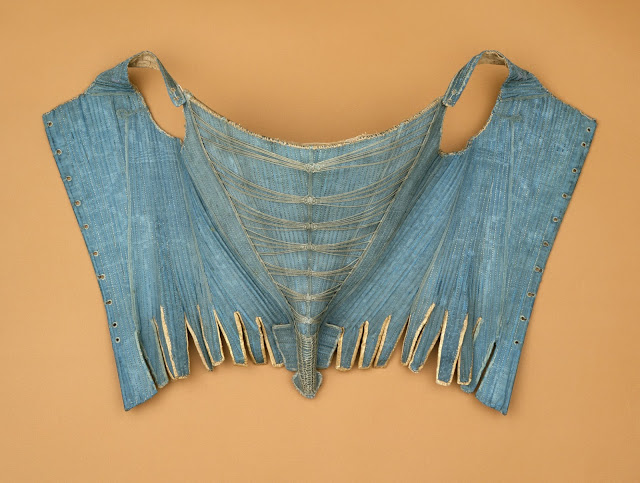
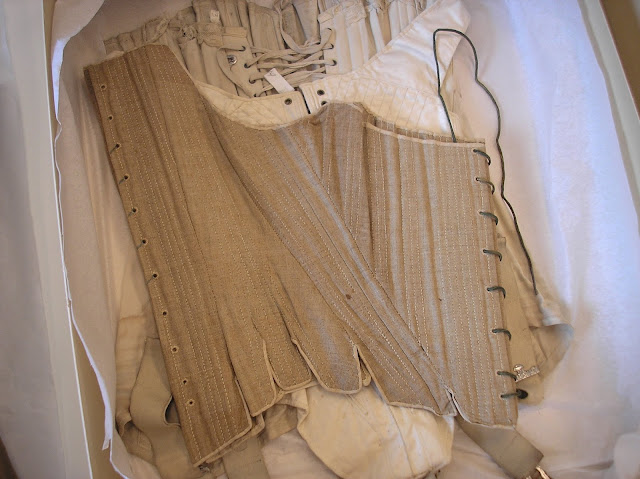
Hello, strangers! I'm back to post again about those underbust stays from the pre-Regency, in preparation for the Short Stays Sew-Along . I saw these, as the label suggests, at Historic Cherry Hill in Albany, NY. (I don't believe there was any definite provenance, but the house was owned by the Van Rensselaers and most if not all of the collection is original to the family.) They're quite simple to put together. The above pattern is 1" per grid box, and drawn without seam allowances. Here's my guide for scaling up patterns!  The marks at the bottom of the seams should be lined up, and the seams only run down to them. Materials used in the original: unbleached linen canvas linen tape (off-white, but not unbleached) - cotton twill tape is an acceptable substitution linen thread (off-white, but not unbleached) whalebone - cane or plastic are acceptable modern substitutes Process (requires hand-sewing): 1. The two side pieces are cut out of two...

A New Kind of Transitional Stay

Image
Hello! It's been a while - due to American politics, personal issues, and other factors, I just haven't had the energy to spend on historical sewing or writing about fashion (beyond what I do for AskHistorians; link to my profile if you'd like to read some short articles on a variety of social history topics) - but last month, I attended the 2018 CSA Mid-Atlantic/Southeastern Biregional Symposium in Shippensburg, PA. It was quite a trip! I was so happy to meet up with so many fashion history scholars, and particularly to meet Ann Wass (of Riversdale House Museum ), Mackenzie Anderson Sholtz (of Fig Leaf Patterns ), and Lydia Edwards (author of How to Read a Dress ). You can see all of my photos of the exhibition at the Shippensburg Fashion Archives and Museum on Instagram ! I delivered a paper of my own, which I hope to turn into a podcast episode/blog post soon, but what really thrilled me was the presentation Mackenzie gave, "A Transitional Corset and its Companion ...

"Corset Cutting & Making", annotated by Marion McNealy

Image
Last year, I invested in the Kickstarter for Marion McNealy's annotated reprint of the 1924 Corset Cutting & Making , by William D. F. Vincent. And I'm very glad I did, because it's here and it's wonderful! The book starts with an introduction explaining the context of the original - it was probably started before World War I, then set aside for several years, lightly updated, and published - and the amount of work McNealy had to do to turn the rather slapdash content into a useful book. This is followed by a section on the materials and construction methods used in corsetry in the early twentieth century, the latter mostly taken from Vincent's own text. Because the original was intended to be published earlier than 1924, most of the patterns are pre-war. (I don't believe they were dated in the original, but McNealy's dating appears to be very sound.) All in all, the book contains patterns for: 2 fashionable corsets between 1900 and 1910, 3 fa...

Review: Stays and Corsets, by Mandy Barrington

Image
I feel terrible that it took me so long to write a review of this book, seeing as I was sent a copy by Focal Press - but I promise it was only because I intended to use it to make a set of stays and/or corset first! And then, unfortunately, I did next to no sewing since receiving it, and so I'm reviewing from a more theoretical basis. Stays and Corsets: Historical Patterns Translated for the Modern Body  is by Mandy Barrington, a senior lecturer in costume at Arts University Bournemouth. (She hasn't posted to Tumblr in a while, but you can see some great images of her work there!) The book consists of thorough instructions on drafting corset patterns based on patterns of extant pieces and modern bodice slopers, similar to the system used in Creating Historical Clothes . (And, incidentally, it teaches you how to draft your own slopers from scratch.) The patterns it contains are as follows: - 1735-1750 sleeved stays (with stomacher; sleeves not included) - 1776 half...

Stay-Dating

Image
My latest project is a proposal for a book written specifically to help out costume designers and writers of historical fiction - a fashion history manual for 1700-1940 that focuses on visuals and on how the clothing works. The first chapter, on the early 18th century (1700-1739), is my sample, and it's making me realize how brushily  we tend to deal with the period before the changes of the 1770s, and especially before the 1750s. I'm pinning down a lot of stylistic changes to at least halves of decades, but I'm finding stays surprisingly difficult. Like a lot of other aspects of fashion I've had to work out, the issue's complicated by museum dates that seem overly broad or just plain wrong. And for stays, there are considerably fewer artistic representations than there are for gowns, caps, etc.! I think I've been able to identify the differences between early-century and 1775-1795 stays - which was tricky, because a lot  of earlier stays were dated later. W...

HSM 2016 Challenge #5: Holes

Image
Sorry, I've pretty much given up on trying to get a good background in a photo in this apartment. The Challenge: #5, Holes - how would a corset function without the eyelets to lace it together? Fabric/Materials: Off-white cotton twill from my corset stash and heavy white twill tape. Originally I was going to cover it with satin, but in the end I'm glad I decided to make this a wearable mockup, as the pattern needs a little tweaking. Pattern: Based on this corset patent applied for by Mina Sebille, with some alterations and boning arrangement based on this corset at the Victoria & Albert Museum. I've been using one of your standard ungored, shaped-pieces corsets for a few years, and while it's been working well, it doesn't have enough hip spring to give me waist reduction. I figured a corset that had a separate hip piece would help me get the flare I needed. Which it does, to some extent! At least, I'm not getting much more reduction, but I am al...

Vintage Lingerie (2011) by Jill Salen

Image
As I've gotten into vintage sewing alongside my regular historical work, I decided to buy Jill Salen's book on vintage lingerie - Corsets is very good, so I was fairly sure Vintage Lingerie would be as well. And it is! This book is an excellent resource for both vintage enthusiasts and fashion historians/collections managers who have anything to do with 20th century dress. Where Corsets overlapped with Waugh's Corsets & Crinolines  (just as Patterns of Fashion  and Cut of Women's Clothes  overlap), Vintage Lingerie  really stands alone - no other books that I'm aware of give patterns for so many pieces of lingerie, especially going so far into the 20th century. The value of the book is in the patterns. The text itself has a tendency to editorialize about corsetry - which, as you're probably aware, is one of my big pet peeves - eg, "inconvenient, unsightly, even tormenting control," "finally achieved freedom from restrictive garments,...

Regency Corsets (or Stays if you will)

Image
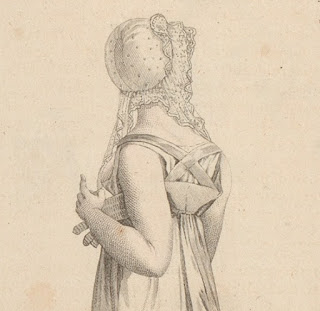
My very first post to this blog was a kind of a summary of corset construction and style in the period 1790-1810. It's awkwardly written, because I was excerpting from a paper and summarizing and wasn't used to blogging like this! It seems like a good time to revisit the topic, now that I've spent even more time analyzing the period. The stays of the early 1790s were essentially those of the 1780s, cut with a higher waist - conical, and heavily or half boned. Very quickly, though, the silhouette changed. Artistic portraits had shown women dressed in flowing draperies, belted high, without stays, and at the same time that those high-waisted flowing draperies entered mainstream fashion, so did softly rounded breasts. While some women achieved this look by not wearing any stays at all, for most, the idea that a boned and laced undergarment was essential to respectability held strong. Non-satirical sources refer to corsets' and stays' existence through this time - for...

Brown (HSM #9)

Image
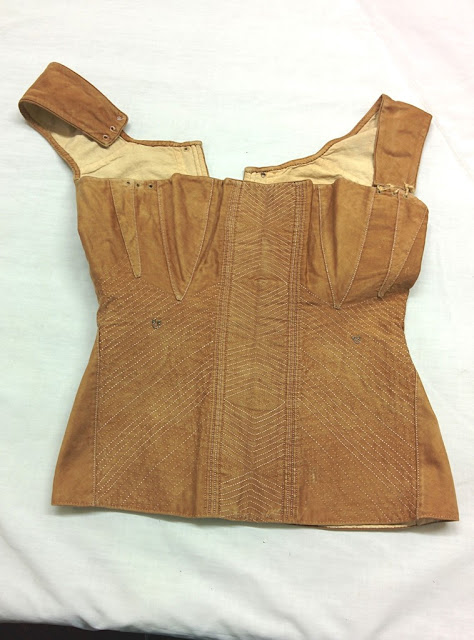
Edit: I guess this is the last time I try to post on Blogger from a mobile device - this post was finished and up, and then when I came back to work on another one I realized that most of it had been eaten and it was set back to draft. Why? Who knows. Probably user error. Apologies! This post is later in the month than I've usually been for the HSM. I just didn't know what to go with! But in the end, I've decided in the end is to give you a preview of Regency Women's Dress 1800-1830 (out sometime in October): the corset made out of brown cotton twill and its description. Corset 1805-1815 Courtesy of the New York State Historical Association, Cooperstown, NY N506.61 Longer corsets of this type were taken up not long after the turn of the century, and were worn for several decades, not falling out of use until the 1850s, when the popularization of the split busk made it even easier for a woman to put on or remove her corset herself. The shape gave a...

Corsetry and Feminism: Appendix

Image
As mentioned in the third part of this series, there are many modern women who regularly wear corsets who have never been scientifically studied. Obsolete Victorian medical science is far too frequently cited as an objective, truthful source - but there have been a few recent studies that are also brought up to defend the idea that corsets are inherently harmful. It is my belief that these studies, however, are flawed and do not prove what they intend or what they are used to prove. A short summary of each, the valid points, and their flaws: Historic Medical Perspectives of Corseting and Two Physiologic Studies with Reenactors Colleen Gau (PhD Dissertation, 1998) This paper is obviously - as it is a dissertation - very involved. At base, though, it is an exploration of Victorian health claims against the corset and a study of corseted women performing physical tasks. The main strike against this study is that it is not impartial. From the beginning, Gau showed a predisposition ...

It's My Body: Corsetry and Feminism, Part Three

Image
A Modern Health Perspective Historical views on corsetry cannot be divorced from the world their creators lived in. When dress reformers wrote about the practice of wearing corsets, they were referring to a context in which women were not sanctioned to be seen without them in public. Is it even possible to infer how they would feel about corset-wearing in a world where it is the extreme anomaly rather than the norm? This was also a context in which medical claims that we now know to be incorrect were taken seriously based on very little evidence. There is no reason to apply Victorian perspectives (feminist or not) to the practices of modern corset-wearers, since none of their experiences would have approached the modern situation. It never ceases to amaze me that critics of modern tight-lacing or moderate corseting ignore and dismiss the experiences of those modern corseters in favor of the Victorian medical claims. Regardless of the official statistics on total lung capacity and t...

Fact and Fiction: Corsetry and Feminism, Part Two

Image
Suffrage vs. Dress Reform Given that the members of the women's rights movement lived at a time when there was no scientific evidence against the intensely negative health claims, it is no wonder that they might regard the corset as a death-trap. However, early feminist opposition to the corset is vastly overstated today. To illustrate, see the fashionable photograph of Susan B. Anthony at the end of the 19th century: Susan B. Anthony, ca. 1895 Based on the smoothness of her bodice and the curve of her waist, we can say that she was clearly wearing a corset even late in her successful career. ( Other photographs of Anthony show corsetry as well, as do photographs of other proto-feminists .) The  Dress Reform  movement associated with the women's rights movement began in the 1850s, promoting the "freedom suit" or "Bloomer costume" consisting of a loose dress over full trousers, worn without a corset.  The suit  attracted ridicule from the public i...