Posts

Showing posts with the label portrait analysis

Portrait Analysis: Susan Brown Moody

Image
I haven't done a post about a painting in a long time! But this painting is the St. Lawrence County Historical Association 's Object of the Week, and I'm taking the opportunity to write more for those members of our Facebook page who'd like more information than will tidily fit in a post there. (And to link back to the museum where I curate for those readers here who might like to follow it!) Portrait of Susan Brown Moody, 1830-1835; SLCHA 1988-8.1 This portrait was initially purchased by the museum at Sotheby's in 1988 as "Clarissa Moody Wright in her wedding bonnet". Let's really dig into the clothing on view here, and then I'll talk some more about why this piece is of such interest to the SLCHA. A dark-colored gown is very common on sitters in folk portraits, but it's not always so common to see this much detail! Quite often, the dress is a kind of dark mass that sets off the whitework on the cap and pelerine. Here, we can see tha...
Marie Antoinette à la Rose (HSM #2)

Image
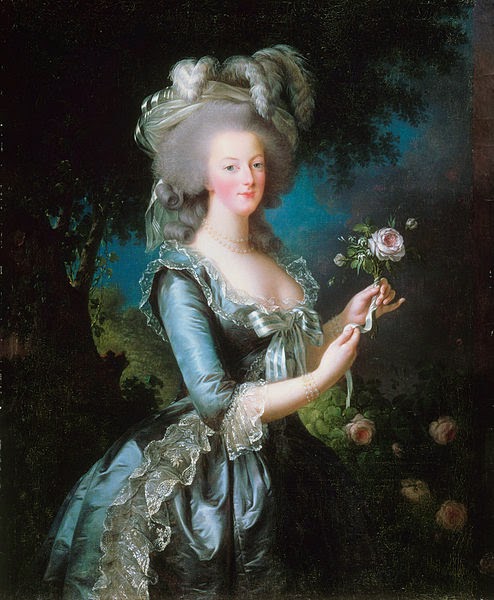
I haven't done a portrait costume analysis in a long time, but it seemed like the most appropriate way to deal with the second Historical Sew Monthly challenge: Blue. Marie-Antoinette dit « Ã  la Rose »,  Marie Louise Élisabeth Vigée-Lebrun, 1783; Versailles  MV 3893 This portrait of the twenty-eight-year-old Marie Antoinette was painted in the same year as the famous portrait en chemise  - in fact, it was painted in order to replace  the chemise portrait with something less scandalous. (You may notice that she's standing in the same pose , holding the same ribboned rose, with the same hairstyle and same expression.) While this blue taffeta gown is more traditional than the chemise, it's nothing like a robe de cour  or a robe parée - two outfits worn daily at court for formal occasions. This is still a very fashionable and casual ensemble. Starting at the top: instead of the straw hat worn in the original, this version of Marie Antoinette is...

Painting Costume Analysis: Pamela Series, Part Twelve

Image
XII: Pamela Tells A Nursery Tale, Joseph Highmore, 1743-4; Fitzwilliam Museum M.Add.9 The whole story ends, of course, with Pamela a loving mother. Her views on child-raising are fairly sensible and modern: she insists on nursing her infants herself, she is against swaddling, and she believes that girls should be educated. This specific scene is described in letter 113 , in the fourth volume. Miss Goodwin imagine you see on my right hand, sitting on a velvet stool, because she is eldest, and a Miss: Billy on my left, in a little cane elbow chair, because he is eldest, and a good boy: My Davers, and my sparkling-eyed Pamela, with my Charley between them, on little silken cushions at my feet, hand-in-hand, their pleased eyes looking up to my more delighted ones, and my sweet-natured promising Jemmy in my lap; the nurses and the cradle just behind us, and the nursery-maids delightedly performing some useful needle-work, for the dear charmers of my heart.

Painting Costume Analysis: Pamela Series, Part Eleven

Image
XI: Pamela Asks Sir Jacob Swinford's Blessing, Joseph Highmore, 1743-4; Tate Collection N03576 Eventually, after recounting the events of the last painting in great detail to Mr. B, the two go home and fail to confront Lady Davers due to Pamela's avoidant behavior. But they do finally converse, and Mr. B makes it clear that he is truly married to Pamela and that he doesn't feel he's done anything to shame his family. They reconcile somewhat, but Lady Davers still makes a fuss over eating with Pamela. After eating the scene shifts to the garden, where Mr. B explains his part in a duel where the other man died (but not because of his actions) and his past with a Sally Godfrey (a sexual conquest), and Lady Davers finally gives in to Pamela's goodness. Here's an interesting tidbit of everyday life for writers: when they eat dinner - the midday meal in this context - they're described as calling for "the cloth" to be laid in the parlor. And I no...

Painting Costume Analysis: Pamela Series, Part Ten

Image
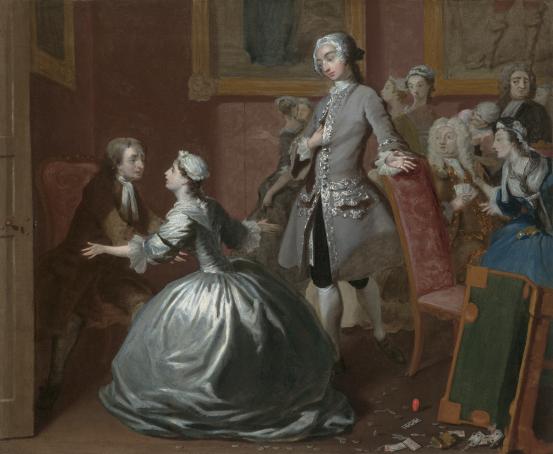
X: Pamela and Lady Davers, Joseph Highmore, 1743-4; National Gallery of Victoria 1117-3 One would think that Pamela's troubles would be over after her marriage: after all, most of her problems stemmed from her "courtship". However, Mr. B's family is still a hurdle to get over. His sister, Lady Davers, does not approve of Pamela's entry into their ranks and is convinced that Mr. B has only pretended to marry Pamela in order to get her into bed, anyway. In the pictured scene, Mr. B has been away with a sick friend for some time, and has asked Pamela to meet him that afternoon at a different friend's house. Unfortunately, Lady Davers arrives with her nephew, "Jackey", and maid, Becks, and pins her up in a parlor. Every time Pamela tries to leave, one of them puts a chair in front of the door and sits in it. (This happens half a dozen times.) Pamela pleads that she has a "pre-engagement" and shows Lady Davers Mr. B's letter asking fo...

Painting Costume Analysis: Pamela Series, Part Nine

Image
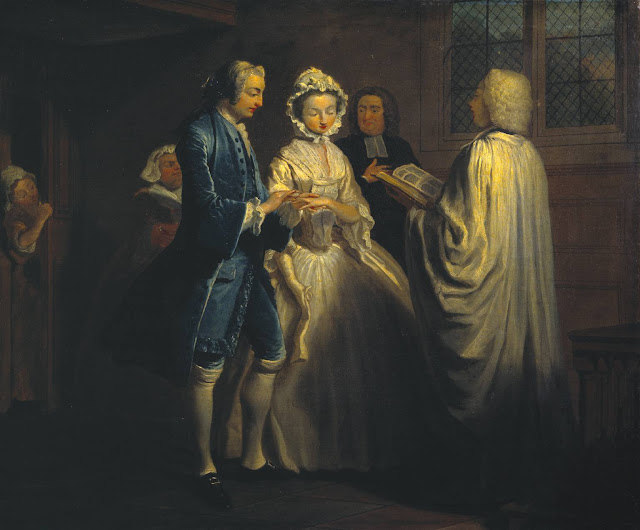
IX: Pamela is Married, Joseph Highmore, 1743-4; T ate Collection N03575 Because Mr. B really isn't supposed to marry Pamela, they need to hide their relationship for a while. He asks her to "dress as [she] used to do; for now, at least ...", which I believe means as she dressed when she was working for his mother, before she decided to retreat back into homespun to prove her virtue. She then goes back to her room and changes her outfit completely: ... and so put on fine linen, silk shoes, and fine white cotton stockings, a fine quilted coat, a delicate green Mantea silk gown and coat, a French necklace, and a laced cambric handkerchief, and clean gloves; and, taking my fan in my hand, I, like a little proud hussy, looking in the glass, and thought myself a gentlewoman once more ...

Painting Costume Analysis: Pamela Series, Part Eight

Image
VIII: Pamela greets her father, Joseph Highmore, 1743-4; National Gallery of Victoria 1116-3 Driven to a frenzy, Mr. B attempts to find any letters to her family that Pamela has secreted on her person, asking if they are inside her stays or pockets and threatening to strip her; he starts to unpin her handkerchief and then to check her garters, but then allows her, due to her begging and crying, to go up to her bedroom and bring them down.  She writes him a note to give her until the next day, then sits down and unstitches them from her underpetticoat. As he reads them, Mr. B finally says that she can go home to her family - but while traveling back, Pamela realizes that she is in love with her captor, and is given a letter where Mr. B confesses his own love and asks her to come back to marry him.  Are we surprised when she does?

Painting Costume Analysis: Pamela Series, Part Seven

Image
VII: Pamela in the Bedroom with Mrs Jewkes and Mr B., Joseph Highmore, 1743-4; TC N03574 This scene is similar to Mr. B's last nighttime attack on Pamela's virtue.  However, while Mrs. Jervis was a somewhat unwitting participant - truly believing in her employer's good intentions - Mrs. Jewkes takes on a more active role.  She dresses Mr. B in a maid's clothing, has him pretend to be asleep in the corner, and then encourages Pamela to take her own clothes off so she can get in bed ... and be ravished by Mr. B.  (The attempt fails.) Pamela's shift is arrayed artistically over her torso, but I believe she is still in an underpetticoat, as there is a tightness around her waist that indicates a waistband.  Her stockings are held up with pink garters, and there is a blue ribbon around her cap - the same cap she wore in part six , but with the ribbon in a different configuration.  Her black leather shoes fasten with buckles, rather than tying.  The blue si...

Painting Costume Analysis: Pamela Series, Part Six

Image
VI: Pamela Shows Mr. Williams A Hiding Place For Their Letters, Joseph Highmore, 1743-4; Fitzwilliam Museum M.Add.8 When Pamela got into Mr. B's carriage, she thought she would be taken to her parents' house, but in fact she was driven to Mr. B's other estate in Lincolnshire.  Before she was under the chaperonage of Mrs. Jervis, who was respectable but sometimes rather dim about Mr. B and his attentions, but in Lincolnshire she was watched by Mrs. Jewkes, a thoroughly disrespectable bawd who hits and insults Pamela.  Pamela's one comfort, apart from writing letters to give to her parents someday when she is free, is Mr. Williams, a local clergyman.  They communicate secretly by hiding letters under a sunflower, which Pamela is pointing to in the painting. There are very few clothing/sewing-related lines in this section apart from Mrs. Jewkes's method of keeping Pamela inside (she takes her shoes) and the following passage: So I went towards the pond, the ma...

Painting Costume Analysis: Pamela Series, Part Five

Image
V: Pamela Leaves Mr. B's House in Bedfordshire, Joseph Highmore, 1743-4; Fitzwilliam Museum M.Add.7 Finally, finally , Pamela's starts and stops and Mr. B's waylayings result in Pamela climbing into his coach to be driven home.  But Letter XXXII begins with Pamela bewailing her fate, before taking a step back to the time when she thought she was being taken back to her parents. The long-hoped-for Thursday morning came, when I was to set out ... They all would have made me little presents, as tokens of their love; but I would not take any thing from the lower servants, to be sure.  But Mr. Longman would have me accept of several yard of Holland, and a silver-snuff-box, and a gold ring, which he desired me to keep for his sake; ... And when Mrs. Jervis told me with a sad heart, the chariot was ready with four horses to it, I was just upon sinking into the ground, though I wanted to be with you. ... But Harry carried my own bundle, my third bundle, as I was used to ca...

Painting Costume Analysis : Pamela Series, Part Four

Image
(For a clothing-related painting, you get a post that is chock-full of clothing-related quotes!) I V : Pamela Preparing to Go Home, Joseph Highmore, 1743-4; National Gallery of Victoria 1115-3 A little recap: in the first few letters, Mr. B was very generous with his late mother's things. (Letter VI) My master has been very kind since my last; for he has given me a suit of my late lady's clothes, and half a dozen of her shifts, and six fine handkerchiefs, and three of her cambric aprons, and four holland ones.  The clothes are fine silk, and too rich and too good for me, to be sure. (Letter VII) Since my last, my master gave me more fine things.  He called me up to my late lady's closet, and, pulling out her drawers, he gave me two suits of fine Flanders laced headclothes, three pairs of fine silk shoes, two hardly the worse, and just fit for me (for my lady had a very little foot,) and the other with wrought silver buckles in them, and several riband...

Painting Costume Analysis: Pamela Series, Part Three

Image
I II : Pamela Fainting, Joseph Highmore, 1743-4; National Gallery of Victoria 1114-3 This painting depicts one of Mr. B's nighttime attempts on Pamela's virtue.  He was hidden in the room and waited as Pamela undressed for bed:

Painting Costume Analysis: Pamela Series, Part Two

Image
II: Pamela and Mr. B in the Summerhouse , Joseph Highmore, 1743-4; Fitzwilliam Museum M.Add.6 After the first letter, Mr. B began to make presents to Pamela of his late mother's clothes.  As the kind housekeeper, Mrs. Jervis (who is "a gentlewoman born, though she has had misfortunes"), told her that she was so pretty any future wife of Mr. B would never allow her to stay in the household, Pamela expected that she would leave to work for his sister, Lady Davers.  Unfortunately, one day while Pamela was sewing in the summer-house Mr. B approached and told her he wanted her to stay, then began to try to seduce/rape her.  She is pictured here resisting his advances.

Painting Costume Analysis: Pamela Series, Part One

Image
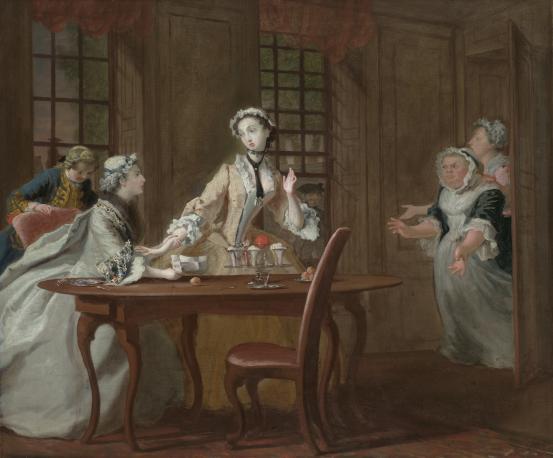
The novel Pamela, or Virtue Rewarded , by Samuel Richardson, holds a special place in the western literary canon, as it marks the transition between adventure novels and character-based novels, and was extremely popular in its day, but it is now largely unknown outside of English literature classes.  The story is told in epistolary form, through Pamela's letters to her parents. I: Mr B. Finds Pamela Writing , Joseph Highmore, 1743-4; T ate Collection N03573 Pamela had been a lady's maid to old Mrs. B for three years when her mistress died.  Mr. B, her son, asked Pamela to stay on to "take care of [his] linen"; he also told the housekeeper to "give [her] mourning with the rest [of the servants]", and gave her the money that was in his mother's pocket when she died, which is later referred to as a common tradition.  This scene is set in the very first letter of the book, when he interrupts her as she is writing in the late Mrs. B's dr...

Portrait: Euphemia White Van Rensselaer

Image
My next portrait costume analysis is of Euphemia White Van Rensselaer , by George P. A. Healy. 1842; MMA 23.102 Euphemia was the third daughter and eighth child of Stephen Van Rensselaer III and his second wife, Cornelia Paterson Van Rensselaer (the daughter of a former governor of New Jersey).  The Van Rensselaers were the premier landowners of upstate New York: Kiliaen Van Rensselaer (1586-1643), one of the original Dutch patroons, founded Rensselaerwyck in the Albany area.  Stephen is supposed to be the tenth richest American in history, according to Fortune magazine, inheriting the largest estate in New York at the time of his father's death.  (Read more about him and the family here and here .)  Euphemia was related to the Schuylers, the Westerlos, the Livingstons, the Ten Broecks - other families of wealth, prestige, and long standing.  It is a sure bet that anyone named "Van Rensselaer" is as up-to-the-minute fashionably dressed as possible....

Portrait: Princesse de Broglie, by Ingres

Image
Ages back, I did a poll on what sort of posts I ought to do, and while costume drama reviews came out as the most popular (and ... I've since done one), portrait costume analyses proved to be the second most popular choice.  Ive never gotten around to writing any, partly because I get anxious that I don't have anything really impressive to say, but I hope to get around that with practice.  Due to the chemise pattern I recently posted, I thought I'd start with a mid-nineteenth century example: Joséphine-Éléonore-Marie-Pauline de Galard de Brassac de Béarn, Princesse de Broglie , by Jean-Auguste-Dominique Ingres. Joséphine-Éléonore-Marie-Pauline de Galard de Brassac de Béarn (1825–1860), Princesse de Broglie , Jean-Auguste-Dominique Ingres, ca. 1852; MMA 1975.1.186