Posts

Showing posts with the label chemise gown

Tableau Général de Goût, no. 2 pl. 3

Image
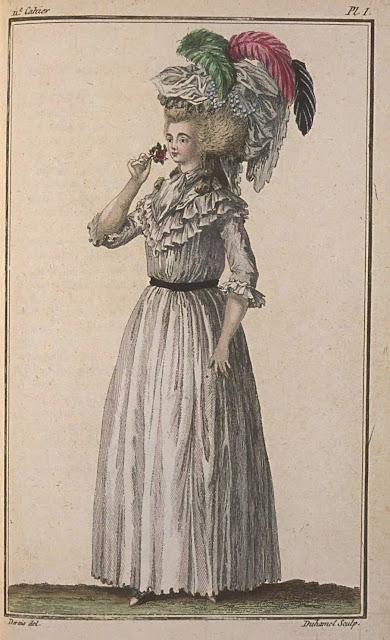
16 Vendémiaire an 7 (7 October 1798) YOUNG WOMAN ON A PROMENADE Blonde wig à la Naiad.  The triumph that wigs have carried over natural hair will last a long time: it is more ornamental than hair. Our elegant women have cut their hair as if they have taken the veil, a strange coiffure, and one that only looks well on some very young people. Can you believe that we have seen (such is the power of fashion, that it often blinds self-love itself!) women coiffed à la Titus  with grey hair? This women's mania for looking shorn could not last. Wigs retook favor, and with them, the inappreciable advantage for coquetry to be able to change the color of one's hair as one changes clothing. Hat topped with a green toque and two white and black plumes. This hat is wrapped with white taffeta with black velvet net.  It is difficult to determine which type of coiffure is triumphing among the beauties. They vary infinitely and it is rare to meet two elegant ladies in a brillia...

Tableau Général de Goût, no. 1 pl. 2

Image
YOUNG PERSON IN MORNING DRESS Blonde wig à la Flore.  The fashion of hair worn flat and cut à la Titus  begins to pass. Now the hair is curled. Wigs that imitate this coiffure have been subjected to hooks, at least for the part of the hair which goes around the face. The top of the wig is wrapped with a bandeau of orange crepe. Gold chain à l'esclavage . These gold chains, with flat links, are also used in the hair, where they serve as a bandeau. They are also seen used as belts, but this fashion has not been followed. Chemise gown without sleeves.  This chemise gown must have a long train: this gives it curvature. Which curvature? Without a doubt, the fashionable one. Plain orange shawl thrown with abandon.  This manner of throwing the shawl is picturesque and must please artists. It is equally advantageous and elegant. Bag.  The bag replaces pockets, banished henceforth from the trousseau of a pretty woman. It is never left off, they are made in ...

Cabinet des Modes, 14e Cahier, 2e Figure

Image
June 1, 1787 PLATE II. 1. A Woman in a Robe à la Turque , of a pearl grey Indian taffeta, edged with a black silk Ribbon. This Woman is in second mourning. On her head, she wears a straw Hat, black, trimmed around the crown with striped black gauze made in diamond points. A pink Ribbon ties the crown. Around are raised at least twelve cock Plumes, flame colored, whose extremities fall back on the crown and on the wings of the Hat. Behind, a large Veil of pinked white gauze is held to the Hat, which descends to the waist. This Woman wears on her neck a flounced linen Kerchief, tied on the front with a pink Ribbon au Diadême . Her hair, in the back, hangs à la Conseillère , and on each side three large curls fall on her chest. She is represented seated, playing the pianoforte. 2. A Woman also in a Robe à la Turque , of a silk fabric, lemon color. The Corset under the Gown is of a white gros de Tours . Her Kerchief of flounced linen-gauze, fastened on the from with a bow of R...

Cabinet des Modes, 11e Cahier, 1ere Planche

Image
15 April 1786 Women's Coiffure has been, in all times, subject to revolutions, even in the times of the Greeks and Romans. Fashions changed then as now. In nineteen years, in the reign of Marcus Aurelius, his wife appeared with three hundred different coiffures: each one of these Fashion had its origin. Did they join taste to this variety? We ignore that. What is for certain, is that those of our ancestors, which succeeded each other with as much rapidity as ours, lacked this grace, of this freshness and this softness , which makes the charm of almost all those of our Ladies. In the reign of François I, women were coiffed with a high sugarloaf cap: in the following reign, they wore little hats with a feather; in that of Henri IV, they had little caps with an aigrette: under Louis XIII, nearly the same coiffure: in the beautiful age of Louis XIV, coiffure became an art; this art was perfected under Louis XV, and one could say that it is perfect in the reign of Louis XVI. Our Mar...

Cabinet des Modes, 9e Cahier, 1ere Planche

Image
March 15, 1786 WE believe that the majority of our Subscribers would not be entirely indifferent, to learning what could give rise to this or that Fashion that we announce to them. We commit ourselves very willingly to publishing it, when we can do it without indiscretion. But very-often a Fashion only was birthed in the imagination of a Woman of taste, and who makes it with art. This Woman wants to give the ton , she wants people to be vexed that she has given it; but her circumspection revolts at our naming her as the author. Thus it is only permitted for us to describe this Fashion. --- Last Thursday, the brilliant Céphise * conquered at the Théatre Française , in a Parure  where art shamed richness. All eyes left the scene for a moment to turn towards her. Women, a little jealous, examine, in going out, in the vestibule, the elegant toilette that had been able to fix all eyes. They could not avoid admiring it; they agreed that it had merit; and the next day, they are...

Cabinet des Modes, 7e Cahier, 1ere Planche

Image
February 15, 1786 ( Note . Letters sent, whether to the Bookstore, or the Editor of this Work, must be franked. Those which are not will not be opened.) FIRST PLATE. It represents a Woman en négligé , in a new Robe en chemise . Pouf  cap, of Italian gauze, trimmed with a bow of Canary's tail  ribbon. Chemise  with two collars, and large flounce of soft lilac  Indian taffeta. Manchettes  of linen. The chemise  is closed in front, with a bow of Canary's tail  ribbon. Shoes of Canary's tail  satin, trimmed with a large frill of black ribbon, around three fingers wide.

Galerie des Modes, 55e Cahier, 5e Figure

Image
Grand Chemise of plain Linen, trimmed with the same Linen in a volant with lowered têtes, the Collar matching: the Manchettes in small Lace trimmed with Linen with turned-up têtes, the Sleeves held with a pink Ribbon and the Belt of the same. (1787) Earrings . - "The vast hats in all colors have made way for the coiffures au Coeur de Lion , à la Harpie .  But Women's enormous earrings which fall onto their shoulders, in the manner of the Kaffirs,* still have not ceded place to a more ridiculous fashion." NOUGARET, The Anecdotes of the Day , 1787 * Now a racial slur in South Africa, but originally a neutral term for various African cultures. 

Galerie des Modes, 53e Cahier, 5e Figure

Image
Young Lady dressed in a morning chemise gown and coiffed with a hat à la Calonne,*  over her hair in hanging curls à la Conseillère.** (1787) " ... The woman's hair is curled only on the toupet , which is covered, to two inches from the head, by the cap.  At the bottom of the toupet  descend two large curls which hang on the breast.  Behind, her hair hangs à la Conseillère .  All her hair is of its natural color, and has no powder at all." Le Magasin des Modes , November 20, 1786 * Charles Alexandre de Calonne (1734-1802), Controller-General of France from 1783 to 1787.  He was initially very popular when he proposed extensive financial reforms, but was later unfairly blamed for the crown's debt and dismissed. ** "counselor", which may refer to Calonne as well - compare to his portrait

Galerie des Modes, 45e Cahier, 5e Figure

Image
The proud Aglaé outraged to the bottom of her soul at the apparent infidelity of her lover, indicating it to him by overwhelming him with reproaches, the time and the place of a mysterious rendez-vous: she is dressed in a chemise à la Jesus, having an elegant hat à la Française, and plumes above it with a ribbon à l'inoculation. (1785) Here is how in her statement Miss Le Guay d'Oliva* detailed the toilette she wore, when, as she claimed, she was made to look like Marie-Antoinette, at the beginning of August 1784, around the time of the famous affair of the Necklace: "The lady de La Motte, the pretended countess of Valois, busied herself with my toilette; it was she herself who wanted to dress me; it was she herself who dressed me.  I was put in a white gown of spotted linen.  It was, as far as I an remember, a robe à l'enfant , or a Gaule , a type of dress that is designated most often by the name of chemise , and it was wanted that I be coiffed in a demi-c...

Galerie des Modes, 45e Cahier, 2e Figure

Image
The Beauty in the uncertainty of sitting waits with impatience for her lover while walking; she is wearing a Caravan hat, a chemise à la Reine, trimmed, with a streaked belt tied in a lover's knot. (1785) On Marie-Antoinette's toilette . - "At noon she dressed for the whole day.  She slept laced in corsets with flaps of ribbon and sleeves trimmed with lace, and wore a grand kerchief. "After her bath, a very big and very long chemise was passed to her, open entirely and trimmed with lace, more of a bedgown of white taffeta. "In the first part of her reign, the Queen loved to put on a little rouge, but several years before her death, she had renounced this practice. "In summer, she often wore white percale gowns, a gauze kerchief, and a straw hat." MADAME DE CAMPAN, Memoirs.

Galerie des Modes, 43e Cahier, 5e Figure

Image
The Flower of the Harvesters walking to contemplate the Summer products without considering anything else: she is in a chemise à la Floricourt,* and coiffed with a hat à la Ceres.** (1784) Trimming made by Mlle Bertin for the Baronne de Benkendorff. "1783, August 4. - A grand robe en chemise of spotted linen batiste, a trimming along the fronts in stylish linen edged with a row of lace, two rows of pleated ruffles around the collar and two at the bottom of the sleeves, the whole edged with lace, a petticoat of English lilac taffeta, covered with a chemise of linen, with a trimming at the bottom edged on two sides with a row of lace, lilac ribbons along the front pieces of the gown and in all the drawstring channels. 220 livres. Dossiers Bertin , Doucet Library * The Memoirs of Floricourt , by Jean Gaspard Dubois-Fontanelle, was originally published in the early 1780s.  The story focused on " the wild and ungovernable impulses of youth ", frequently those...

Galerie des Modes, 41e Cahier bis, 4e Figure

Image
Chemise à la Reine seen from the back.  This Woman has a fichu-mantelet over her shoulders, she is coiffed in a flat hat surmounted by a plume , the hair en négligé and with two cadogans, the belt is of black velvet. (1784) Lévites .  "One can predict the downfall of an empire, but who can divine which cap, which ornament women will wear next year?  Who can predict the metamorphoses of fashion?  Ah! who said it, that these majestic gowns, whose folds touched the cobbles of Jerusalem, and which belong specially to the tribe consecrated to the custody of the Arch, entered women's dress, and that the elegant ladies and the petites maîtresses of Paris wore in imitation of the antique and respectable design?" Sébastien MERCIER, Tableau de Paris , 1783

Galerie des Modes, 41e Cahier (bis), 3e Figure

Image
Chemise à la Reine open at the bottom like a Lévite, Elegant evening coiffure covered with a large, pulled-down straw Hat. (1784) "The taste for the parure in which the queen was dressed during the first years of her reign had been replaced by a love of simplicity worn even to an impolitic degree, the splendor and magnificence of the throne being almost to a certain degree separated in France from the interests of the Nation. "Except on the days of the very great assemblies in court, such as January first, February second (devoted to the procession of the order of the Saint-Esprit), and the feasts of Easter, of Pentecost, and Christmas, the queen no longer wore gowns of percale or white Florentine taffeta.  Her coiffure was confined to a hat: the simplest were preferred and diamonds were only taken out of their caskets for the parures which belonged to the days that I indicated." Mme CAMPAN, Memoirs

Galerie des Modes, 41e Cahier bis, 2e Figure

Image
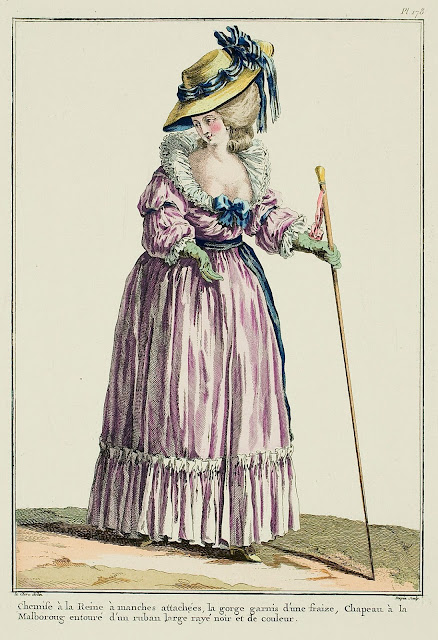
Chemise à la Reine with bound sleeves, the neckline trimmed with a frill, Marlborough Hat wrapped with a wide ribbon striped in black and color. (1784) "Chemises" belonged to the category of simple and comfortable dress which was in vogue from about 1781 overall due to Marie Antoinette. At the time, one said that an upper-body garment was made en chemise when "the beginning of the sleeves ended in two pieces which were added" (Dictionary of the abbé Jaubert, 1778).  One frequently finds in the notes of Mlle Bertin mentions such as "a piece en chemise of Italian gauze", "a fichu-chemise * of Italian gauze", etc.  On the date of the appearance of the " chemises à la reine ", Bachaumont fixes it for us in writing about the portraits of the Queen and Madame, by Vigée-Lebrun, shown in 1783: "The two princesses are en chemise , a costume invented recently for women ." And he added, "Many people have found it inapp...

Galerie des Modes, 41e Cahier (bis), 1ere Figure

Image
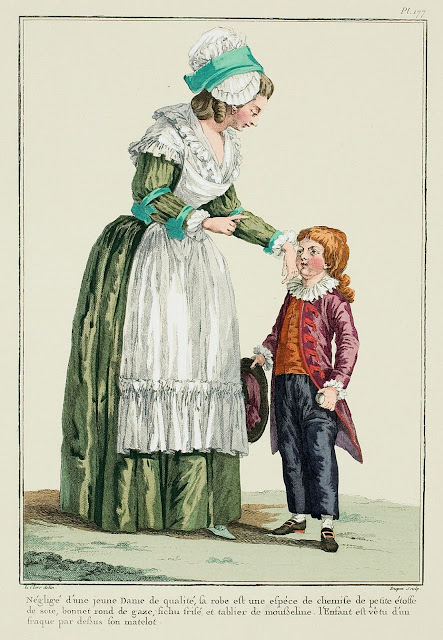
Négligé of a young Lady of quality, her gown is a type of chemise of thin silk stuff, round gauze cap, frilled kerchief and apron of muslin.  The child is dressed in a frock coat over his matelot. (1784) "In the tenderest infancy, one inculcates, so to speak, women's love for vanity and lightness!  Everyone contributes to this: the papa, the mama, the nursemaid, and family friends; the dancing master who educates the young girl has precedence over the reading master, who must inspire in her the fear of God and love of her future duties.  The marchande des modes and the seamstress are beings whose importance she will evaluate before hearing of the existence of the shape which nourishes her and of the weaver who dresses her ... "We deign to regard with reflection these marionettes that are seen in our promenades, to prelude with silliness the errors of the rest of their lives.  The little gentleman , in a cloth suit, and the little lady , coiffed in the mann...