Posts

Showing posts with the label 1930s

The New Look?

Image
I've written a lot (a  lot ) about why it's wrong to put Chanel, and even Chanel plus Poiret, up on a pedestal as the pivot(s) of a sharp turning point in fashion, but I've only touched on Dior and the New Look once or twice. Just like the earlier narrative compresses time to juxtapose frothy Edwardian gowns against the short, narrow dresses of the mid-late 1920s, the centering of Christian Dior as the inventor of stereotypical 1950s fashion in 1947 is a big oversimplification. Women's fashion for much of the 1930s was streamlined: the overall emphasis was on a sleek line from shoulder to ankle. At the beginning of the decade, the tubular figure of the 1920s was still common, but within a few years dresses and skirts were being worn with waistbands and belts at the natural waist. By 1935, it was common for jackets to be made with built-up or padded shoulders, turning the silhouette into a long, slender carrot shape "Afternoon suit: solid-colored silk dress, t...
“Dresses All Worn Long in the Evening”: Fashion in the “Provincial Lady” Diaries of E. M. Delafield

Image
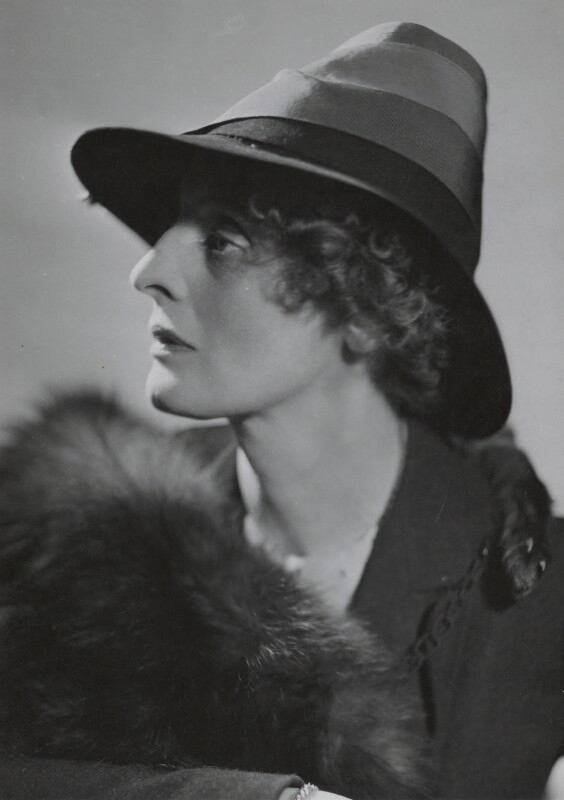
(In October, I attended the Costume Society of America Southeastern/Mid-Atlantic Symposium in Shippensburg, Pennsylvania. My debut as a conference speaker! I presented this paper.) "Edmée Elizabeth Monica Dashwood (née de la Pasture)", Howard Coster, ca. 1938; National Portrait Gallery x10669 Edmée Elizabeth Monica de la Pasture Dashwood (1890-1943), better known by her punning nom de plume E. M. Delafield, penned dozens of novels and plays about middle- and upper-class British society in her short life. She was already a successful author when Margaret Mackworth, Viscountess Rhondda, asked her to write a "space-filler" for the feminist literary magazine, Time and Tide , in 1929. This filler, very much based on the author's life and acquaintances, was titled Diary of a Provincial Lady , serially printed, and eventually published in book form in 1930. The unnamed protagonist's social standing is only indirectly stated: she is certainly below the elega...

Fabulous Full-Slip (and the Haslam System)

Image
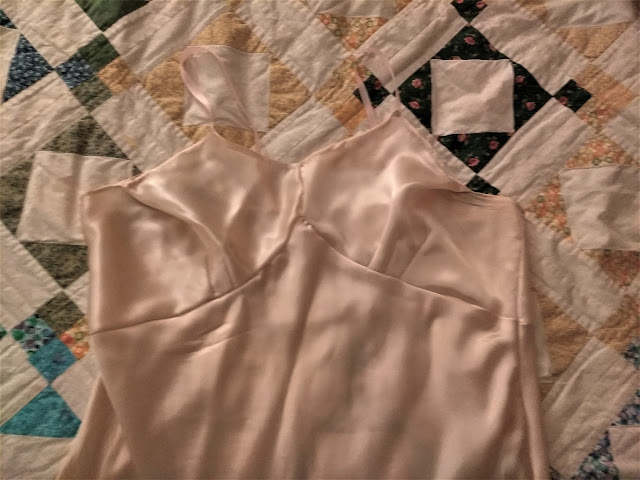
When I posted about my half-slip , I linked to some information about the Haslam System of Dresscutting but didn't really get into it. Let me rectify that now! The Haslam System is a method of creating patterns for anyone, at any size within a particular range. Where a paper pattern comes at full size in a range of set measurements, and a gridded pattern à la  Janet Arnold comes in one particular size, Haslam patterns were printed to scale, roughly, with information on how to make them full size depending on an individual's measurements. The way this works is through the use of a two-sided chart . (The one at the link is prepared to be printed on A4 paper, so if you're American it will cut off some of the edges, but it's fixable.) Each side helps you draft the top of the back and front of a bodice sloper specific to any individual: the chart is perforated to allow you to plot points based on your neck, shoulder, and bust measurements, and on one side there are a few...

Book Review: The Long Weekend, by Adrian Tinniswood

Image
I picked out The Long Weekend: Life in the English Country House, 1918-1939  from NetGalley to review here as the country house has such a prominent place in classic and historical fiction - think of how many mysteries wouldn't exist without characters being cooped up together for a country weekend! The book is exhaustive - Tinniswood goes through all the aspects of the country house itself, from architecture to interior decoration to sale to (royal, aristocratic, and common) owners, with detailed descriptions of how these went down at various specific estates. The social aspects, unfortunately, don't seem to get as much time as the others (or perhaps the architecture and interior design chapters simply seemed very, very long?). Country house parties are dealt with at the very beginning, and then at the end there's discussion of gay country house owners, hunting and fishing, the servants, politics, and the collapse of this culture during WWII. Ultimately, I'm not...

The Hunger Games (Silver Screen - HSM #11)

Image
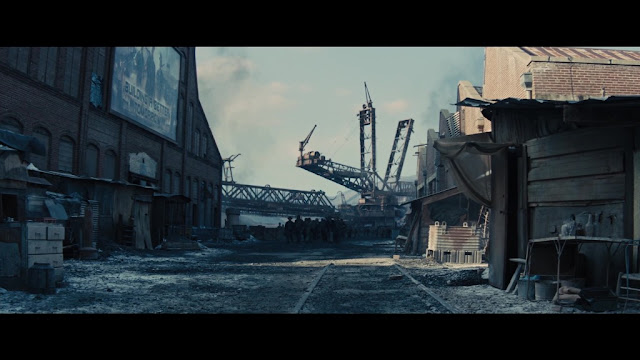
Sorry that I missed October! I promise to get to "secrets" in December for the re-do challenge - there was a lot going on and that's a tricky one for writing. The Hunger Games  and its sequels are set in the far future, in an America ravaged by climate change and changed politically beyond recognition. However, there's so much influence from the 1930s and early 1940s in the costuming and design that I tend to spend a lot of my time watching for that. This is really an image-heavy post rather than a text-based one, because I want to highlight these design elements that your eye might have skated over. Warning: there's a spoiler for the latest movie in here. It's from the book, but if you're a movie-only fan ... Very little in the various districts would look out of place for rural Depression-era towns. The buildings are dilapidated shanties or abandoned factories, with nothing futuristic about them. Two views of District 12. Compare to th...

The House of Doucet (1816-1928)

Image
Just as John Redfern began as a mercer, the Doucet family's business began in fabric and lace. In 1841, La Mode  described the Doucets (then at 17 rue de la Paix ) has having a "numerous and noble clientele", highly stylish in late spring for "trousseaus and corbeilles " - the  corbeille  being the gift of material wealth given to a woman by her husband the morning after the wedding, a continuance of the medieval Morgengabe  - and was frequently recommended for fine  lace for ruffles, berthas, and skirt flounces. Toilettes from Petit Courrier des Dames , including chemisette and lace from Doucet, 1840; NYPL 802380 The business was split by 1862 into two parts, both housed at 21 rue de la Paix : Mme Doucet was a lingère , selling women's chemises, drawers, caps, and other linen and cotton articles, while her son Edouard was listed as a tailleur-chemisier , selling men's underwear and outerwear, and marked a "notable business". (Quite a fe...