Posts

Showing posts with the label Magasin des Modes

Magasin des Modes, 5e Cahier, Plate III

Image
December 30, 1786 In the twelfth Book of the first Year, we showed four new Buckles, seen from the side, to mark the effect on the instep; we show three newer ones here, shown in full-face, to show the length and width. While we showed the four in the twelfth Book of the first Year, hardly anyone wore oval buckles, today, round, square, and oval buckles are worn. The oval one that we have drawn is silver, with gold sequins in the middle, and with little lozenges connected around the edges. The round one is in love-locks, silver, with gold sequins in the middle. The square one is silver, with pearls on the edges, with large steel lozenges, cut in facets in the middle, and with six large rosettes in gold. These buckles were drawn from the Shop of M. GRANCHER, at the Little Dunkirk , which has a full assortment of them, of all types and in the latest taste. The full selection there renews itself each day at his Shop. In this Shop can be found Rings and Bracelets with talisma...

Magasin des Modes, 7e Cahier, Plate II

Image
January 20, 1787 PLATE II Dark green satin is no less used for men's full dress than for women's. This color, which suits the figure so well, cannot fail to be seized by both sexes. The dress suit worn by the man represented in this Plate is of dark green satin. It is all plain. The buttons are of the same stuff. The breeches and waistcoat are also of the same stuff. White stockings. Jabot and ruffles of needle lace. Very wide collar. Hair is in a squared grecque , with three curls in front of each side. The hair behind is confined in a bag. Very large hat with white plume under his arm, placed in such a manner that the front corner hangs lowest. A sword with a black scabbard, trimmed with a gold dragoon. Very large squared silver buckles on his shoes.

Magasin des Modes, 7e Cahier, Plate I

Image
January 20, 1787 So great is the quantity of redingotes, also called Franco-Anglomane  gowns, that we've given, but it's necessary to do so again. Our Ladies have hardly any other dress. One will agree that at least we have varied the forms and the taste of all those that have been shown. That which the Woman shown in PLATE I wears, very different from the others, is made and cut like chemise gowns. Like them, it is passed over the head or stepped into. This redingote is of scarlet wool; it is fastened in front with large white buttons. Its sleeves are slit on top à la Marinière , and along on the sides, where four little white buttons are sewn. We could say that this form of redingote is particularly designed for going about in a cabriolet, for we have seen Ladies getting into or out of cabriolets in it. The Woman has a simple, puffed kerchief on her neck, with the ends falling like a man's jabot. She holds a rose in her right hand, and a cane in her left. On ...

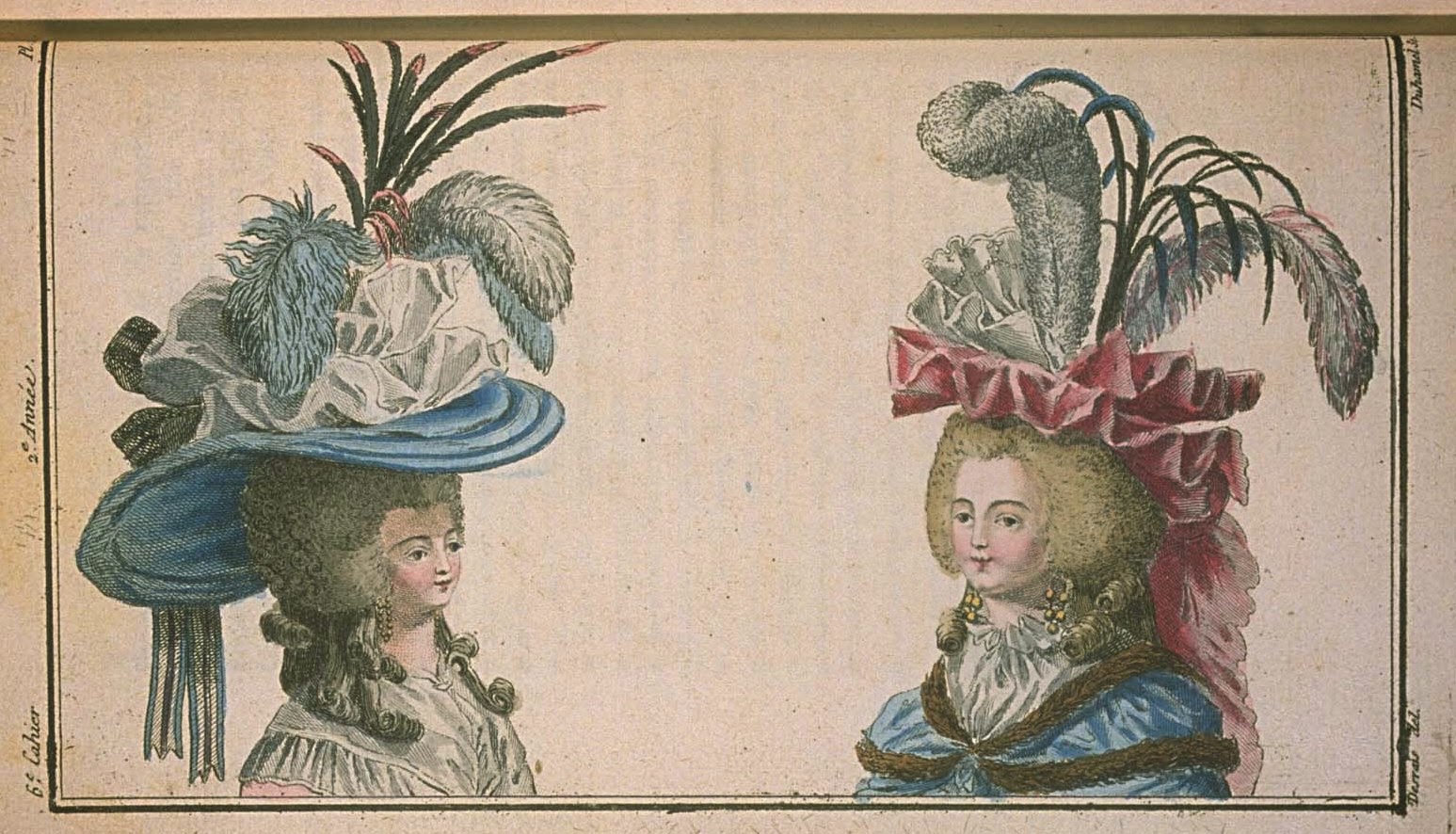
Magasin des Modes, 6e Cahier, Plate III

Image
January 10, 1787 Two Busts of women. The Woman dressed in a pink gown wears a demi-négligé cap. This cap has a double ruffle of white blonde lace, in large pleats. Its crown or base, very puffed, is of blue crêpe, with its two ends hanging behind, on the shoulders, in the form of a veil. This crêpe is dotted with violet bouquets. Between the base and the ruffles, there is a wide, figured ribbon with a white satin ground and violet selvages. This Woman's hair is frizzed on the top. A single large curl falls from it on each side on the chest. Behind, the hair hangs à la Conseillère . She has a fichu-chemise  with two collars on her neck, and gold earrings à la Plaquette  in her ears. The other Woman wears a hat à l'Espagnol , in which satin. (1) The crown of this hat is of pink crêpe. This crown is tied with a purple and pink ribbon, forming a large bow in the back whose ends hand very low, and it is surmounted by three white plumes and a rooster aigrette, dyed flame-...

Magasin des Modes, 6e Cahier, Plate I

Image
January 10, 1787 No-one can deny that our French Ladies cause their fashions to be adopted by Ladies of nearly all other Kingdoms; however, we must admit that there are restitutions that they make to nearly all. Did they not borrow, at least two years ago, Polonaises , Anglaises , Turques , Chinoises ? Now they borrow Espagnoles . It is true that they return versions that are much better than those they received, and, to be exact, they only borrow the names, and they create the things themselves. When they copy, they correct and embellish. When they imitate, they create. From a too inventive imagination, too fecund to stick slavishly to their models, they borrow, they create. They become, in a word, the masters  of the originators. This talent shines in the modern Spanish hats and cap, as it shined in the robes à la Polonaise , in the English hats, in the Turkish caps, and in the poufs à la Chinoise . The Woman dressed in a pink satin gown wears a hat à l'Espagnole . This hat...

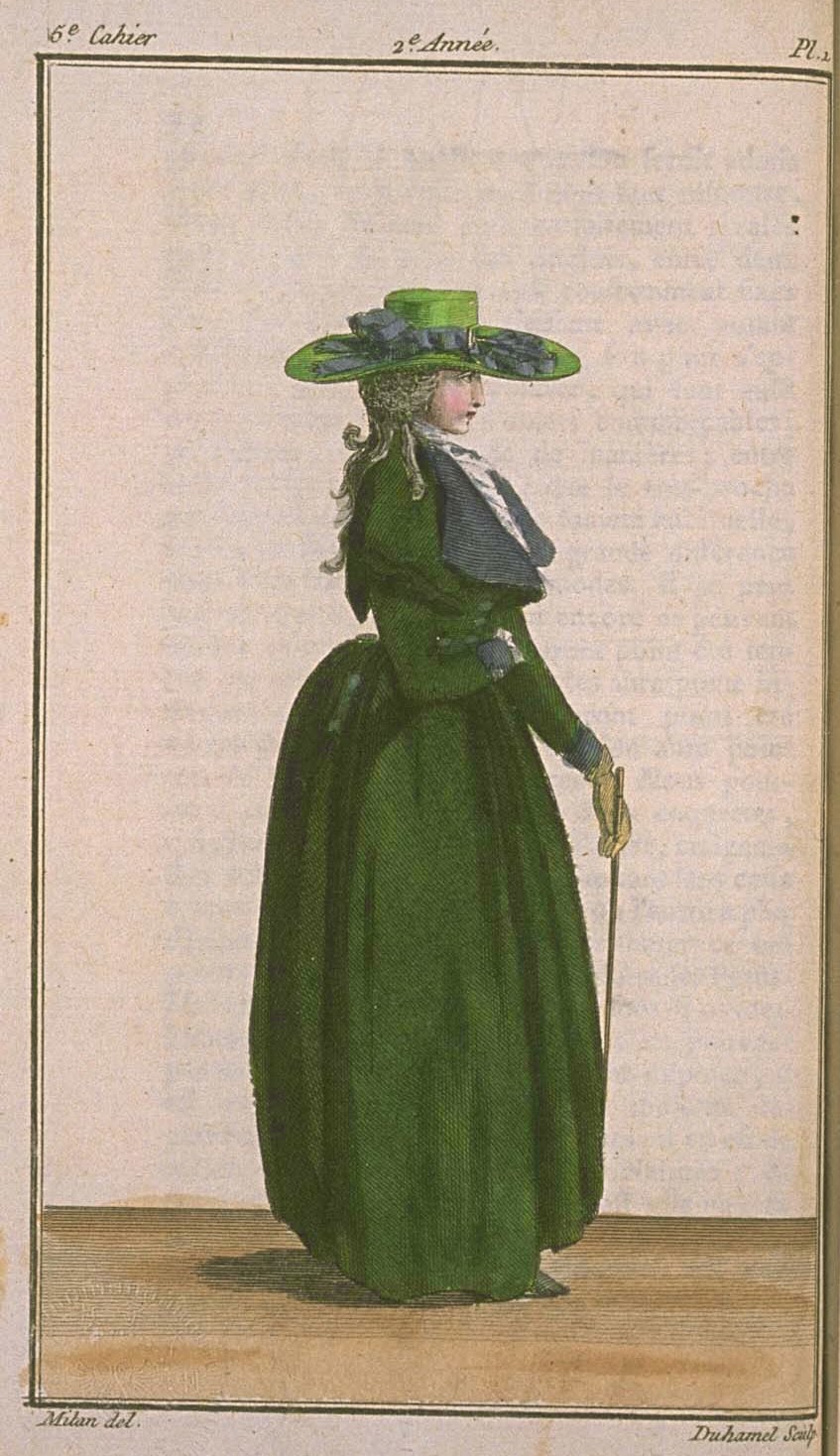
Magasin des Modes, 5e Cahier, Plate II

Image
December 30, 1786 FRENCH FASHIONS. We said in the second Book of this second Year that women hardly go out in the morning but in night caps, when they aren't dressed; we should add here that many wear a chapeau-bonnette  over the night cap. In this manner, they give an air of half-dress which saves them from the great undress that the simple night caps, which would never be supportable without fashion, present to the eye. How was this fashion begun? We dig into our heads to imagine it, and do not succeed. It is impossible for us to conceive it, when we think that there are so few women who have a seductive air in a night cap. Everything that we can find is that women have decided to renounce looking pleasant during this part of the day. Could we concede this beautiful invention without fear that we will be reproached for pronouncing some blasphemy against the Ladies' taste? The Woman dressed in a violet satin gown wears over the night cap a gauze  chapeau-bonnett...

Magasin des Modes, 5e Cahier, Plate I

Image
December 30, 1786 [The issue begins with a long remark on the interchange of fashion between France and England, "whose eyes are constantly fixed on one another".] Consequently, one should not be astonished if we happen to give as English Fashion what was some time ago French Fashion, and as French Fashion was we had already published as English Fashion. Men's redingotes, that we should call Franco-Anglomane  gowns, having come from Englishwomen to Frenchwomen, and this Fashion existing still in both countries, one should not be surprised today if we show Englishwomen dressed like Frenchwomen. The Englishwoman drawn in PLATE I wears a man's redingote of olivish wool, with three wide collars falling very low to below the shoulders, with large revers lined with violet satin, with violet satin cuffs, and trimmed on the cuffs, on the hips, and on the fronts with wide white mother-of-pearl buttons. A sort of belt of the same wool, trimmed with the same buttons, bin...

Magasin des Modes, 4e Cahier, Plate III

Image
December 20, 1786 FRENCH FASHIONS. Two women's Busts. The first, dressed in a pink satin gown, wears a hat with a very high crown, made of satin with pink stripes and Sky blue stripes, trimmed on the front in three rows of large bows of yellow ribbons with green plain stripes down the middle and pinked pink stripes on the edges, and on the back with three large bows of matching ribbons. In the middle of the three rows of large ribbon bows rises an aigrette of seven medium plumes in white, pink, black, and green. A veil of satin matching that used on the hat hangs from the back. The crown of this hat is, so to speak, the only hat crown which is worn today. They are made in different satins with stripes of different colors - blue and white, black and pink, yellow and black, violet and white, etc. The Woman's hair is all frizzed en tapet , and six curls, placed in three rows, hang over her chest. Her hair, behind, is pulled up in a floating chignon . On her neck, a ...

Magasin des Modes, 4e Cahier, Plate II

Image
December 20, 1786 A young Englishman in full dress. Here, men never appear without a sword; it is easy to see that in London, this practice is not the same. One can see that in London, they are also fully dressed in a frock coat. The one worn by the young Englishman is of a puce little velvet on a yellowish ground. It is trimmed with flat, medium-sized gilded buttons, all plain; it is lined with a puce silk twill, mixed. Under this frock coat, he wears a gilet of sea-green satin, with wide pink stripes forming large squares; breeches of black satin, buttoned on the sides with seven buttons, and the garters of which are fastened with narrow rectangular silver buckles. White stockings. In his watch pockets, two watches, from one of which hangs a simple cord of Sky blue silk, with a large key at the end, and from the other hangs a cord of silk and gold,also with a large key. Her shoe buckles are silver, in very wide squares, and trimmed with pearls. On his neck, wrapped th...

Magasin des Modes, 4e Cahier, Plate I

Image
December 20, 1786 [Before the plate description is a long comment on how devoted the Authors were to their Work, and how unhappy they are that German Subscribers were complaining about them being put together wrong - ironically, in the previous issue plates one and three were switched around - when apparently the issues they were receiving were counterfeits, containing plates and text not drawn or written by the Authors. However, they accepted the complaint that the styles were out of date by the time they arrived there, several weeks after they were originally drawn.] ENGLISH FASHIONS. While Englishmen and Englishwomen nearly always seem negligent in their dress, especially in Paris, where they successfully get past all the airs in toilette and parure  which overwhelm us and hold us ceaselessly in a reserved or stiff composure, they have nonetheless their own most formal dress, or Court dress. It is perhaps more curious than useful to present it, since in this Foreign cou...

Magasin des Modes, 3e Cahier, Plate III

Image
December 10, 1786 ENGLISH FASHION. Never, perhaps, have colors been better united and nuanced in an entire outfit than in the one in which the young Englishwoman is shown in this Plate; never will one find colors which, taken together, would give more grace  or sweetness to the face. We do not hesitate to say that our Print presents a perfect whole. Agility in her figure, softness and liberty in her composure, harmony in her dress: everything is found here. This young Englishwoman is dressed in a violet satin redingote, with sleeves à la Marinière , trimmed with large mother-of-pearl buttons. Under this redingote, there is a gilet and a petticoat of canary's tail  satin; the petticoat is flounced with a narrow white gauze flounce. And over the front of this petticoat, a long apron of black taffeta. She wears a full gauze kerchief, trimmed in three rows. Her hair is frizzed all over in large curls, two of which fall on her chest, and behind, her ...

Magasin des Modes, 3e Cahier, Plate II

Image
December 10, 1786 To be precise, it is not the leading fashion that we show in this Plate: it is not even fashionable, since frock coats must be of puce , black, or London chimney-soot  colored wool, but it is a dress which could become fashionable for the reasons that we gave in the sixteenth  and twentieth Books  of the first Year . We have discussed, in this Book, how a fashion is born: this one could be born in the same manner. The young man who appeared in this outfit has been fixed, and applauded by many women; he has been complimented on his taste by many young people, and it is a certainty that his outfit will be adopted. When he would not be it, one would not have the right to seriously reproach us for having proposed it, being in the order of possibilities that he be it. We would have to respond to those who would mark the mood, that we have been prevented in this attempt by the Author of Fashionable Magazine , or Magasin des Modes   Anglaises , wh...

Magasin des Modes, 3e Cahier, Plate I

Image
(Lately, I haven't had much appetite for sewing, or for writing substantive blog posts, so I'm going to bring back my translations in order to provide content and give me an outlet!) December 10, 1786 For showing winter dress, it would not suffice to give a Lady fully dressed in a satin gown (1); it would be even worse to show her covered with a pelisse and carrying a muff, to have the full dress. The former would show the effect of the gown, uncovered by the pelisse, and in the way that she would appear at an Assembly; but the latter would show the full outfit, and in the way she would appear in a Promenade or at the Spectacle. The former was necessary for the purpose; the latter is no less so. The practice of wearing pelisses does not survive with as much strength as in previous years (the fashion of mantelets, and, even more, wool redingotes, have given it a rude push!), but it is not past: one could say that at present one is still not fully dressed without a peliss...

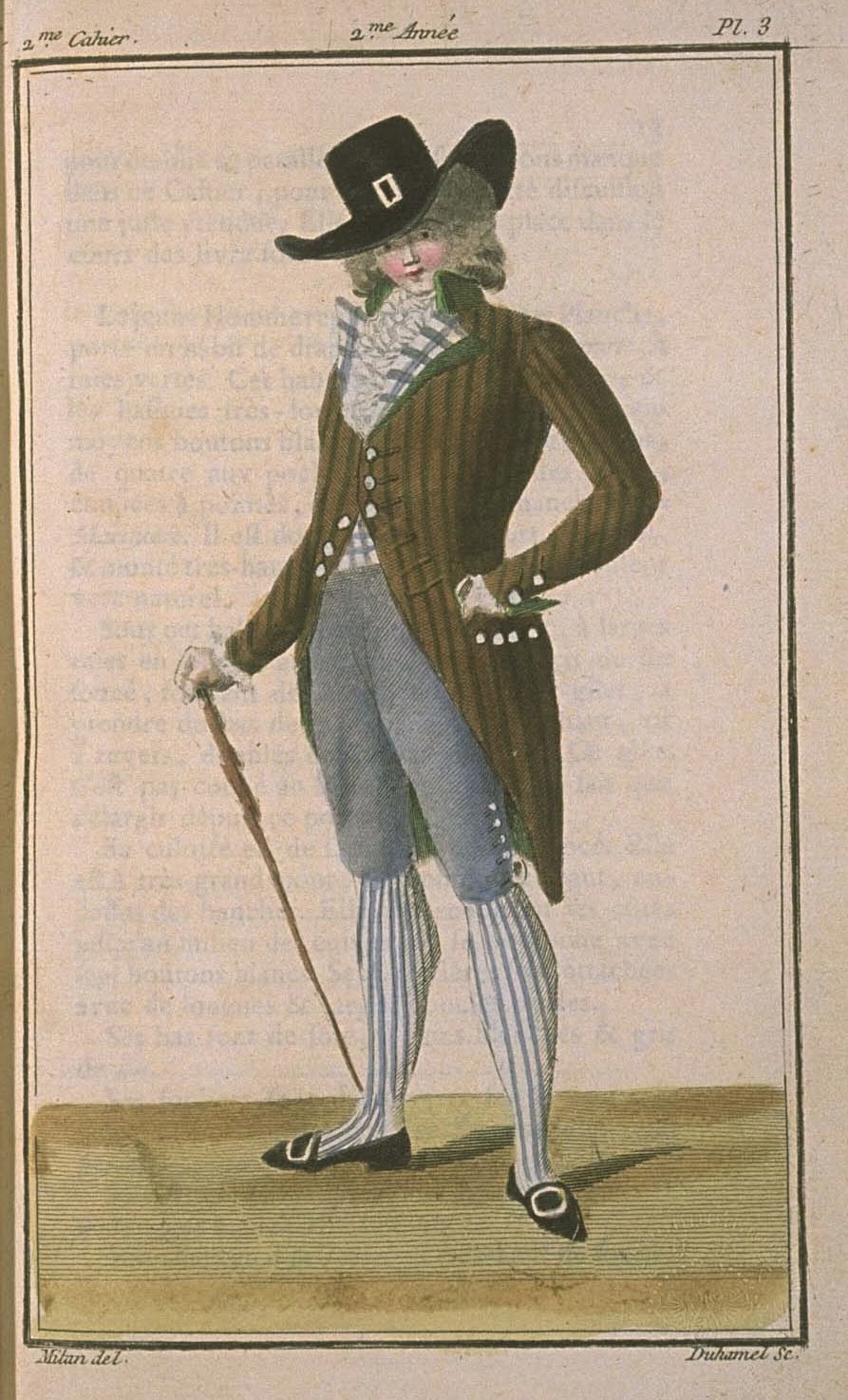
Magasin des Modes, 2e Cahier, Plate III

Image
November 30, 1786 ENGLISH FASHIONS. May young people not follow the fashion of the cramped  and stiff attitude of the young Englishman shown in this Plate; may they feel that this young man lacks the liberty, the ease which makes grace, that the French possess more than any other Nation, and which must be recherchée  at least by all the Votaries of Fashion. We only give English Fashions in order that those who will desire it will adopt the costume, which does not allow being piquant , but never in order for them to adopt the discomfort, the contortion, which would give, it is true, a foreign air, but not an agreeable and seductive one. We will never argue here whether English dress is preferable to French dress, which differed so much hardly twelve years ago; whether it makes the body better, pronounce accents better, and give it more grace: we have not yet produced enough Prints of this to establish this comparison, and we lack the space in this Book to give this dis...

Magasin des Modes, 2e Cahier, Plate II

Image
November 30, 1786 We said in the twenty-fifth Book  of the first Year  that the caps à la Turque  could bring back the great mounted caps, which went so well with women's faces that they removed and ruined straw hats and  chapeau-bonnettes , which most often uglified them, for the reasons we recorded, but which still broke them. One may judge between the two Busts shown in this Plate, if even the baigneuses , which are like the great mounted caps, do not perfectly suit. The baigneuse  that the Woman dressed in a  dawn-colored  satin gown wears has large pleats and is made of striped white gauze. It is trimmed with a dawn  ribbon with white stripes, which forms a large bow on the front. This Woman wears on her neck a full gauze kerchief en chemise , with three collars, held together with an arrow pin. In her ears hang gold rings à la Plaquette . Her hair is frizzed all over her head. Two curls which descend to the chest are allowe...

Magasin des Modes, 2e Cahier, Plate I

Image
November 30, 1786 Again a redingote in a new form. It is buttoned with two rows of buttons to the waist, and with only one from the waist to the bottom. This redingote is of lemon  yellow wool, with apple  green stripes. The collar and cuffs, slit à la Marinière , are of dark green satin. The buttons are of mother-of-pearl, with a little gold dot in the middle. These buttons, on the bust, pass through little flaps  of green satin, fixed on the left side, and from the bust to the bottom, through simple green silk ribbon buttonholes. The Woman who wears this redingote has her neck covered with a full gauze kerchief with two rows of ruffles, the two ends of which are tied in front as a cravat, near the bodice of the redingote, and descend like a jabot over it. On her head is a chapeau-bonnette , lined with green satin in the brim, covered with a pink satin on the same brim, and whose crown is of white gauze, very puffed, and belted with a very wide green ribbon with ...

Magasin des Modes, 1er Cahier, Planche III

Image
November 20, 1786 ENGLISH FASHIONS. Will we censure the English Fashions, in order to raise ours over theirs? Will we establish a comparison between them, in order to always give the preference to ours? Will we reproach English attitudes, in order to give ourselves a dogmatic air? Will we approve or fault everything which has a foreign air? One or the other of these two options would properly announce our French character. Will we describe the English Fashions simply, in order to make them known, leaving each person the liberty of approving them? Accustomed to boldly faulting what appears bad or defective to us, and to frankly approving what appears good and worthy of praise, we will give ourselves on the English Fashions the same rights that we have over French Fashions: sometimes as censures, sometimes as  praisers , sometimes as simple describers, sometimes as appreciators; we will be free to choose. We will permit ourselves the comparison on occasion, and we will allot t...

Magasin des Modes, 1er Cahier, Planche II

Image
November 20, 1786 We announced in the previous Book, on the occasion of caps à la Turque , that we would publish the type and the origin of caps à la Randan , sometimes called à la Bayard . These caps were born from the exquisite taste of the celebrated Actress (1) who played the role of Madame de Randan  in The Loves of Bayard , a new Comedy by M. MONVEL. The sweet and tender air that they extended over her face, which she had been careful to render still calmer by the total lack of powder in her hair, and by a tint of melancholy, giving her this interesting air that allowed Madame de Randan to make the conquest of the sensitive King François I , of the brave Knight Bayard , of the generous de la Palice , of the presumptuous and galant Bonnivet , and even of the impudent and ferocious Sotomayor . The greater part of our Ladies who have adopted these coiffures were persuaded that they would make conquests as brilliant, or at least that they would have the seductive air o...

Magasin des Modes, 1er Cahier, Planche I

Image
November 20, 1786 In summarizing all the Books where we have presented women dressed in men's redingotes, it will be easy to see which were temporary variations of Fashion. Here is another redingote which shows that its progress has not relented. It was the most difficult step to get over, and it was overcome; it was the most brilliant shape and the most agreeable to take, and it has taken hold. The Woman shown in PLATE I wears a redingote of dark green wool, embroidered with gold on the fronts, on the side pockets, cut vertically, and on the cuffs. Under this redingote, a petticoat of glossy pink. On the neck, a full gauze kerchief, en chemise , with two collars. On her feet, pink shoes, flounced with a green ribbon. On her head, a straw hat, lined with canary's tail  taffeta or satin, with black stripes, whose very full crown is of pink crêpe, with little black stripes, and which is belted with a wide pale green ribbon, edged in white, pulling up the hat on the...