Posts

Showing posts with the label turque

Cabinet des Modés, 24e Cahier, 1ere Figure

Image
November 1, 1786 ADVICE To renew a Subscription, which ends with this Issue. The reception that the Public gave to the Cabinet des Modes  and the desire that we have of perfecting it engage us, as we change the title to give it a more extensive form and to enrich it with new material. The title of this Journal will be henceforth thus: MAGASIN DES MODES NOUVELLES, FRANCOISES ET ANGLOISES A Nation with which we have made more than once an exchange of opinions, customs, and fashions is zealous to profit from our Enterprise, in publishing in English a Journal, titled: The fashionable Magasine  or Magasin des Modes Angloises . Flattered by this imitation, we will turn it to the profit of Messrs. the Subscribers and the Public, in enjoying all the objects that will be in the English Journal. But here is another precious resource for our Journal: a skillful Designer, maintained at great expense in London, is charged with not letting us ignore any new Fashions whic...

Cabinet des Modes, 17e Cahier, 2e Figure

Image
July 15, 1786 IF however there were some rebels who never wanted to submit (for there are some in many Empires), and who, from contrariness, still preferred to renounce all coiffure, and get rid of all panaches , from where I permit removing them, than to adopt the Hat which I spoke of in the Ist Plate ; as my empire is sweet, easy, and that I only want to command subjects with good will, it may be permitted to them, conforming with the  IInd Pl. , in making a coiffure en cheveux , and in only wearing as a parure  on the head two ribbon bows, of which one is attached in the back, over the toque or chignon  comb, and the other on the front of the head, three or four inches long. This will be, if I can say it, my little uniform. We have received these two orders, and we have brought them back. Our Subscribers may sport one or the other. The Woman represented in this Plate, is dressed in a Gown of gauze with white satin stripes, and soft lilac stripes. This Gown...

Cabinet des Modes, 14e Cahier, 2e Figure

Image
June 1, 1787 PLATE II. 1. A Woman in a Robe à la Turque , of a pearl grey Indian taffeta, edged with a black silk Ribbon. This Woman is in second mourning. On her head, she wears a straw Hat, black, trimmed around the crown with striped black gauze made in diamond points. A pink Ribbon ties the crown. Around are raised at least twelve cock Plumes, flame colored, whose extremities fall back on the crown and on the wings of the Hat. Behind, a large Veil of pinked white gauze is held to the Hat, which descends to the waist. This Woman wears on her neck a flounced linen Kerchief, tied on the front with a pink Ribbon au Diadême . Her hair, in the back, hangs à la Conseillère , and on each side three large curls fall on her chest. She is represented seated, playing the pianoforte. 2. A Woman also in a Robe à la Turque , of a silk fabric, lemon color. The Corset under the Gown is of a white gros de Tours . Her Kerchief of flounced linen-gauze, fastened on the from with a bow of R...

Cabinet des Modes, 13e Cahier, 1ere Planche

Image
May 15, 1786 FIRST PLATE. One could advance, without fear of being contradicted, that it is hardly usual today for Women to wear full Dress Gowns, as it is for Men to wear Suits à la Française , with the hat under the arm, and the sword at the side. These Toilettes are no longer made but for pageantry  Assemblies, such as the Wedding Assembly, the Bals parés , the great Meals, and others, which are in very little number. This has justified our not having given representations of these Parures  often, and of only being applied to giving drawings of current and light Toilettes, as it were. However, as the great Parures  are worn sometimes, and it is the times when one can be obliged to wear them several consecutive days, we imagine that we do not prematurely give these figures in the first two Plates of this Book. In the simple detail that we are going to go into the 1st Plate, one can easily perceive that Women no longer wear the grand Panniers  which gave th...

Cabinet des Modes, 5e Cahier, 1ere Planche

Image
January 15, 1786  FIRST PLATE. Woman in Robe à la Turque . In the Orient, where one enjoys a sweet climate, pure air, a cloudless sky, men wear long garments, which have fullness and nobility. An almost continual winter, a bitter and dry cold, permit the same practice in some Inhabitants of the North, like the Poles and the Russians, who once displayed an oriental luxury. In the temperate Zones to the contrary, where the atmosphere is nearly always humid, the City cobbles covered with mud, the men, to protect them from impropriety, wear short and narrow coats; but women are above the inconveniences of the climate and the intemperacy of the seasons. Frenchwomen, principally in the capital, which is the center of taste, know how to imitate and appropriate even the Costumes of all the Nations. The  robes Françaises  have been succeeded by the  Polonaises , the  Polonaises  by the  Lévites , the  Lévites  by the  robes à l'Angl...

Galerie des Modes, 50e Cahier, 1ere Figure

Image
The young Eglé crying over the absence of her lover: she is dressed in a robe à la Turque*  with gauze sleeves which are rétroussée with ribbons, she is coiffed en cheveux with poppies . 1. The Hat which crowns the whole is of gauze and relieved by laurels, called à la Victoire.**   2. Hat à la Calprenede.†    3. Pouf à l'Oriflame. ‡ (1786) "As the flat  chignons  are worn very low, and it is impossible that all hair be equally long to be caught into the comb which holds them up, some time ago a sort of ligament of bronze iron was invented that is attached inside the chignon , around the middle, and which keeps the hair firmly embraced.  Chignons  are seen no more detached, to fall in scattered wisps on the neck, and to present to the eye a disagreeable mat." Le Magasin des Modes , July 15, 1786 * It's very interesting that there's nothing much to tie this to the turque as it was originally conceptualized in the 1770s. ...

Galerie des Modes, 43e Cahier, 3e Figure

Image
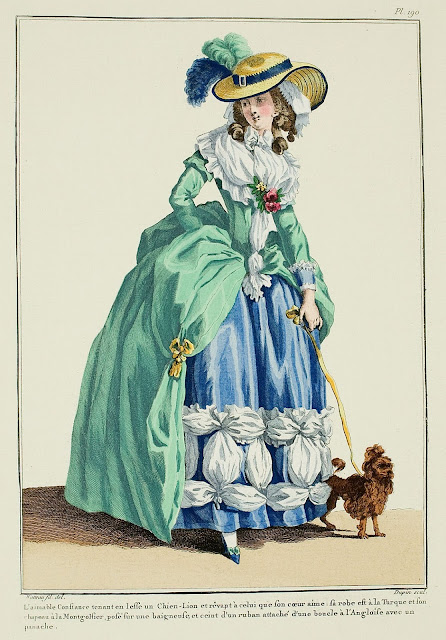
The amiable Constance holding the leash of a Lion-Dog and dreaming on that which her heart loves.  Her gown is à la Turque and her hat is à la Montgolfier, positioned on a baigneuse a nd belted with a ribbon fastened with an English buckle and with a panache. (1784) Trimming of a Robe turque made by Mlle Bertin, marchande des modes to the Queen, for Mme de Bercheny. "1785, March 24. - The trim of a Gourgouran robe turque , the fronts trimmed with a pleated strip of gauze with a scalloped bastard blonde lace, a garland of blue and white daisies on the head of the flounce, the white taffeta petticoat covered with a beautiful rich gauze in large pleats, edged at the bottom with a blonde fond d'Angleterre lace, the parements of the gown pleated with a little bordered net, the edges of the gown in bastard blonde lace. 360 livres. Dossier Bertin , Doucet Library.

Galerie des Modes, 30e Cahier, 1ere & 2e Figures

Image
Robe à la Turque, the same explained in the twenty-seventh Book p. 1 5 9; it is here shown in profile or three-quarter view. (1780) This Gown, called à la Turque, is the same which was described in the twenty-seventh Book, p. 159; it is seen here in all its length, the tail training. (1780) The Turquoise , or Robe à la Musulmane .  We have pledged, in describing the fashions of the twenty-fourth Book, to give the view of this pretty dress.  It is that which is found executed in the first two Prints of this Book. In bringing together these three Prints, it is easy to understand the whole an the graces of this dress, whose noble and graceful simplicity one never tires of admiring. It owes its elegance in part to a seam taken in the front, and intended to give play and elasticity to the strongest fabric.  It is that which forms in back the fifth nervure , covered by ribbons which one sees in the present Print.

Galerie des Modes, 27e Cahier, 3e Figure

Image
Robe à la Turque or type of Circassienne, but different than the others; it has a collar like a Lévite, and a very large white scarf knotted at the waist: the petticoat is coupé: no trimming.  This gown, which we will show in profile and from the back, attracted all the eyes of the Public, when it was seen for the first time at the Palais Royal in the month of last July 1779. (1779) Robe à la Turque , called the Turquoise.  It was in the beaut iful path of the Palais-Royal that this Gown was seen for the first time, thus is it shown in the Print.  The young Beauty wh o wa s dressed in it held all gazes, and the Public, always intrusive when p resent ed with something new that pleases it, having, so to speak, enclosed her in a circle with a diameter that shrank without ceasing, would have suffocated her if the Swiss Guards had not hastened to her aid, and had not given her the facility to escape from th is so-dangerous a cclaim. It is a type of dol man that...