Posts

Showing posts with the label Garsault

The Art of the Lingère - Chapter VII: Second Part of the Works of the Lingère

Image
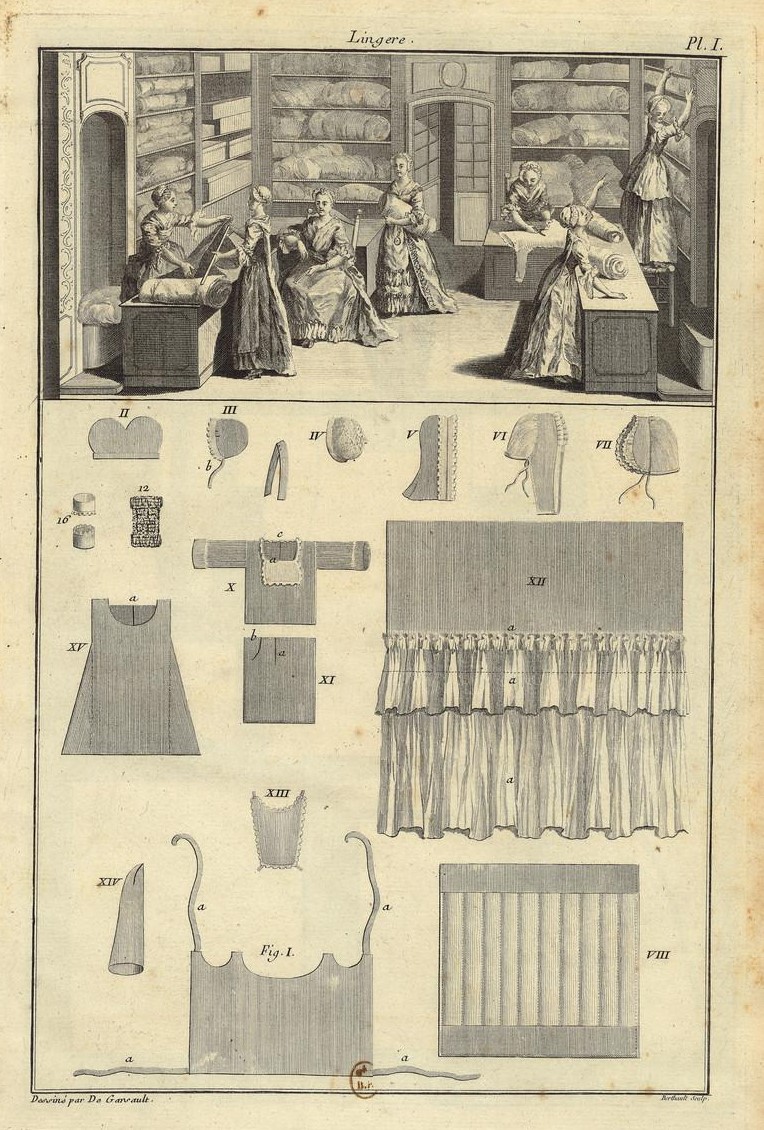
The Layette In an earlier chapter, marriage gave the lingère the work of making and furnishing a convenient trousseau. Once the wife is pregnant, she must still resort to the lingère: she contemplates the fact that she is going to become a mother, and therefore it is time to prepare the layette for her and the infant that she will bring into the world. "Layette", which etymologically means a "little box", refers today to an assemblage of all the clothes and necessary items for the infant born by its mother during the time of her confinement. With regard to the newborn, whether a boy or a girl: the sexes are not distinguished by different clothing until the age where the infant is no longer an infant. The layette can be magnificent like the trousseau, and for the same reasons a magnificent one will be described: it will contain every possible item. How and when it is put on the infant will also be indicated, and what is called the "suit": this item...

The Art of the Lingère - Chapter VI: The Seaming Stitches in use in Lingerie; Marking Linens; and the Sewing of Lace.

Image
Lingères not only sell and cut linens, laces, etc., but as they are charged most often to make garments that are finished and ready to be worn, they send them out for seaming, assembling, mounting, and marking to their Linen Workers. Sometimes the assembling is also done in households of women or by maids who have some knowledge in that respect, or even by thrifty ladies who do it for their amusement: this is why we will explain the seaming stitches used in linen-making as clearly as possible, together with the method of sewing the different marks on the linen that make it known to the laundresses, or any other launderers, to whom they belong. The different Stitches are: The overcast stitch, which joins fabrics at the edges. The whipstitch, which holds fells at the edges. The backstitch, which joins fabrics flat. The running stitch, same. The flat-felled seam joins and holds the edges. The knotted or buttonhole stitch, which prevents edges from frayi...

The Art of the Lingère - Chapter V: Explanation of the Terms of Art

FIFTH CHAPTER Explanation of the Terms of the Art, spread through in the previous Article and in the following. We thought that it would be more convenient and more comfortable to the reader to find the explanation of the terms of art used in the previous and following articles here, than to have to go look at the end of the book. The term “row” is applied not only to the ruffles of a cap, but also to the sleeve ruffles, when there are several layers of cloth or lace one over the other; that's why one says, “Cap with two rows”, “Manchettes with three rows”, etc. The term “band” is applied not only to coiffures and caps, but also to all lengths of linen, muslin, etc. of small width, which are used to edge several pieces of lingerie. The “trimming” consists of bands that are placed around the edges of certain pieces of lingerie. “The selvage at the bottom, on the front, etc.” are expressions which signify that the piece must be cut so that the selvage of the fabr...

The Art of the Lingère - Chapter IV: First Part of the Works of the Lingère

Image
The Trousseau. Two great events in life exercise the art of the  lingère  more than any other: marriage and birth, and it is not to be doubted that marriage precedes legitimate birth. When a marriage is decided, fathers and mothers, a relative, etc. ordinarily prepare the trousseau for the wife. "Trousseau" means everything that is necessary to enter into housekeeping, excepting bedclothes and table linen, which the husband must provide. The rich and the great make it of what is most beautiful and most sought-after. We will use this type for an example, because its description will present most of the pieces which are used by women. So we begin with the list for a most opulent trousseau: the yardage of the pieces will be next detailed, then their cut and their fashioning for those who need it. The same will be done for an infant's layette, which will be followed by several pieces of linen which are neither part of the trousseau nor the layette, and we will finis...