Posts

Showing posts with the label 1850s

HSM 2016 Challenge #4: Gender Bender
Image
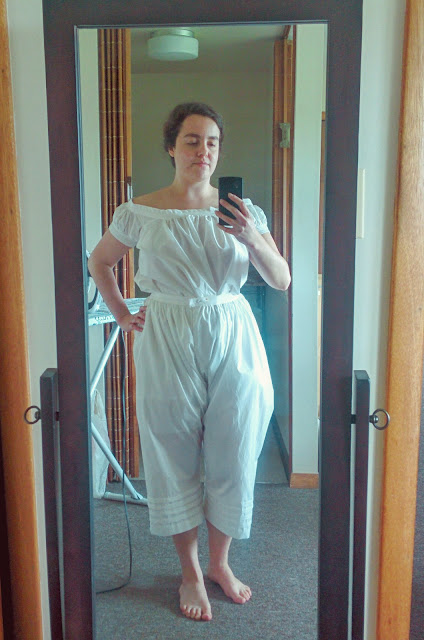
The Challenge: #4, Gender Bender. I know what you're thinking, but if we go back a few decades drawers were really controversial  for women - they simply didn't wear bifurcated garments. So even though I'm not aware of the attitude that drawers were inherently gender-bending still existing in the middle of the nineteenth century, I'm counting it because I really need drawers for my presentation. Fabric/Materials: White Pimatex cotton from Dharma Trading Co. at $6.79/yd. I'm not sure of exactly how many yards I ended up using - after making my chemise, there was only enough left for one leg, so I bought two more yards and didn't use all of that. I think it's probably about two yards in total? Pattern: From the drafting instructions by Liz Clark on the Sewing Academy Compendium. I was going to get out a pair in the collection and pattern them and base mine off that, but then I realized that that made no sense. The instructions are very clear and sim...

HSM 2016 Challenge #2: Tucks and Pleats

Image
Last year at my museum's Civil War Weekend, I was not very well kitted out. I had a decent corset, a good cage from Kay Gnagey (worth the money, by the way), a secondhand dress that fit perfectly, an 1840s chemise that's too tight under the arms, and a knee-length 1950s-style crinoline I used as a petticoat (which was awful but better than nothing). So the plans I laid out in December have been changed, because without firm deadlines I won't finish anything. Instead, I'm using the first half of the year to get everything together, starting with a pair of petticoats. This is especially important as I'm going to do a "Dressing the Fashionable Woman" presentation and need to have every layer in viewable condition. Petticoat, 1850-1865; MMA 2009.300.3256 (OASC) Liz Clark's instructions for petticoats describe pretty much what I did; I used the patterns at the end of Patterns of Fashion I  to calculate how much yardage to buy, and otherwise just sor...

Re-evaluating C. Frederick Worth

Image
While there are some (many) times that I suspect my gut reactions of being contrary simply for the same of being contrary, at other times my contrariness seems to lead me in the right direction. I've been writing about lesser-known contemporaries of Charles Frederick Worth since 2014 (see my first post on the subject , regarding Emile Pingat) in an effort to promote the knowledge that Worth wasn't literally the whole of the Parisian fashion world in the second half of the 19th century. But it wasn't until a recent question on the AskHistorians subreddit about Worth's innovations in the industry that I began to really reconsider his accepted position as a revolutionary who elevated the simple business of dressmaking into the completely new field of haute couture . There are certain Worthian innovations that I can't question, because I don't have the resources to investigate them, and I've deconstructed the idea of assigning widespread stylistic changes t...

From Hoop to Bustle: 1856-1875 (HSM #1)

Image
(For a while I intended to join in on the Historical Sew Monthly 2015, using it to put together an outfit for a Halloween wedding, but I realized that the themes were not lining up exactly with what I needed to sew. Before I thought I might participate properly in '15, I came up with the idea of participating by writing an in-depth post on the subject for each period, and I decided to go back to that idea. For January - Foundations - I'm looking at the development and evolution of the mid-nineteenth century hoop skirt to the bustle.) Something I find very interesting about the history of clothing is the contrast between the fluidity and briefness of periods of various fashions, and the way we solidify them by naming them and choosing to concentrate on specific periods. That's a very  jargony way of putting it, sorry; an example would be that the trend of a bell-shaped hoop lasted for only about five years, but somebody who chooses to recreate that period is, in a way, m...

Waistcoats: 19th and 20th Century

Image
Apart from certain stylistic keys, I've always had a harder time dating men's clothing. It's just not as interesting to me, so I haven't taken the time to really study dated extant pieces and images and improve my skills. But lately I've come across more undated waistcoats while cataloguing - it's become something that I need to work on. And how better than by putting together a blog post? Wedding waistcoat, 1808; MMA 2009.300.7449  [OASC] At the beginning of the century, fashionable waistcoats were cut straight across at the bottom to match fashionable coats, although the vests often protruded slightly below the waistline of the coat. High collars, also matching the coats, would cover the sides of the shirt collar that extended up to the jawline. Both coats and vests could be single- or double-breasted, generally with self-covered buttons. While coat lapels were generally wide, waistcoat lapels were somewhat narrower. Toward the end of the first decade ...

Fashion History Mythbusters: The Cage Crinoline or Hoop Skirt

Image
As Julia Thomas points out in Pictorial Victorians , the satirical cartoons and anecdotes in Punch  heavily colored contemporary (and modern) impressions of the fashions of the 1850s and 1860s. As a result, the wide skirts seem like fantastical costumes that played havoc with ordinary life and were impossible to move around in. And so the myths have proliferated. “Cool Request,” Punch, or the London Charivari , Volume 32, January 31, 1857, p. 50. - compare to the actual 1857 fashion plate below The first myth to address is the name of the garment. My impression is that most people use the term "cage crinoline"- "hoop skirt" sounds farby: it gives the impression of a cheap and flimsy petticoat worn by someone who doesn't know any better. eBay and Etsy sellers using elastic and plastic sell hoop skirts, but those who use metal and fitted waistbands (and the more established companies with their own websites) sell cage crinolines. Even when used without a neg...

Mrs. Joseph Mead's Slippers, 1856

Image
Wedding slippers, 1966.21.3a-b  (pattern available at link) Unfortunately, I don't know anything about Joseph Mead's unnamed wife. And her wedding gown either no longer survives or is being held somewhere else. The attribution might not even be correct - it's based on a handwritten note placed inside one shoe (the handwriting does look to be Victorian, however, so I tend to think it was done by someone with first-hand knowledge). I wish the gown did  survive - not just because every surviving gown is a victory against entropy and the Lone Power, but because that fabric is pretty amazing, and I would love to see it stretching over the yards and yards of an 1850s skirt. However, these slippers are in good condition, and it's good to have them! The construction is very simple, and anyone who wants to have slippers to match her gown should be able to use the pattern to make them.

A Question for the Living Historians and Re-enactors

You probably all know by now that I love to do research and write (but mostly do research), and lately I've been working on turning that blog post, Fashion vs. Feminism , into an article, with citations and five times as much text and things. You probably also know that I haven't made very many ensembles, and that I haven't experientially explored many different eras (by which I mean my only full outfits that I've worn have been from the eighteenth century).  So I need a little bit of help. When it comes to the cage crinoline/hoop-skirt, there is only so much satires, fashion plates, and photographs can tell me.  There are a lot of accounts out there of the regular use of corsetry, but I don't find many regarding skirt supports.  I'm hoping that some of you ladies can answer a few questions: - Did figuring out how to sit down take a lot of practice, and does it take you much effort to control the hoop when you do? - Do you find that you have much trou...

Portrait: Princesse de Broglie, by Ingres

Image
Ages back, I did a poll on what sort of posts I ought to do, and while costume drama reviews came out as the most popular (and ... I've since done one), portrait costume analyses proved to be the second most popular choice.  Ive never gotten around to writing any, partly because I get anxious that I don't have anything really impressive to say, but I hope to get around that with practice.  Due to the chemise pattern I recently posted, I thought I'd start with a mid-nineteenth century example: Joséphine-Éléonore-Marie-Pauline de Galard de Brassac de Béarn, Princesse de Broglie , by Jean-Auguste-Dominique Ingres. Joséphine-Éléonore-Marie-Pauline de Galard de Brassac de Béarn (1825–1860), Princesse de Broglie , Jean-Auguste-Dominique Ingres, ca. 1852; MMA 1975.1.186

Pattern Time: 1860s Chemise

Image
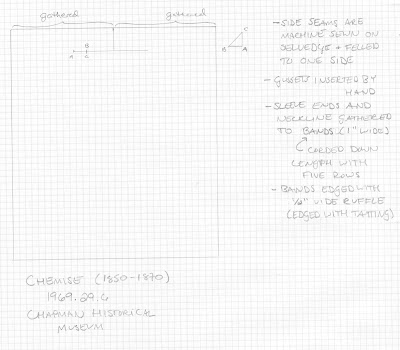
For my 150th post ( \o/ ), a quick little pattern someone might find useful. When I was working my way through a box a few weeks ago, I came across a chemise that didn't quite want to lay flat.  I took a closer look at it to figure out why, and noticed that it had a unique construction with the sleeves cut in one with the body and gussets inserted in the neckline.  I did a really quick sketch of the cutting layout and measured the important bits, so that when I got home I could draw it up in proportion on graph paper. (nb. I messed up. I've been noticing it for a while, but didn't want to point it out from shame, but I accidentally gave the neckline length as it is when gathered - the horizontal cut should be much longer, to within about four inches of the side seam. Please correct for this when making your own version.)