Posts

Showing posts with the label wedding dress

Wedding dress made by Jane Warnock, 1837

Image
Hey, everybody! It's been a really long time since I posted anything substantial here, but this fall I was lucky enough to curate my first exhibition at the Fenimore Art Museum: Elegant New York , a sampling of garments from our collection that were made by professional dressmakers or tailors in New York State, as well as a few from the Parisian haute couture world. Some of these garments have never been displayed before, and they certainly aren't on any online databases or other websites. There's only so much room on a label for information about a dress, and you also have to balance the desire to inform with the need to write something the largest audience can digest. Since I am only supposed to share my own photos of collections items when they're on display, I'm going to take advantage of the opportunity to blog extensively about each piece! The first garment you see on entering the exhibition is this dress: Let's look closer! This is a one-piece gown of a v...
Before Victoria: Royal Weddings (Part III)

Image
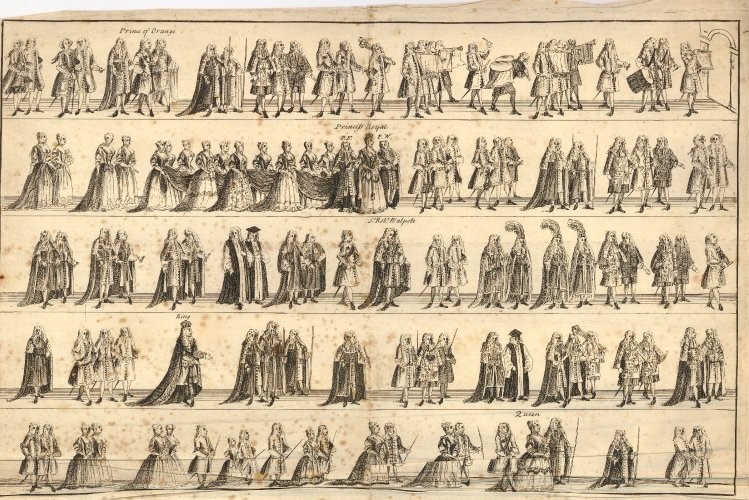
( Part I of this series and part II , if you're not coming to this from one or the other.) Royal weddings need to be dealt with on their own, because their dress traditions differed from those of ordinary and even aristocratic women. These differences are key to understanding the context of the gown that Queen Victoria chose for her own wedding, and what exactly was the tradition she was setting with it. I know that many of you are aware that royal weddings employed silver fabrics, but I think you might be surprised at the amount of white incorporated as well. "The Ceremony of the Marriage of the Princess Royal with the Prince of Orange," 1734; British Museum Mm,3.5 Anne, Princess Royal, was married to William, Prince of Orange, in 1734. The bride and her eight bridesmaids were all in the "stiff-bodied gown" – a two-piece gown made with a boned, back-lacing bodice. This style of dress had been fashionable in the 17th century and had held on as English c...

Before Victoria: White Wedding Dress (Part II)

Image
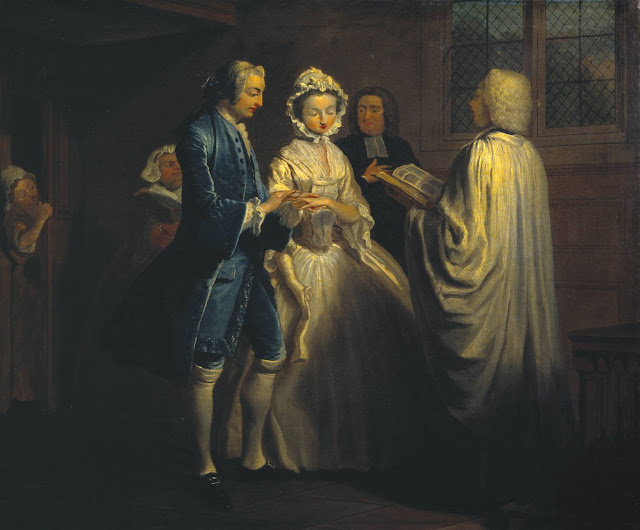
So, previously  I showed you a lot of examples of actual white or white-ish gowns worn for weddings, including fashion plates (as they are intended to be prescriptive of real clothing - they exist to tell you what you can/should wear); these prove at least that white was worn. Now I'm going to follow that up with the kind of sources that can tell us more about the reasons white gowns were chosen, and whether the examples found previously are representative. The Commonness of Bridal White Although fictional weddings are by definition not real, the choices that authors and artists make can show what's considered normal or at least ideal for their societies, and the majority of authors and artists I found chose to dress their brides in white. The marriage (ha!) of both textual and visual sources can be found in Samuel Richardson's Pamela (1742) and Joseph Highmore's painted illustrations of the same. Happily, the book describes what she wears in order to get marri...

Before Victoria: the White Wedding Dress in the 18th and Early 19th Centuries (Part I)

Image
The history of white wedding dresses is a popular topic, and a few related narratives have built up in both popular and academic writing: Queen Victoria was the first to wear a white gown for her wedding in 1840, and women began to copy her, creating a tradition. Queen Victoria was not the first to wear a white wedding dress, but it experienced a boom in popularity as a result of her marriage. Queen Victoria was not the first to wear a white wedding dress, but it was only with her marriage that it took on the connotations of purity and innocence. I could digress to talk about the perils of "Great Man" history, but that's  better for a discussion on Chanel (hey-o!), so instead let's just look at why these narratives are all incorrect, and why Victoria was not really a turning point at all. (For the use of white, that is - Cele Otnes and Elizabeth Pleck make a very convincing argument in Cinderella Dreams: The Allure of the Lavish Wedding  that Victoria's wedd...