Posts

Showing posts with the label sacque

The Nightgown (and the Negligee) (HSM #3)

Image
(My version of "stashbusting" - the Historical Sew Monthly challenge for March - means finishing a post that had been languishing in my drafts for some time.) The term "nightgown"/"night gown", as used in the 18th century, is somewhat confusing. J. P. Ryan defines an English nightgown as synonymous to robe à l'anglaise , a fitted gown. The Dictionary of Fashion History defines it as "an unboned, loose dress worn for comfort and usually informally." These definitions are polar opposites! The latter appears to be drawn from period dictionaries, which refer to a man's garment and/or an older usage, based on the examples they use. In reference to women's daily dress rather than nightclothes, the term appears as early as the 17th century: From the  Trial of Ford Lord Grey of Werk, et al. 1682 , published 1712. "Woman of quality, in summer dress", Nicolas Arnoult, 1687; LACMA M.2002.57.67 At this point, women...

Galerie des Modes, 42e Cahier, 3e Figure

Image
Full Robe Française revived by the Court for the journey to Fontainebleau in 1783. (1784) This plate was taken from the MFA Boston, 44.1581 .

Galerie des Modes, 41e Cahier bis, 5e Figure

Image
Grand Robe Française which was that required for the journey to Fontainebleau in 1783. (1784) Long trains . - "There is nothing lighter, more elegant, newer than what women wear now; and yet you found long trains at court in Louis XIV's time.  These trains remind me of Indian sheep which are driven in enormous trains by a chariot which follows behind them.  Our duchesses walk on the floor with these long gowns, while all the rest of the outfit is absolutely changed.  Why do we retain this train, two ells long, sweeping the dust behind them, if there had been dust on the daily-crowded floor of the court?" Sébastien MERCIER, Tableau de Paris , 1788

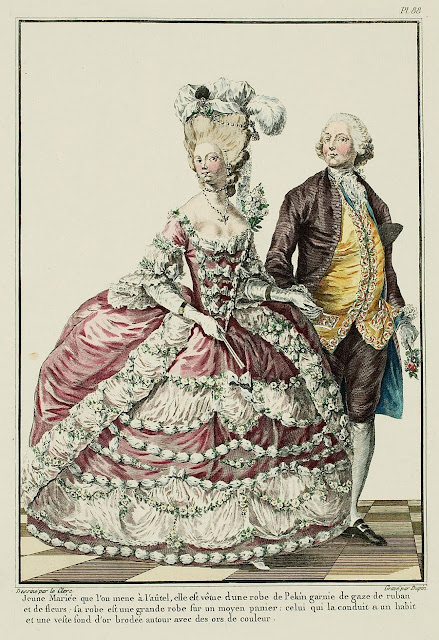
Galerie des Modes, 23e Cahier, 1ere Figure

Image
Young Wife, as she is led to the altar; she is dressed in a gown of Pekin* trimmed with gauze ribbon and flowers.  Her gown is full dress over a medium hoop: the man conducting her is wearing a suit and a vest with a gold ground embroidered around with colored gold threads. (1779)    WEDDING DRESS.   This is a full sacque of rich stuff, trimmed with taste. Formerly, not only Dress but also the manner of being conducted to the Church and the place of Marriage varied according to the rank and quali ty of the person.  Th is is the result of a report from the first of December 1446, in the reign of Charles VII, which is here analyzed, which could give an idea of the fashions and customs of the time. "The Dean of Gaye maintained, that Jean Bureau was a Human body, and was provided to serve his Church, because of his mother, wife of Jean Bureau of Tas, his father; and to prove the contrary, and that their people were not only frank ish, but also noble,...

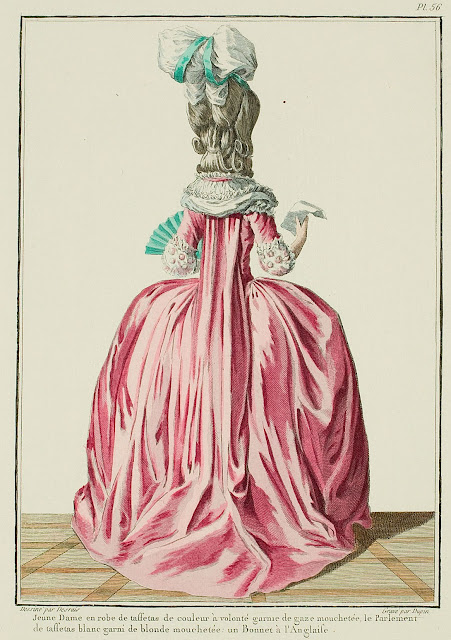
Galerie des Modes, 16e Cahier, 4e Figure

Image
Young Lady in a taffeta gown of any color, trimmed with spotted gauze; the Parlement of white taffeta, trimmed with spotted blonde lace: an English Cap. (1778) The Parlement is a type of taffeta, satin, or gauze kerchief, with a hood à coulisse .  This garment has been very much in fashion.  It is completely exclusive to the full parure ; also the Figure represented in the Print is only dressed in an informal sacque with a medium hoop, and trimmed with spotted gauze.  This gown is seen from the back; the pleats are caught a little below the collar; previously these pleats were free and in box pleats: a flat, smooth back has since seemed more agreeable, and it is the fashion which remains at present. Chignon knotted at the bottom with a half-braid; the two ends forming two large curls.  Hair in a racine droite , with two stylish curls, and on the whole a crayfish pouf.

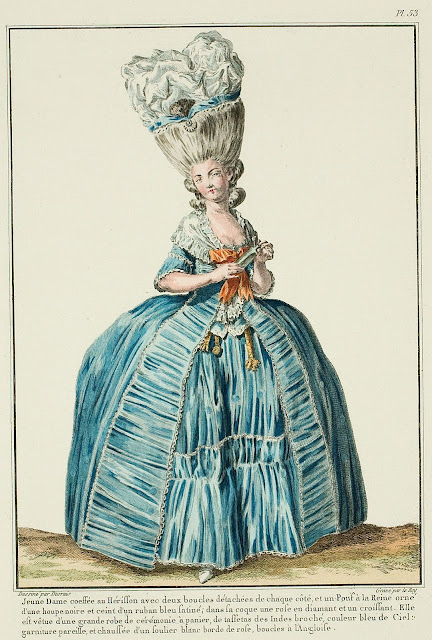
Galerie des Modes, 15e Cahier, 6e Figure

Image
Young Lady coiffed with a Herisson with two curls, not touching, on each side, and with a Queen's Pouf trimmed with a black tuft and girded with a blue satin ribbon, in the coque is a rose and crescent of diamonds.  She is dressed in a grand ceremonial gown on a hoop, of brocaded Indian taffeta in sky blue; matching trim.  Shod with a white shoe edged with pink, English buckles. (1778) Sacque, on a little hoop, with a parement in a box-pleated band: both edges of the parement are trimmed with épis and juliennes ,* or a narrow lace.  Very little sabot cuffs.  Kerchief trimmed all around, caressing the shoulders entirely and leaving the chest almost uncovered.  The two sides of the gown come very close under the contentement , and spread at the bottom of the waist, in order not to cover a little Peruvian vest which is in the place of a compere .  Volant with a simple head, with trim matching the parement . This neglected beauty has recourse to a ...

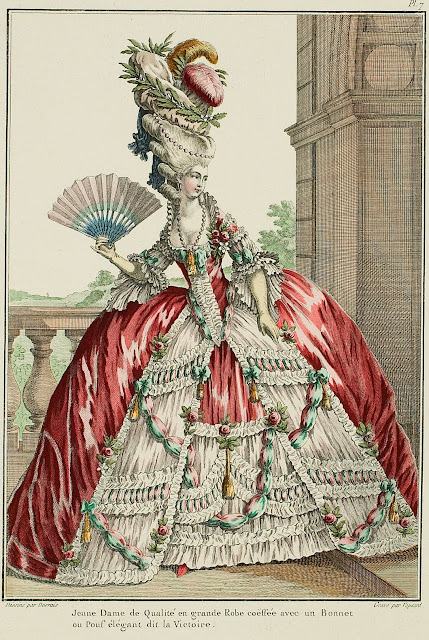
Galerie des Modes, 8e Cahier, 1ere Figure

Image
Young Lady of Quality in full Dress, topped with an elegant pouf cap called "the Victory cap". (1778) Grande sacque, with closed bodice.  This gown is pleated in the back, like all the other sacques, but has no pleats in the front: it is low-cut and busquée like a scabbard,* and the bodice seems, as it were, isolated in the center of a vast and rich drapery.  It requires an elegant figure from the wearer; it is only suitable for the beautiful young woman. The parement is of blonde lace in even pleats, and cut by narrow, gathered blonde lace; the pleats on the flat trim are crossed by two rows of eight bouillons , edges covered with two bands of gathered lace; the ends of the bouillonné ribbons are left to fall diagonally, held up with tassels; the upper edge of the parement is covered with a third bouillonné ribbon, which marks the waistline and shows its lightness; two straight, gathered bands are the only trimmings on the bodice, which is busqué in a point; b...

Sacque and Petticoat, ca. 1765 - Preview

Image
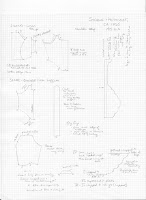
Today I spent about six hours taking the pattern of the sacque and petticoat that will be displayed in Great, Strange, and Rarely Seen - so I thought I might post the rough draft up here for comments, critiques, &c.  I'm going to redraw it in ink for the final version, move pieces around (rotate some), write directions in better handwriting, all that sort of thing, but is there anything that seems odd or confusing or messed up in some way?

The Robe à la Française, or Sacque

Image
The antecedent of the robe à la française was the robe volante , a form of negligée dress.  Once the mantua became suitable for public dress, the wealthy required something else to wear while relaxing.  The robe volante (or robe battante ) was said to have been invented by Mme de Montespan, mistress of Louis XIV, in order to hide her pregnancies. Detail of Concert Champêtre , Jean Baptiste Joseph Pater, ca. 1734; MMA 37.27 [Edit, 1/14/2013: Newcomers, you may want to see my tag for the sacque , which will show you all of the Galerie des Modes française/sacque plates I've translated so far.  Paintings are great, but labeled fashion plates are even better.]