Posts

Showing posts with the label caraco

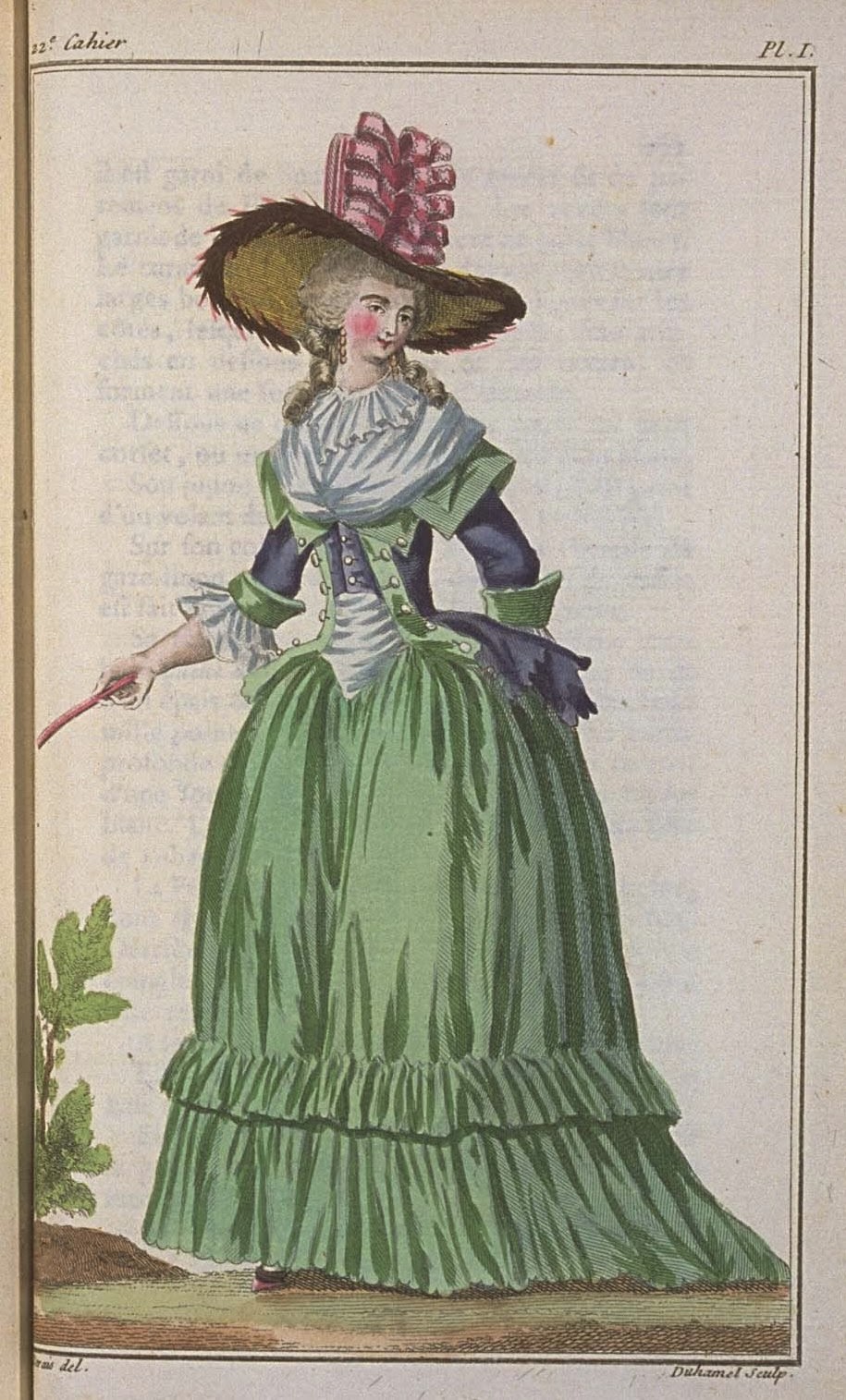
Cabinet des Modes, 22e Cahier, 1ere Figure
Image
October 1, 1786 Fashion, whose Detractors have called it light, inconstant, flighty, frivolous, is however fixed in its principles; and we believe, in truth, that it is an injustice to treat it so, irrevocably, with such callousness. We see it as constant in seizing all remarkable events, in appropriating them to itself, in recording them in its annals, in ETERNIZING them in memory. What great event, what great feats of our Warriors, of even our Magistrates has it published? If d'Estang , d'Orvilliers  have won, did it not announce that? did it not want Ladies to dress their heads with symbols in memory of their triumphs, and entering thus through the top of their bodies, doesn't the memory sink deeply into their hearts? Did it not impart the success of Figaro  to the whole of Europe? Under how many forms did it not reproduce  Janot ? Did not M. Cagliostro , more famous for his trial than for his false immortality, see Fashion make his existence known in one and the o...

Cabinet des Modes, 19e Cahier. 2e Figure

Image
August 15, 1786 PLATE II. One wears successively caracos of white muslin, with pink stripes or white satin stripes, and caracos of taffeta, or of another colored stuff. None has pleased us more than the slightly light puce caraco, accompanied by a pink taffeta petticoat. There is no doubt that this is only what we have drawn.  Sky blue  caracos are also worn, with gris-de-lin  linen petticoats; caracos with waving green stripes, and with white stripes, with puce petticoats; caracos with sequined stripes and with moiré  puce stripes, with water green  petticoats. Under her puce caraco, our Woman is dressed in a corset of white taffeta, tabbed on the bottom, and fastened in front with a number of puce ribbons, tied in bows. Her neck is covered with a full kerchief of linen-gauze, flounced. Instead of a cap, on her head is positioned white gauze, forming ruffles  on each side. Four plumes, one pink, one white, and two black, and an aigrette of green...

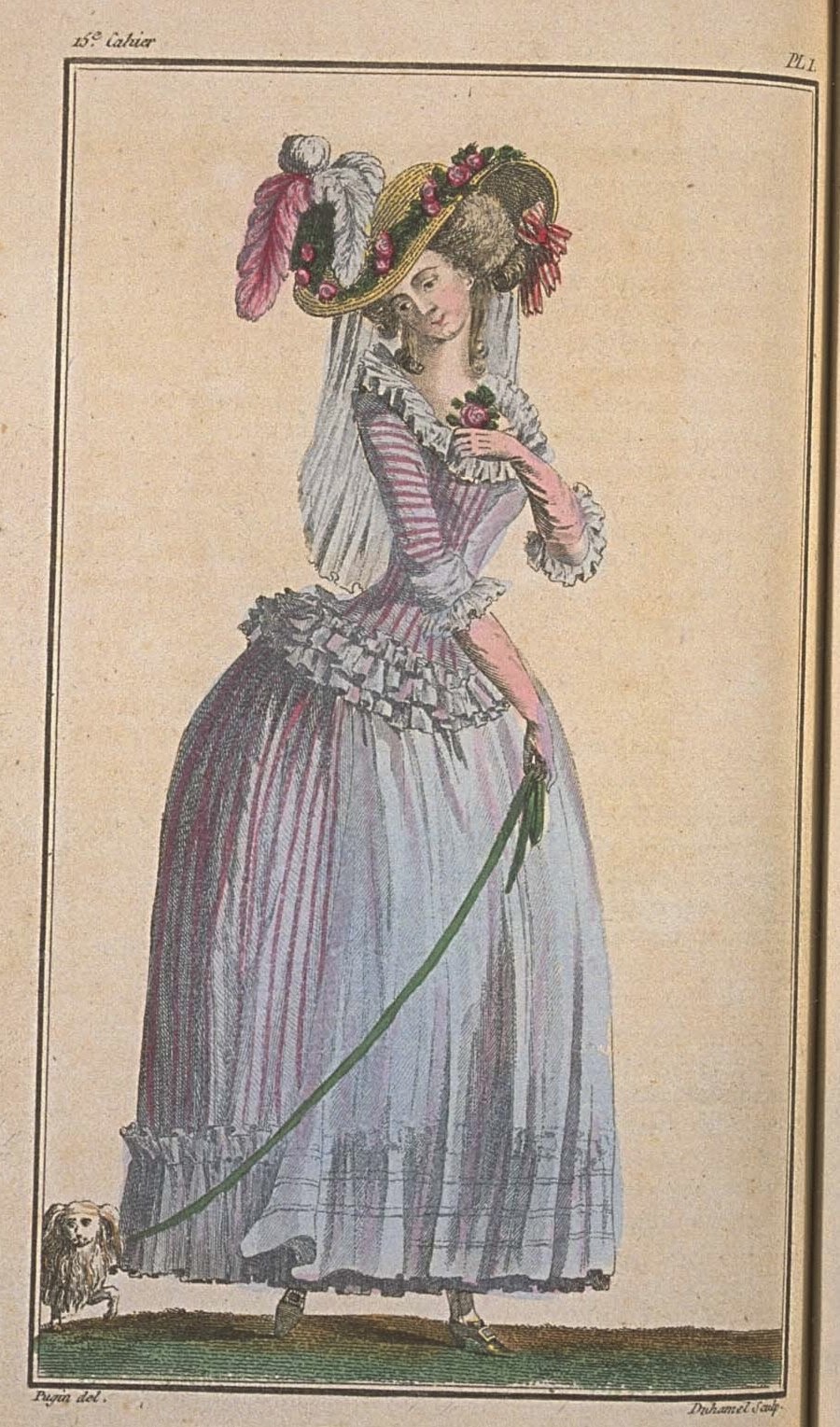
Cabinet des Modes, 15e Cahier, 1ere Figure

Image
June 15, 1786  A Woman, at her toilette, always has need of someone she can consult in order to know if this Coiffure, this Cap, this Hat, this Gown suits her well, and if she can wear it to advantage in the Promenades or other public places: why should we not be her Counsel, and why would she not read in our Books the advice that she asks for? Zulmé shines today in her muslin Caraco , quite simple, quite plain; and you, Zélis, would like to shine the same? No richness in her Dress, no loaded ornaments, taste alone made them fresh; and you would like to grasp this taste, this manner, which has seduced you? Listen, Zélis. Zulmé owes less of her éclat to her dress and coiffure, than to her air, where reigned an amiable liberty, a soft abandon, and an interesting facility. She is never seen sometimes bending, sometimes stiff, and sometimes inclining to the right or left, to give herself an air of the Petite-Maîtresse : no, her walk was frank, without affectation; sh...

Cabinet des Modes, 3e Cahier, 1ere Planche

Image
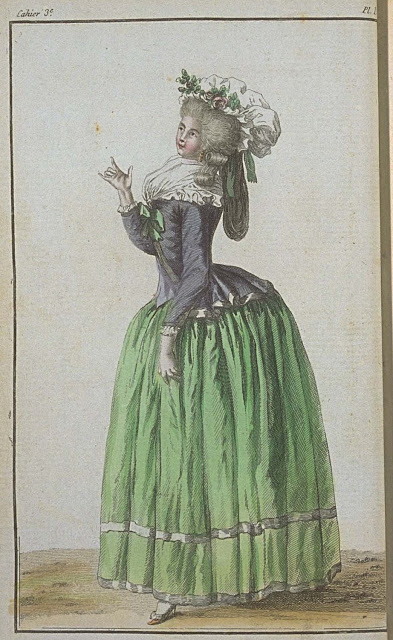
December 15, 1785 It represents a Women in a Pierrot . Cap en Pouf , trimmed with a garland of roses; and a dark green ribbon. Ordinary coiffure with two curls, chignon on top . Trimmed kerchief, of Italian gauze. Violet caraco , edged with white; the stomacher  matching, with a bow of dark green ribbon. Apple-green petticoat, trimmed with two white ribbons. Chinese sabots , carmelite  color, trimmed with white ribbons, à la Jeannette .

Galerie des Modes, 62e Cahier, 3e Figure

Image
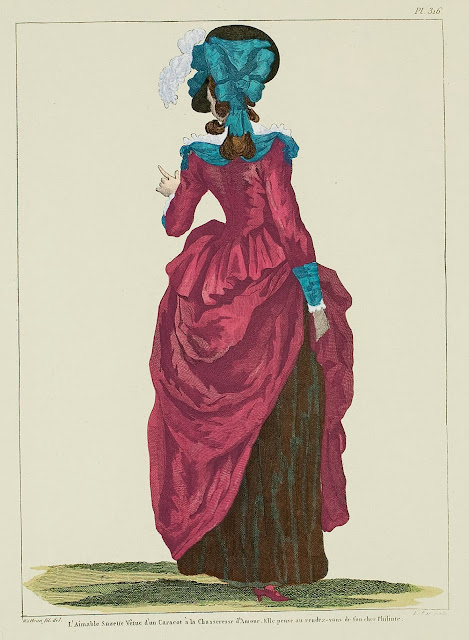
The amiable Suzette Dressed in a Caraco à la Huntress of Love. She is thinking about a rende-vous with her dear Philinte. "Our Ladies having adopted caracos almost exclusively for all sorts of dress, it was a relative necessity for them to apply themselves to varying them, to embellishing them, to deprive them of this great simple, this great plain, which in the long run finishes by displeasing, regardless of her elegance and taste, precisely because it does not vary, and because it wounds the laws of Fashion; also in order to guard the relative decencies, have they varied, embellish caracos; also have they laden them with embroidery: this is a bad one, because they have hastened the end of it. One only knows how to disagree with the variation, the embellishment, the overloading that they have brought to them, not be a perfect taste, and that it would be maybe impossible to imagine anything more agreeable to the eye." Le Magasin des Modes , 20 November 1787

Galerie des Modes, 62e Cahier, 1ere Figure

Image
  Young Nymph provoking pleasure. She is Dressed in a Caraco à l'Amazone and Coiffed with a Sunflower Hat etc. etc. " Advice . A shop for women's clothes was just established at no. 28  rue  Salle-au-Conte, under the direction of a very-skilled master seamstress. Gowns of diverse types will be found there, caracos, and all sorts of feminine garments of the newest taste. One distinguishes, among other objects, gowns à la Czarine , caracos Zélandois , riding habits à la Muscovite , gowns à la demi-négligente , ball caracos à la Hollandoise , and all sorts of other gowns.* "This establishment will be very useful to women of taste, both in the capital and the provinces. It is under the direction of distinguished artists. This store is open every day from eight o'clock in the morning to eight o'clock at night. We are eager to satisfy the demands that are made promptly and punctually." Le Magasin des Modes , 10 February 1788 * Technically, Cathe...

Galerie des Modes, 60e Cahier, 6e Figure

Image
The young amazon resting from the fatigues of the hunt. She is coiffed in a Hat surmounted by Plumes and Panaches ; she is dressed in a Caraco with revers, with Sleeves à l'Anglaise . "Many women wear petticoats and long caracos of white Holland basin, or plain white muslin or white linen, trimmed entirely with effilé  of white silk.* It is necessary to observe that it is still more frequent for caracos and white petticoats to bear effilé . The fashion of wearing it on colored gowns is only being born. We do not know if these petticoats and caracos of white basin, or white muslin, trimmed with effilé , are particularly intended for riding horses; but we have seen many ladies dressed thus on horseback. They only wear, with this, on their heads, a hat of black gauze, or black taffeta, trimmed with black plumes, and a very puffy kerchief on the neck; and they derive a very-bright éclat  from it." Le Magasin des Modes , 30 August 1787 * Possibly a fringe of unravel...

Galerie des Modes, 59e Cahier, 4e Figure

Image
  Pretty Agnes, coiffed à l'Anglomane, dressed in a Caraco en Veste with revers, &c. "Our Ladies, after having consumed all their science in infinitely varying their gowns, redingotes, demi-redingotes, etc. etc., have employed the little which remains to them to vary caracos which are nearly the only garments worn today. For that they have begun to compose them of a corset  which is worn underneath, and from which the sleeves come out, and a caraco bodice to which they have only given quarter-sleeves, that they trim with manchettes ." Le Magasin des Modes , 10 October 1791

Galerie des Modes, 59e Cahier, 3e Figure

Image
Young Lady in a Caraco à la Flamande,*  coiffed with a Turban à la Turque, &c. "A new fashion that many women have adopted and which doesn't truly suit them is that of curling the hair of young people, in five curls, of which two are above and three below, placed in "pigeon wings": excluding, however, of only curling to the bottom of the ear, they are curled to the bottom of the face, to the bottom of the chin. Their curls are stiffly crinkled, and as applied on their face. They never wear curls that hang down to the kidneys, their hair in the back is braided and pulled up very high like the braids of the Swiss. On this hairstyle they wear a little toquet  or a very little cap of plain gauze. This whole ensemble gives them an air of stiffness, a hard air which is not charming ..." Le Magasin des Modes , 30 August 1787 * Flemish.

Galerie des Modes, 52e Cahier, 6e Figure

Image
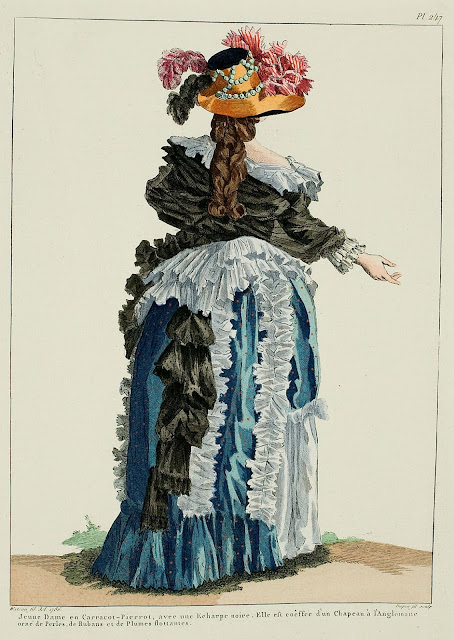
Young Lady in a Caraco-Pierrot, with a black Scarf.  She is coiffed with a Hat à l'Anglomane* trimmed with Pearls, Ribbons, and floating Plumes. (1787) "The caraco  can only make up the morning toilette, when it is still too early to dress and one wants to go out and make a tour of the promenade before noon; or the evening toilette when one has spent the whole day at home and at seven or eight o'clock one wants to take the air to be seen in public." Le Cabinet des Modes , June 15, 1786 * The - mane  suffix means, essentially, "fan".

Galerie des Modes, 52e Cahier, 3e Figure

Image
Lady of quality, a bouquet in her hand, breathing the good air at the Champs Elysées: she is in a hat à la Dorothée, trimmed with pearls and aigrettes, caraco à la Praslin edged with black with a trained petticoat. (1787) "Today felt hats are made of wool, very light, with tints of different colors.  The most fashionable are the canary's tail  yellows, the s ky  blues, and the apple  greens.  They are of a great size and have brims seven inches wide.  They are trimmed around the squared crown with two wide colored ribbons which are tied to make a large rosette on the left side.  With the canary's tail  yellow hat, violet ribbons are worn; with the apple  green, pink ribbons; with the s ky blue , white ribbons.  Under the rosette, three or four large colored plumes are attached. "A very great assortment of these felt hats are found in the shop of Sir Donnet, hat-merchant of Paris at the rue Saint-Honoré, next to that of l'Ech...

Galerie des Modes, 51e Cahier, 6e Figure

Image
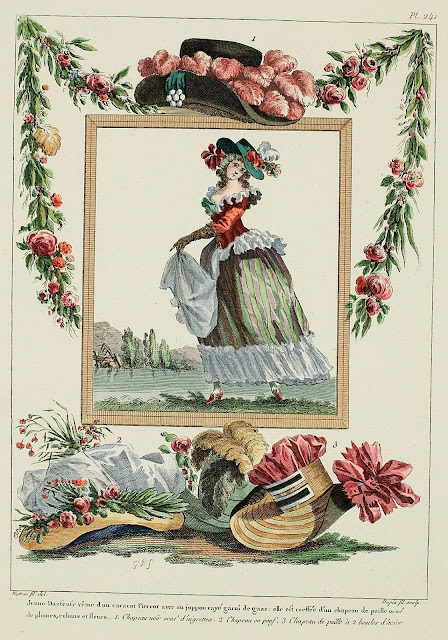
Young Dancer dressed in a Pierrot caraco with a striped petticoat trimmed with gauze: she is coiffed with a straw hat trimmed with plumes, ribbons and flowers.  1. Black hat trimmed with aigrettes. 2. Hat en pouf. 3. Straw hat with 2 steel buckles. (1786) "It is the greatest fashion today, overall for the morning promenade, when it is the best weather, to wear the fourreaux , the robes à l'anglaise , and the long caracos of solid white linen, with a matching petticoat and a white petticoat on top.*  Besides these blue, pink, violet, etc.  transparens  that are worn under the white muslin, gauze, or linen petticoats." Le Magasin des Modes , 1787 * The text uses dessous , underneath, but this is one letter away from dessus , on top, and there are more than occasional typos in the reprint.

Galerie des Modes, 51e Figure, 3e Figure

Image
Young Lady dressed in a caraco à la Berrot with a trained petticoat, holding in her hand a little switch. 1. Cap trimmed with a ribbon pleated down the length. 2. Hat à la Harpie.* 3. Hat trimmed with plumes and ribbons. (1786) "It is true that Zulmé was dressed in a caraco  and a petticoat of striped muslin, very white, very fresh, elegantly flounced; the petticoat and the pink corset beneath, which was shaded by and made a base, so to speak, for the white, spread overall an air  of sweet freshness and an agreeable variety: but to be dressed thus is the least difficult thing.  I ask you for the maintenance, you can as easily as she put on your head a straw hat, in the natural color, wrapped with a garland or artificial roses, surmounted by four plumes (three white and one pink) and to which hangs, attached behind, a large veil of white gauze falling to the waist ... but still one time of the maintenance:** there is all the magic of Zulmé." Le Cabinet des Mod...

Galerie des Modes, 50e Cahier, 6e Figure

Image
Servant woman, in a caraco à la Pierrot with a petticoat of particolored taffeta, covered by a spotted apron behind the petticoat. 1, 2, 3. Fashionable hats in the newest taste. (1786) "Zulmé shined well in a muslin caraco , all simple, all plain; and do you want, Zélis, to shine with the same brilliance?  No richness in her dress, no laden ornaments, taste only made them fresh; and do you want to seize this taste, this manner, which has seduced you?  Listen, Zélis.  Zulmé owes less of her brilliance to her dress and her coiffure than to her bearing where an amiable liberty reigns, a soft surrender and a sustained ease.  One never saw her sometimes bend, sometimes stiffen and sometimes lean to the right or left, to give herself an air of the petite -ma î tresse : no, her gait is forthright, without affectation, she never spites nature, she is never studied.  Born with these infinite graces shared by nearly all of your sex, she never offends them, she ...

Galerie des Modes, 49e Cahier, 5e Figure

Image
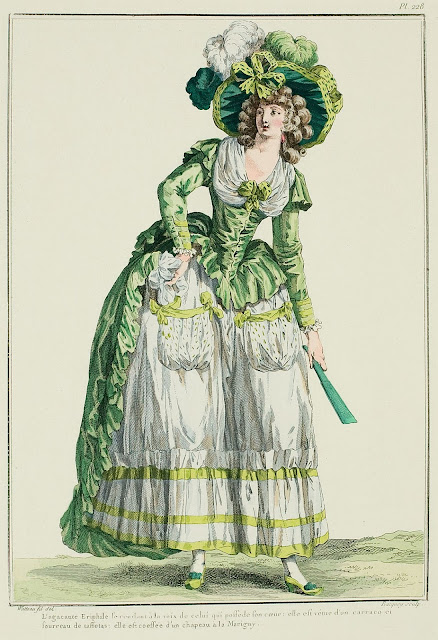
The provoking Eriphile traveling to the voice of that which possesses her heart: she is dressed in a caraco and fourreau of taffeta: she is coiffed with a hat à la Marigny.* (1786) "We wear successively black-striped or white satin-striped white muslin caracos, and taffeta or other colored fabric caracos.  We also wear sky-blue caracos, with unbleached linen petticoats; caracos with wavy green stripes, and with white stripes, with puce petticoats; caracos with straw-colored stripes and moire puce stripes, with water-green petticoats." Le Magasin des Modes , July 15, 1786 * Possibly Charles de Bernard de Marigny (1740-1816), a French naval hero.

Galerie des Modes, 49e Cahier, 3e Figure

Image
The beautiful dreamer sitting in the summer in the middle of the Champs Elysées, waiting on her favorite with impatience: she is dressed in a caraco à la Chérubin with a hat à l'Erigonne.* (1786) Champs Elysées . - "A very agreeable glance is still that which offers the Jardin des Tuileries, or rather the Champs Elysées, on a good day in the spring.  The two rows of pretty women which border the grand path, crushed against each other on a long train of chaises, watching with much liberty those who watch them, resemble an animated parterre of several colors.  The diversity of the physiognomies and finery, the joy that they have on being seen and seeing, the type of assault that they make when on their faces shines the desire to eclipse each other, all add to this diverse tableau which bind the looks and give birth to a thousand ideas on what fashion removes from or adds to beauty, on the art and coquetry of women, on this innate desire to please those who make their go...

Galerie des Modes, 49e Cahier, 2e Figure

Image
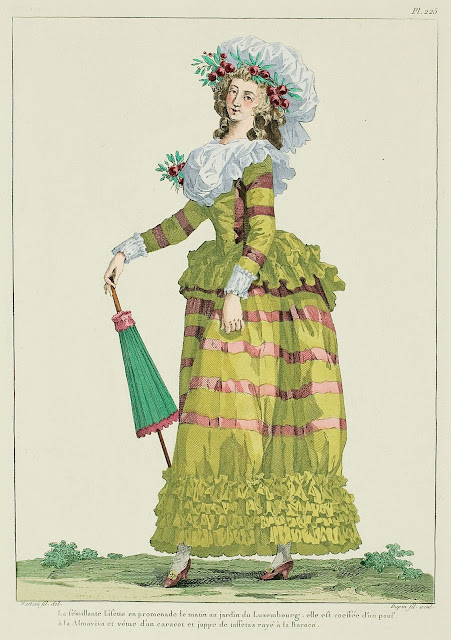
The frisky Lisette on a morning walk in the Jardin du Luxembourg: she is coiffed with a pouf à la Almaviva and dressed in a caraco and petticoat of taffeta striped à la Baroco. (1786) "It was useless to recommend to our young beauties walking exercise, if fashion was mixed on it.  One tronchined * because coquetry found something in it.  The négligé toilette is a refinement of the art of pleasing.  A fine and delicate waist never fears to show itself in a caraco ; the other sort is best in the gown à la polonaise  and the pulled in  mantelet.  The shadow of an ample calash  lends more piquancy to the attractions which dread the brightness of the day.  A beautiful hand rounds itself on a cane which has no other use; frail ornament, that reluctantly takes these to which it becomes a necessary support." * Took morning walks; from the name of Theodore Tronchin .

Galerie des Modes, 45e Cahier, 3e Figure

Image
The young and elegant Suzanne sending the response which she just made in a letter to keep her dear Figaro:* she is dressed in a caraco trimmed with muslin, the petticoat of the same with three rows of ruffles, and a Globe cap. (1785) "The women who are coiffed en hérisson with little curls wear a cap à la Princesse of Italian gauze; a bouquet of flowers on the right side, over a tuft of hair; on the neck a simple ribbon necklace; the earrings en mirza ,** trimmed linen kerchief; green satin fourreau ." Journal général de France , 5 December 1786 (later le Cabinet des Modes ) * Suzanne and Figaro are the characters involved in the titular act of The Marriage of Figaro .  Suzanne is the Countess's maid. ** "Mirza" is a title, indicating descent in the male line from the Persian Imperial Families.

Galerie des Modes, 33e Cahier, 2e Figure

Image
Young Miss studying music; she is dressed in a caraco juste à la Polonaise.  Her coiffure is a milkmaid cap. (1780) The first toilette of this young beauty is finished.  Pending the time of her usual morning walk, she goes to assure herself that her voice has lost nothing of its agreeableness and her fingers none of their suppleness.  She hopes also that the new air that she is undertaking to decipher will be soon interrupted by a certain awaited visit.  Also, she has particularly ensured the agreeableness of her négligé dress.  She has thrown over her shoulders one of these rounded caracos which fasten only at the middle of the waist; a wide gauze kerchief trimmed with the same, forming a too audaciously décolletée "gorgerette", always serves decency and coquetry. To this so simple toilette a coiffure without finish is added; a slightly raised coque , supported on the sides with a fashionable curl, very low, and surmounted by a medium cap with rounde...

Galerie des Modes, 32e Cahier, 2e Figure

Image
Young Governess of a child helping a very young child to walk; he is dressed in a little S ailor suit, but he is equipped with a Pudding Cap and also wears leading strings. (1780)