Posts

Showing posts with the label polonaise

Galerie des Modes, 37e Cahier, 3e Figure

Image
Black polonaise or informal gown that can be worn in Grand mourning.  The muff is of black plumes according to etiquette.  Grey pelisse edged with swansdown. (1781) This plate is from the Museum of Fine Arts Boston, 44.1521 .

Galerie des Modes, 36e Cahier, 4e Figure

Image
The children of M . le Comte d'Artois, to wit, Monseigneur le Duc d'Angoulême, eldest Son, Monseigneur le Duc de Berri and Mademoiselle, accompanied by their Governesses, one of which holds in her arms the Duc de Berri, youngest of the three. (1781) Although it is not necessary to accord a grand iconographic value to this plate, it is interesting to recall what the destiny was of the children whose portraits Le Clerc gave here. The oldest of the boys, the duc d'Angoulême , born in 1775, after having emigrated, was the grand admiral of France, commanded the Spanish expedition of 1823 and just when his father, King Charles X, abdicated in 1830, he renounced himself as dauphin, his rights to the crown.  He took the name of comte de Marne and died in 1844, seven years before his wife, Marie-Thérèse-Charlotte, daughter of Louis XVI. The smallest, the duc de Berry , born in 1778, also emigrated, returning to France in 1814, married Caroline of Naples, sister of the ki...

Galerie des Modes, 36e Cahier, 3e Figure

Image
Madame, only Daughter of the King, on the knees of her Governess. (1781) This plate is from the Museum of Fine Arts Boston, 44.1515 .

Galerie des Modes, 35e Cahier, 1ere Figure

Image
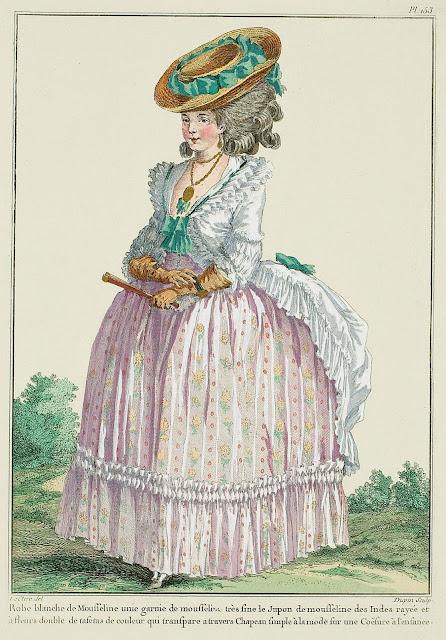
[The 34th book was apparently coiffures, and was not included in the reprint.] White gown of plain Muslin trimmed with very fine muslin; the Petticoat of striped and flowered Indian muslin lined with colored taffeta which can be seen through [the muslin].  Simple fashionable hat on a coiffure à l'enfance. (1780) "I saw hats in my youth which had very large brims; and when they were turned up, they resembled umbrellas; sometimes they were pulled up, sometimes the brims were reduced by using gances .  They were then given the form of a boat .  Today the round and bare form seems to be dominant; for the hat is a Proteus which takes all the shapes that one wants to give it. "Ask our women who, after so many attempts, have definitively adopted the English hat , despite their antipathy for England; I counsel them to keep them, to ornament them with pearls, diamonds, plumes, cords, ribbons, tassels, buttons, flowers; that the poets in their language should attach stars ...

Galerie des Modes, 33e Cahier, 6e Figure

Image
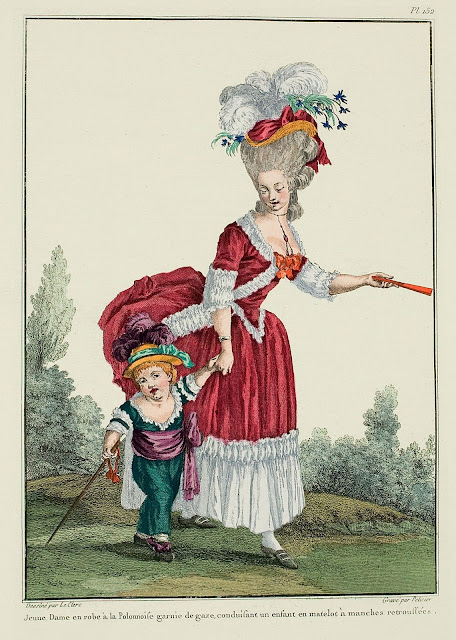
Young Lady in a robe à la Polonaise trimmed with gauze, escorting a child in a matelot with turned up sleeves. (1780) One knows that the industry of women's dress was divided between three principal groups: the staymaker , which we call corsetiers, which make equally court gowns, camisoles , children's jacquettes and fourreaux ; the marchandes de mode who sew and mount caps, trim gowns with ribbons, flounces, etc.; and finally the seamstresses .  The Dictionary of the Abbé Jaubert (1773) thus enumerates these different phases of the making of a gown; the seamstress first cuts the back, composed of two pieces , then the fronts, the petticoat, the sleeves, manchettes , and trims.  Then she assembles them, after having basted the lining, if approp riate, in sewing the fronts to the back, then the sleeves between the backs and fronts, then the manchettes to the sleeves, finally the trim.  Finally she assembles the pieces of the pettic oa t, she edges them on the ...

Galerie des Modes, 33e Cahier, 4e Figure

Image
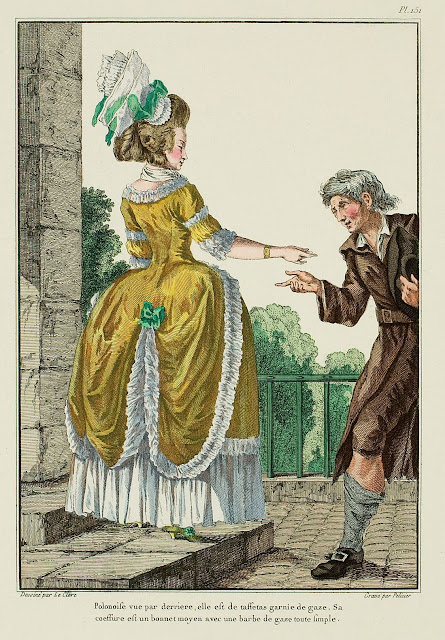
Polonaise seen from the back, it is of taffeta trimmed with gauze.  Her coiffure is a medium cap with a very simple gauze lappet. (1780) [Note: the text that goes with this plate, and most (if not all) of the rest in this volume, is not original to Galerie des Modes - it has been extracted from another source by the compiler of the full-color version reprinted after the fact.  Others have simply been written by the compiler.] Gown trims are an essential object to a n outfit, but what must without a doubt interest is changing them with ease, whether relatively to the design or becau se it is the part of the gown which suffers the most by usage.  The Demoiselle Saint-Quentin has conceived of making trims which may be basted on the gown: they are of gauze, of a new and agreeable design, and are sold by the ell; they can be over-all a very co nvenient thing for polonaises. - La Feuille sans titre [the Paper Without a Title], 16 June 1777. (100 follo...

Galerie des Modes, 33e Cahier, 3e Figure

Image
Young woman in a robe à la Polonaise with a fashionable large, white mantelet ; she is coiffed with a parasol hat, trimmed with folded blond lace around it, and surmounted by a bouquet of plumes. (1780) Walking tim e has arri ved.  It sufficed, to correct the abandon of the preceding toi lette, to t hrow one of these fashionable white mantelets, whose flared points fall almost to the bottom of the petticoat, over the shoulders , such that one seems as dressed as in an ordinary polonaise.*  This mantelet is simply decorated with a gauze trim. To complete the illusion of a full toilette, on a coiffure of two fashionable curls, one of which is falling very low on the neck, a light parasol [hat] is posed which is surmounted by a bouquet of plumes that surround a flood of bouillonné ribbons; those end in bows which fall behind at the point or edge of the hat, pulled up, uncovering the chignon.  A cord necklace holding a medallion and two tassels at the end, which bru...

Galerie des Modes, 33e Cahier, 2e Figure

Image
Young Miss studying music; she is dressed in a caraco juste à la Polonaise.  Her coiffure is a milkmaid cap. (1780) The first toilette of this young beauty is finished.  Pending the time of her usual morning walk, she goes to assure herself that her voice has lost nothing of its agreeableness and her fingers none of their suppleness.  She hopes also that the new air that she is undertaking to decipher will be soon interrupted by a certain awaited visit.  Also, she has particularly ensured the agreeableness of her négligé dress.  She has thrown over her shoulders one of these rounded caracos which fasten only at the middle of the waist; a wide gauze kerchief trimmed with the same, forming a too audaciously décolletée "gorgerette", always serves decency and coquetry. To this so simple toilette a coiffure without finish is added; a slightly raised coque , supported on the sides with a fashionable curl, very low, and surmounted by a medium cap with rounde...

Galerie des Modes, 31e Cahier, 1ere Figure

Image
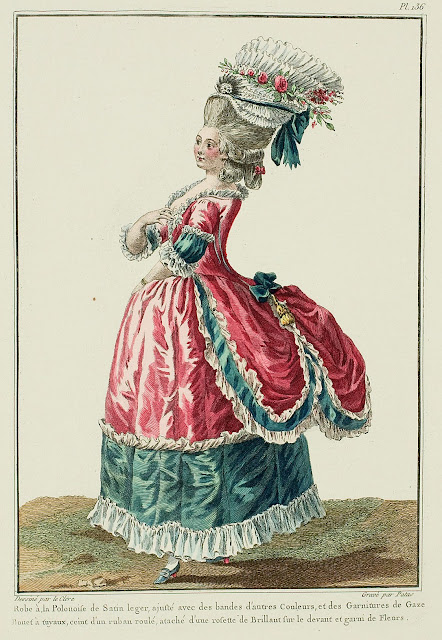
Polonaise of light Satin, trimmed with bands of other Colors, and Gauze Trims.  Cap à tuyaux, belted with a rolled ribbon, attached with a Brilliant rosette on the front and trimmed with Flowers. (1780) TRITON POLONAISE.*  The Author of historic Essays on Paris, said that in the sixteenth century, Men adopted the fashion of large stomachs, and Women of large bottoms.  This latter fashion is renewed in our days: not only have Women taken bouffantes under their Gowns to appear fatter, but they have applied, in the back, pads to give more roundness to the Gown, and to create the curved Mermen's tail. This fashion owes its return to the Polonaises, and other pulled-up Gowns.  It gives grace to the retroussis , to give it the form of agreeable draperies; and there is no better expedient than imagining a domed machine on which can be arranged, in the back, the fabrics of which the Gowns are made. It is thus that Fashions are reciprocally linked, and that one inv...

Galerie des Modes, 30e Cahier, 6e Figure

Image
Young Lady in a Polonaise of taffeta trimmed flat with bands of another color: she is coiffed with a handkerchief with pinked borders, fitted with taste and bordered with flowers. (1780) ROBE A LA CLEOPHILE.*   Thi s is a Polonaise, noteworthy for its manner of being pulled up with beads and tassels, in the method that the two seams of the waist fasten the places where it is pulled up. This manner of pulling up gives a very wide form to the drapery, and seems to lend it new graces: this is what the Elegant Women of the Capital did not fail to notice, and Cléophile cannot complain of having not been feted. * At first I thought this was in reference to Danaus cleophile , the Jamaican monarch butterfly, but it seems that it was only identified in 1819.  However, then I found a list of ballet dancers in The Lady's Magazine (1775) which includes a woman named Cleophile.

Galerie des Modes, 30e Cahier, 3e Figure

Image
Young woman dressed in a caraco à la Polonaise of vermicelli linen, edged with a narrow band; the petticoat edged with a wide band of fabric with a white ground with garlands of flowers. (1780) CAMISOLE A LA POLONAISE , MITIGATED.  Amadis sleeves cut en botte , without parements .  Border in a band: matching petticoat, with soubassement , forming a framed volant , like the Camisole of vermicelli linen, following the current taste. Angora cat: these Cats have become very fashionable, and have multiplied with a surprising rapidity.  Their appearance in France has almost entirely made caniche or long-silk dogs fall out of fashion; but the mobility of fashions, the difficulty of taking cats places, will soon bring back the reign of the little dogs to carry under the arm.

Galerie des Modes, 29e Cahier, 4e Figure

Image
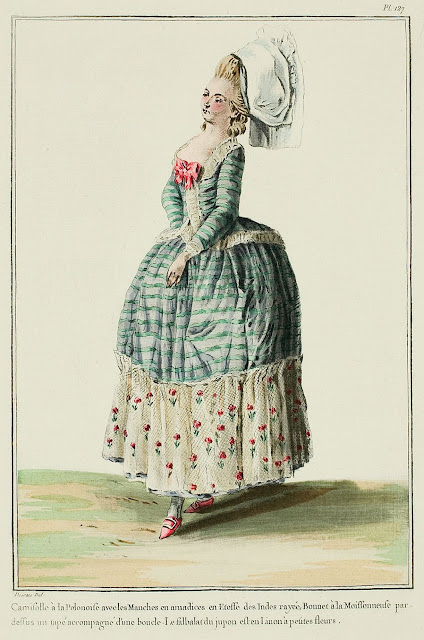
Camisole à la Polonaise with amadis sleeves, in striped Indian stuff.  Reaper's cap over a tapé accompanied by a curl.  The flounce of the petticoat is in Linen with little flowers. (1780) Camisole, or bedgown à la Polonaise, serving as deshabillé.  See on this subject what will be said later, in describing the sixth Figure of the thirtieth Book.  We will only observe here, the long and pointed slippers, which, in these recent times, are retaken in favor. This fashion had the greatest vogue at the beginning of the eighteenth century.  The shoes lengthen, to the point that they form a type of beak at the end of the foot.  These points took even insensibly to consistency, to the favor of the inner soles or linings that were made to support them, but they were a little blunt; which produced, around 1730, duck-bill shoes. To this fashion succeeded that of round shoes, cambered underneath, and very narrow above, the end also raised underneath.  T...

Galerie des Modes, 28e Cahier, 3e Figure

Image
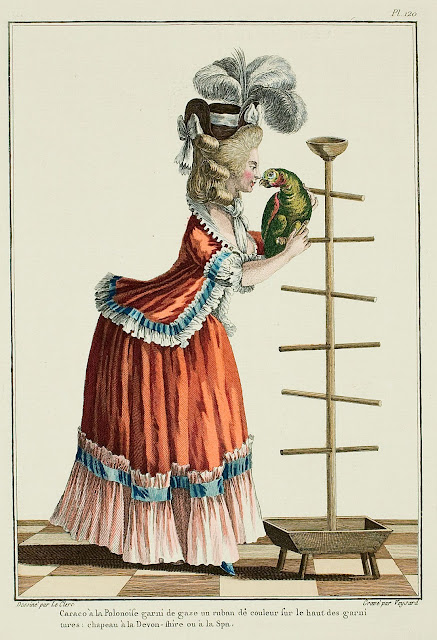
Caraco à la Polonaise trimmed with gauze, a colored ribbon on the top of the trim: Devonshire or Spa hat. (1780) CARACO A LA POLONAISE , the body loose and floating at the waist.  Tour-de-gorge of a reversed Medicis , or raised collar; gauze kerchief, tied en cravate .  Spa hat, seen in profile.  Another view of this Coiffure can be found in the twenty-seventh Book, sixth Print.

Galerie des Modes, 27e Cahier, 4e Figure

Image
Young Lady holding her infant in her arms; she is dressed in a caraco à la Polonaise with bands and piping in another color: the bands are edged with a little blonde lace.  She is coiffed with a pretty straw hat edged with ribbon, with a trimming of gauze in the shape of a mushroom, and a twisted ribbon. (1779) CARACO A LA POLONAISE , trimmed in bands, and crossing in front, with sleeves en parement in Peasant style.  The petticoat is cut by a half-apron, equipped with pockets and trimmed with gauze around the perimeter. This young mother, wh o is walking her infant, has pierced ears furnished with little rings, called "night rings".  Hair en chien couchant , hanging chignon , with falling curls on top.

Galerie des Modes, 27e Cahier, 2e Figure

Image
Changeable taffeta gown, trimmed with white taffeta with a chiné print in diverse colors, and decorated with blonde lace on the edges of the trimming; the hat is belted with a roulé ribbon. (1779) Robe with chiné trimming.  This Gown in a Polonaise, leaving the throat uncovered.  It fastens in front, over a compere forming the stomacher.  The trimming is bordered with a band of scalloped gauze . The Musician re presented in the Print is sitting on an armchair in the new fashion, that is to say, which has molding made of cardboard .   These armchair s, as solid as those of woo d, have as much éclat and more lightness.  But it is to presume that, despite this circumstance, o ne will go back to the former armchairs again, those of cardboard only remaining for ornament and decoration.

Galerie des Modes, 23e Cahier, 2e Figure

Image
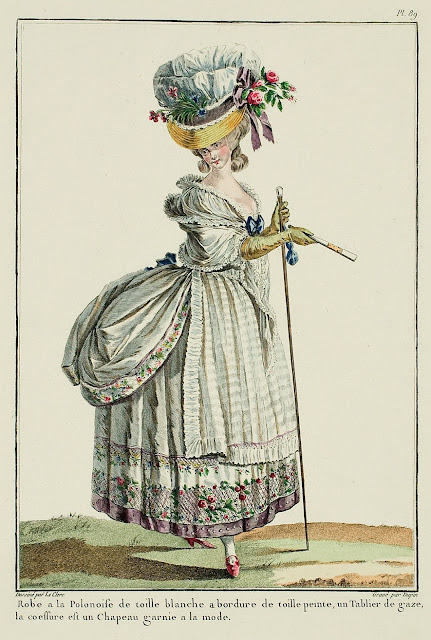
Robe à la Polonaise of white linen with a border of painted linen, a gauze Apron ; the coiffure is a Hat trimmed fashionably. (1779) ROBE A LA POLONAISE , of white linen, with borders or a frame.  This Gowns have seemed so comfortable, especially in the country, that Women were eager to give them the most favorable reception.  It is true that these Gown give service only momentarily: soon it is necessary to restore them to their first whiteness.  But it seems that nothing can resist the desire to satisfy the fair sex; the Calenderers have found the means of rendering these Gowns to their original luster, without being obligated to take them apart, nor remove their trim, and this discovery must certainly make an epoch in the History of Fashion.

Galerie des Modes, 21e Cahier, 5e Figure

Image
Taffeta polonaise trimmed with indienne borders, spotted gauze ther è se over a round cap belted with a head-band knotted negligently. (1779) GRAND NÉGLIGÉ .   The caption should be thus written : Pretty Polonaise Gown, of plain taffeta, trimmed with painted taffeta, covered with a black Mantelet with flared points.   Filet bouffante , knotted en cravat .   Gauze thérese , veiling a round cap, covered and belted with a boiteux ribbon, which is to say, half of one color, half of another, and serving as a head-band: a fashionable curl falling on two sides.

Galerie des Modes, 21e Cahier, 4e Figure

Image
Young Lady coiffed with an English hat called a chapeau à la Turque, trimmed with flowers and gauze; she is dressed in a Polonaise of gauze striped with silver on a ground of pink taffeta, as is the petticoat. (1779) POLONAISE WITH TW O MODES , thus called, because in detaching the cords that hold it up in the back, it hangs to the ground and procures the double pleasure of the short Gown and the trained Gown.   Sleeves with sabot cuffs, decorated with a ribbon bow; little désespoir ,* serving as the first necklace; second pearl necklace, accompanying the around-the-throat and holding in two libertins ,** also of pearls, frolicking on the body of this Beauty. * "despair", evidently a term for a bow tied around the neck   ** Literally "libertines", probably a sort of metaphorical term as a libertine is literally "free" (Lat. liber , free ) and the libertin here is a strand of pear ls attached to the front of the gown at one end and free on ...

Galerie des Modes, 19e Cahier, 5e et 6e Figures

Image
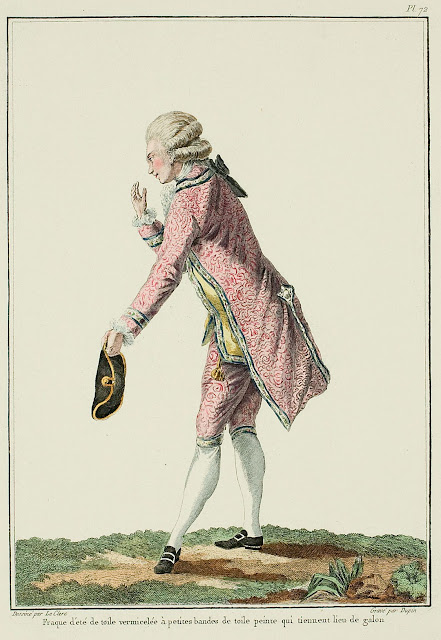
Summer frock coat of vermicelli-patterned linen with little bands of painted linen that take the place of braid. (1779) Polonaise of blue and white vermicelli-patterned linen, trimmed flat in bands of linen, painted in all colors on a white ground. (1779) VERMICELLI GOWN AND SUIT.  Place these two Prints so they are looking at one another: they will offer you a little Master who addresses his Mistress, and gives her the salute of love.  Both have clothes of vermicelli-patterned Indienne , which is to say, representing the twists of woodworm tracks.  It has been borrowed from Architecture, where the vermicule ornaments are in use.  These indiennes have been extremely fashionable, and both sexes have adopted them. The Elegant Man that the Print presents is dressed in a Frock coat with a collar called à la Saxe , with a Perse border forming a frame.  The tabs of the basques are made with vazisdas .*  Vest of white linen, with a border matchin...