Posts

Showing posts with the label fabric

Choosing Fabric: Regency Edition
Image
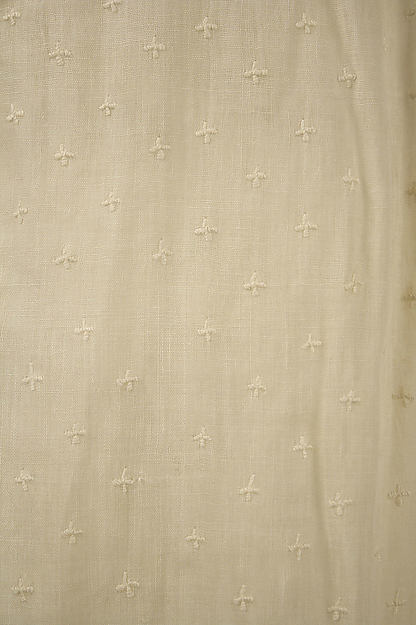
As a member of several historical-reenactment Facebook groups, I see a lot of people post a photo of cloth they've bought or are thinking of buying with a question about its suitability for a certain era. And so I thought I would write up a guide to give seamstresses more confidence in choosing a fabric, and perhaps help prevent people from buying something too modern and only discovering it once they get home. Note: you can of course use anything you want. You can make a spencer and petticoat out of a Hello Kitty print, if you like, and actually that would be pretty fun. Please see this guide as a helpful aid for those aiming at accuracy, rather than a prescription. White Cotton Let's start with the easiest category: white cotton.  The simplest way to make sure that your fabric is accurate is to pick a white cotton at either end of the spectrum - very light and smooth, or completely solid and with some body. With the lighter, sheerer cottons, you can also use a woven c...
A Little Advice?

Image
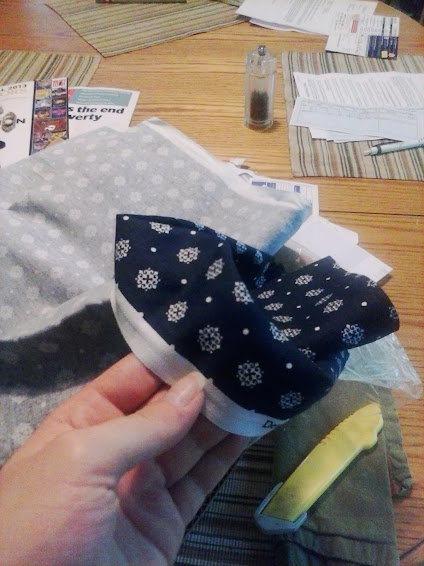
Today I got the Joann's package I've been waiting for - fabric for a 1920s dress.  On the plus side: nothing ended up being a huge mistake, too heavy or too light, a bad color or weird texture.  Here's the indigo blue twill cotton with a nice little geometric print that I intended for the dress: And here's the soft rayon with an identical print (which I didn't actually realize was exactly the same - also, I thought it was paler) that was intended for an envelope chemise: The problem: I like them both for dress fabric.  Obviously I'd have to check to make sure there's enough fabric in the rayon, but with the heat right now I'm leaning toward lightness.  At the same time, the weight of the twill means it will work better without a lining and, perhaps, hang better on my body. Or .  If you remember my previous post on the subject - what if I were to use the twill for most of the dress, with the rayon (lined or backed, maybe just doub...

The Place of Fabrics: Miscellaneous!

Image
I was able to find a great many different terms for different types of fabric, far too many to create a post for each one - especially as many only come up in legal/accounting contexts, rather than descriptive ones.  So I decided to make a post for all of the fabrics that I mainly found in accounting contexts, as these references do give information on how much they're comparatively worth

The Place of Fabrics: Silk

Image
Everyone is aware that silk is a fine fabric.  However, I believe that it was worn by a slightly broader section of society than it is generally represented as.  Lady's maids received cast-off clothes from their mistresses, and even other servants and the lower middle classes could afford second-hand silk clothing.  Women could be scorned for dressing above their station if their silk clothes were deemed too fine, however. Some types of silk I have come across in advertisements: Taffeta/taffety, lustring/lute-string, alamode ("a sort of silk or taffety"), bridges, Granado, Naples, organzine, pole, satin, sarcenet, syper, Bengal. (NB: I've also gone through and reformatted the other fabrics posts, so that they (mostly) link to the quoted page, and the quote is a picture of the page rather than a retyped version.)

The Place of Fabrics: Cotton

Image
For the most part, descriptions of cotton clothing before the 1720s are in the context of travels to Asia and Africa.  I was a little surprised to find that cotton was relatively common as a fine fabric from the 1720s, and something that poorer women could purchase second-hand.  It became an affordable kerchief fabric by the 1740s, and the practice of wearing a light muslin gown over a colored silk petticoat can be documented by the late 1750s.

The Place of Fabrics: Callimanco

Image
According to the OED , callimanco (also spelled callimanca, calamanco, &c.) is "a woollen stuff of Flanders, glossy on the surface, and woven with a satin twill and chequered in the warp, so that the checks are seen on one side only; much used in the 18th c."  It was finer than stuff, but still respectably simple: a fabric that a woman of the lower middle class could wear without exciting comment that she was living above her means.  Generally, callimanco seems to fall off in use later on in the century, but it seems to have often been used in shoes.

The Place of Fabrics: Stuff

Image
I was intending to make a post on wool, but the term "wool gown" does not turn up any results on Google Books.  "Stuff gown," however, is a very common phrase.  Meg Andrews defines "stuff" as "a general term for worsted cloths. Twill or plain weave and made of common wool."  A New General English Dictionary (Thomas Dyche, 1768) defines it as "any sort of commodity made of woollen thread, &c. but in a particular manner those thin, light ones that women make or line their gowns of or with ..." Stuff was a cheaper fabric than linen; while linen was the fabric that a tenant farmer's daughter would wear, her servant would wear stuff.  Poor women and farm workers are described as wearing it, and it is strongly associated with clothing given as charity.  While linen could also connote a respectable simplicity, stuff could not.

The Place of Fabrics: Linen

Image
This is perhaps not the most necessary post/series, but I began looking at historical mentions of various types of gowns for my thesis and found so many sources.  I thought people might be interested in seeing the many quotes I turned up that relate to various gown fabrics. Linen gowns were close to the bottom of the scale, worn by poorer women in the country, under-servants, and wealthier women in the morning, before anyone came to call.  However, linen that had been printed with a pattern was considered much finer (though not as fine as silk).  While linen could be read as evidence of being poor and slovenly, it could also be used as an antifashion statement, showing a deliberate lack of attention to fashion and frivolity and indicating a deepness of character.  This is especially true later in the century, when a simple country look became fashionable.

Stays and Swatches

Image
Today I got some swatches I ordered from Mood Fabrics, and I thought I'd show them off and give my impressions based on them.  Plus some WIP pictures of my stays.