Posts

Showing posts with the label mourning

AMBA: The Recent History of Mourning
Image
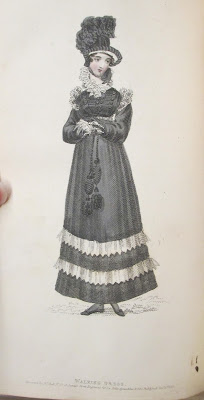
This episode took me forever to write. I was originally going to start with a blog post I wrote a few years ago, relying on primary sources on mourning from the 18th, 19th, and early 20th centuries. Then, as I started to go through it, I started to reinterpret a number of the primary sources, and then I came across Lou Taylor’s book, Mourning Dress: a Costume and Social History , and I realized that I needed to fully read it and regroup. So. (This is the transcription of the episode, for those who prefer reading to listening, or want to go back and double-check something they heard.) Walking dress and evening dress in the general mourning for Princess Charlotte, La Belle AssemblĂ©e,  Nov. 1817 Funerals and mourning goods seem to have become status symbols in Europe in the late Middle Ages, when royalty and the upper aristocracy began to indulge in long funeral processions with large numbers of mourners and horses in black draperies. Male mourners would wear loose gown...

On Mourning

Image
(I decided to write this post because I'm planning to branch out into historical social topics more frequently - but it lines up very well with an event this week! I will be attending  Death Becomes You  at the Metropolitan Museum of Art on Halloween, in a post-Edwardian black wool dress with white collar and cuffs. Hope to see you there! Next week, I'll be posting some information about the dress, plus gloating about how happy I am with my dyed Renoir boots.) The subject of mourning is a very popular one when it comes to the mythology of the Victorian period. Traditional rules of mourning, however, go back further than Prince Albert's death, Victoria's reign, or even the nineteenth century. The concept of mourning in specific clothing is very, very old, but to focus specifically on Western European codes involving specific styles of dress, stages of intensity, and periods of time, a mourning code including concepts of first and second mourning extends at least as...

Cabinet des Modes, 20e Cahier, 2e Figure

Image
September 1, 1786 PLATE II. LIKE the Lady drawn in the Ist PLATE , we have thought to represent in this a man in half-mourning. We would have given one in full mourning in the eighteenth Issue ; but we would not be able to say to have given a fashionable man. Here is how a very-great number of young people wore half-mourning. Black stockings and breeches; gilet of taffeta with wide white and black stripes; grey coat with collar of black velvet; black lining with piping; and striped, bronzed steel buttons. Manchettes  of entoilage  with effilĂ© ; oval shoe buckles, and long oval garter buckles. On the head a hat Ă  l'Androsmane  (1); a wide grecque , four curls, and a braid Ă  la Panurge  in the back, with a black ribbon at the top of the braid; a black cord for the watch on one side, and a colored cord or a chain on the other: hands in the pockets, our arms swinging . We have said in the sixteenth Issue  that men wore all black below; we should observ...

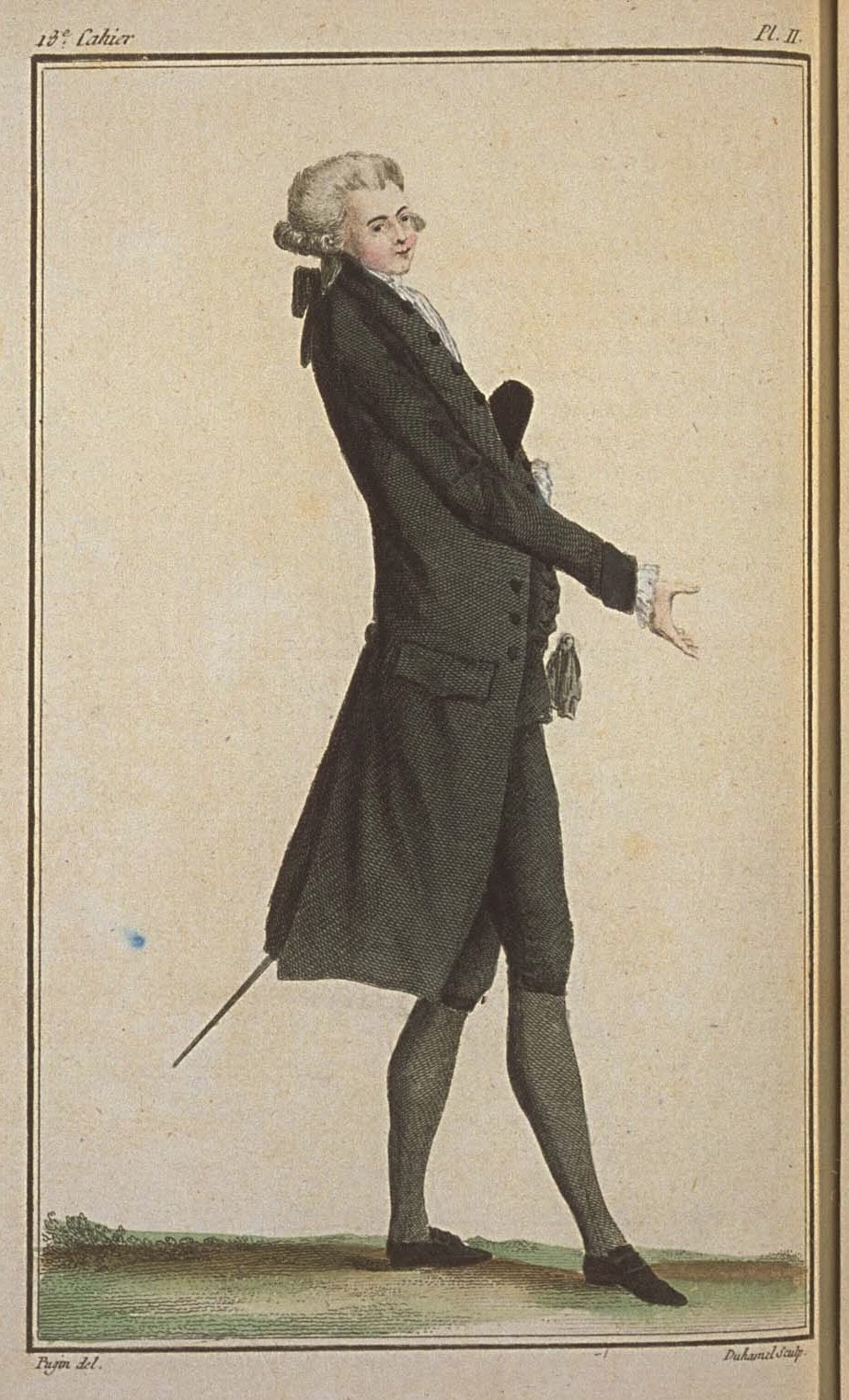
Cabinet des Modes, 18e Cahier, 2e Figure

Image
August 1, 1786 A Man in great mourning, in a wool coat, without buttons on the parements  and on the pockets. One wore, in summer, great mourning in voile, without buttons on the parements  and pockets. The front of the coat of our drawn Man has only six buttons, one on top, two in the middle, and three at the bottom. He wears a black sword, trimmed with a black crĂŞpe. His shoe buckles and carters are of bronzed steel. His shoes are of beaver: they can be worn of goat skin, lustered with glossy wax. His neck is trimmed with a wide cravat, whose two ends come to fall on the front, and cover the jabot  of his shirt. The manchettes  and jabot are of batiste, with flat hems. He wears under his arm a large hat, whose crown is trimmed with a black crĂŞpe. His hair, in the back, is enclosed in a large purse. His grecque  and his curls are hardly powdered.