Posts

Showing posts with the label recipe

Godey's Lady's Book, December 1835

December 1835 RECEIPTS. WINE MARROW PUDDING. Boil half a pound of the finest and freshest marrow in a pint of new milk, with a bit of lemon peel, cinnamon, and half a leaf of laurel. Pour it over the sliced crumb of a three penny loaf, or the same quantity of French bread; and, covering it up, let it stand till quite cold. Beat up well, in the mean time, six yolks with three whites of eggs, a quarter of a pound of powdered loaf sugar, two ounces of blanched and pounded almonds, and a little orange-flower water; add this mixture to the cold marrow and milk, and bake it in a dish with puff paste around it. Washed and picked currants, with syrup of cloves or nutmegs, a little brandy, and some slices of candied citron and orange peel, with any other sweetmeats, may be added, if required to be very rich. The marrow, too, instead of being boiled with the milk, may be minced very small, and strewed over the French bread; or rather on Naples biscuits. Marrow puddings made in either ...
Godey's Lady's Book, November 1835

November 1835 RECEIPTS. BROWN AND WHITE VERMICELLI SOUPS. Boil two ounces of vermicelli in three quarts of beef or veal stock, for about twenty minutes; skimming it, and seasoning to palate: this will be sufficient for preparing the common brown vermicelli soup. White vermicelli soup, however, should be made in the following manner: -- Blanch two ounces of vermicelli, in the usual way, by putting it over the fire in cold water; and, on its boiling up, strain it off, and throw it into fresh cold water; for, were it to continue draining in the sieve while hot, it would become lumpy, and not again dissolve. After straining it, when quite cold, dry from the water, boil it in three quarts of veal stock, or broth, for a quarter of an hour; rub it through a tammy; season it to palate; and make a leason of four eggs, and half a pint of boiled cream gradually added, with or without a table-spoon of béchamel. Put the leason to the soup, off the fire, stirring it all the time: then set...

Godey's Lady's Book, September 1835

September 1835 RECEIPTS. EAU DE BOUQUET. Take of sweet scented honey water 1 oz., eau sans pareille,* 1 1-2 do., essence de jasmin, 5 drachms, syrup of cloves and spirit of violets, each, 4 dr., calamus aromaticus,* long rooted cyperus,* lavender, each, 2 do., essence of neroli,* 1 scruple.* Mix. Some add a few grains of musk and ambergris: it is sweet scented, and also made into a ratafia with sugar. * Eau sans pareille , "unequalled water," is another perfume, made with citrus fruits; you can see some recipes here . Calamus aromaticus is Acorus calamus , or sweet flag, and Asian plant historically used in medicine and perfumes. Cyperus  is a genus containing hundreds of species of plants; I don't know which is meant here. Neroli is bitter orange. A scruple is 1/24 of an ounce. ESSENCE DE JASMIN. The flowers are stratified with wool or cotton, impregnated with oil of behu, or nut oil, in an earthen vessel, closely covered, and kept for some time in a wa...

Godey's Lady's Book, August 1835

August 1835 THE TOILET. - No. 11 FOR CHAPPED HANDS. Take three drachms of bole ammoniac* - three drachms of myrrh, and a drachm of white lead - incorporate these with a sufficient quantity of goose-grease; and with this anoint the parts affected; and wear worsted gloves. * A drachm is a unit of weight, during this period referring to either 1/16 or 1/8 of an ounce. Bole ammoniac is Armenian bole, an iron-rich clay from Armenia ANOTHER. Take myrrh, one ounce; litharge,* one drachm; honey, four ounces; wax, yellow, two ounces; oil of roses, six ounces. Mix the whole in one well-blended mass for use. OBS. -- When the hands are chapped, avoid putting them in water. * lead oxide FOR CHAPPED LIPS. Take two tea-spoonfuls of clarified honey, and a few drops of distilled lavender water, or any other agreeable scent. Mix them together, and anoint the lips frequently. If the hands are affected, anoint them all over at going to bed, wearing gloves during the night. Wash ...

Godey's Lady's Book, June 1835

Image
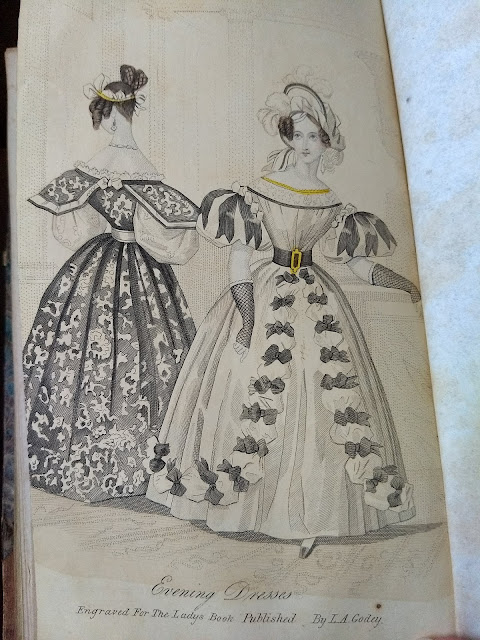
June 1835 DESCRIPTION OF THE FASHIONS. FIRST DRESS. The robe is composed of satin Memphis , a black ground figured in white in an Egyptian pattern. The ground is a plain silk of the richest ground, the pattern satin. The corsage  is cut low, tight to the shape, and trimmed with a standing tucker of tulle illusion . Sleeves à la folle ,* of tulle illusion , surmounted by mancherons  of the material of the dress, bordered with satin riband, a white ground lightly figured, an edged with black. The ceinture to correspond, is tied in short bows and long floating ends. The hair is parted on the forehead, disposed in luxuriant curls at the sides, and arranged in perpendicular bows formed of plaited braids behind. It is ornamented in a light and novel style, with a half-wreath formed of puffs of rich white gauze riband, which goes round the back of the head, and terminates in knots over each temple. * à la folle  - literally "madwoman-style", from the same origin c...

Godey's Lady's Book, May 1835

May 1835 RECEIPTS. MARMALADE Differs from jelly, in being the pulp  of fruit combined with sugar rather  in excess as to quantity. PLUM MARMALADE Is made by boiling the Plums for a short time, draining them, pouring them through a sieve (of hair;) again boiling, so as to reduce the pulp considerably, and adding it (the pulp) to the clarified loaf sugar, boiling at near the crack : when you obtain a good stiff consistence on your dipper, the compound is finished. Mind to stir the mass well while on the fire . Put it in pots. CHERRY MARMALADE Always take out the stones  and stalks  of fruits for Marmalade. Use 1¾ lbs. of sugar to 1 lb. of the fruit. GREEN APRICOT MARMALADE Is made by boiling the fruit till, the down becoming loose, you can rub it off with a cloth. Mash them; dry the pulp a little; and just before your boiling sugar (as above) comes to the little ball , add the pulp; stir,  and boil the whole well together. -- Pot it...

Godey's Lady's Book, March 1835

March 1835 RECEIPTS. ICES. The Spaniards are famous for their ices; and, perhaps, this is not extraordinary, considering that their climate renders the use of them so indispensable. In this country, we are hardly permitted to form an opinion as to the exquisite relief they afford to a system, of which the energies have been in a state of retrogradation for twelve or fifteen hours. AGRAS -- that is, the Green-Grape iced  -- is the favourite. The Vessel. Mix salt and ice well together in a vessel, and place your freezing pot  in the midst: put into the last your juice, or cream, &c. and stir it about well : put on the cover of the vessel, and keep the ice-pot moving quickly round, by means of transverse handles; taking off the cover continually to stir up the contents of the freezing pot . Serve it up; or if not immediately wanted, put ice on the cover of the freezing pot. Creams for Icing. Add thirteen yolks of eggs to one and three-fourths pint of crea...

Godey's Lady's Book, February 1835

February 1835 RECEIPTS. FRUITS IMITATING NATURE. Are made by means of wooden shells ; (the color of the stone and containing an almond,) overlapped with an imitation of the Fruit  itself, made by means of leaden moulds into which sugar boiled sufficiently has been poured. When taken from the mould, the sugar is varnished with isinglass; and this last is strewn over with dry colour, to represent the peculiar bloom  of the fruit. I should have stated that the isinglass is tinted with liquid colour to represent that of the fruit while it (the isinglass) is dissolving. CHESTNUTS IN CLARIFIED SUGAR. Are a favorite little dish. The sugar (2 lbs.) is boiled, and ten yolks of eggs being beaten up with a small quantity of some choice liqueur, these last are added, and the whole is manipulated into a paste, which with powdered sugar, is formed into the appearance of chestnuts; colour them a little where necessary. FOR SCOURING GRAYS, DRAB COLOURS, FAWNS, MAROONS, AND...