Posts

Showing posts with the label 1910s

Mimic of Modes Historic Patterns

Image
At last, Julie and I have basically wrapped up all of the rewards for that Kickstarter campaign we ran some time ago! But whatever the roadblocks, all of the sewn rewards have been distributed, all of the digital patterns have been sent out, and I have passed on all of the ones meant to be printed to Julie and contacted anyone who filled out the survey as needing help. Many, many, many thanks to everyone who supported us. Going forward, however, I will not be with Dragonrose Historic Patterns, but will instead be running Mimic of Modes Historic Patterns . This really doesn't make much of a difference to you - I can still fulfill the "future pattern" rewards, and the overarching ethos of my patterns will still be the same: they'll be based on actual garments from museum or personal collections, some that are representative of the "average" and some that are interesting variations. I do plan to have standard sizes available as well as the custom sizi...

Book Review: The Long Weekend, by Adrian Tinniswood

Image
I picked out The Long Weekend: Life in the English Country House, 1918-1939  from NetGalley to review here as the country house has such a prominent place in classic and historical fiction - think of how many mysteries wouldn't exist without characters being cooped up together for a country weekend! The book is exhaustive - Tinniswood goes through all the aspects of the country house itself, from architecture to interior decoration to sale to (royal, aristocratic, and common) owners, with detailed descriptions of how these went down at various specific estates. The social aspects, unfortunately, don't seem to get as much time as the others (or perhaps the architecture and interior design chapters simply seemed very, very long?). Country house parties are dealt with at the very beginning, and then at the end there's discussion of gay country house owners, hunting and fishing, the servants, politics, and the collapse of this culture during WWII. Ultimately, I'm not...

Ardis's Graduation Dress (Historical Sew Monthly #8, Heirlooms & Heritage)

Image
Originally, I was going to write about lingerie dresses in general, as they make up a large portion of heirlooms everywhere, and especially of my small collection of antique clothing. But then I remembered - I can do better! A long time ago, I posted some photos of ancestors of mine, including one of the following portraits: This is my great-grandmother, Ardis Burdick Allen Luce, in 1919 - although at the time, she was just Ardis Burdick. Like pretty much all young women in the late 19th and early 20th century, when she graduated high school, she wore a white cotton commencement dress. It's not exactly cutting edge, but it is  fashionable for the time - raised waistlines could be found even in the Gazette du Bon Ton through 1921 - and it was probably made for the occasion, perhaps by someone in her family. (Her maternal grandmother worked in the clothing industry for most of her life, as a dressmaker and then as a saleslady/merchant.) Ardis kept this dress and passed it...

Waistcoats: 19th and 20th Century

Image
Apart from certain stylistic keys, I've always had a harder time dating men's clothing. It's just not as interesting to me, so I haven't taken the time to really study dated extant pieces and images and improve my skills. But lately I've come across more undated waistcoats while cataloguing - it's become something that I need to work on. And how better than by putting together a blog post? Wedding waistcoat, 1808; MMA 2009.300.7449  [OASC] At the beginning of the century, fashionable waistcoats were cut straight across at the bottom to match fashionable coats, although the vests often protruded slightly below the waistline of the coat. High collars, also matching the coats, would cover the sides of the shirt collar that extended up to the jawline. Both coats and vests could be single- or double-breasted, generally with self-covered buttons. While coat lapels were generally wide, waistcoat lapels were somewhat narrower. Toward the end of the first decade ...

A Delphos Dress

Image
"Delphos" dress, Mariano Fortuny, 1910-1930; CHM 1997.68.1 (pattern available at link) Mariano Fortuny y Madrazo (1871-1949) is best remembered for two things: vibrantly patterned silks and velvets, and the Delphos gown, inspired by ancient Greek chitons (themselves imported from Asia Minor), which were made from a single rectangular panel of linen or silk sewn into a tube, the top edge fastened with brooches down the length of the arms, and belted to fit to the body. The Neoclassical revival had already begun in the decorative arts by 1907, when Fortuny developed the Delphos, and high fashion was beginning to show its influence as well - but this was much more extreme than anything else in existence at the time. Not only was it originally intended to be worn without a corset at home (corsetless teagowns had been worn for some time already), there was absolutely nothing about its design that hid that fact. The straight, clinging line would soon become mainstream fashion,...

Post-Edwardian Mourning, plus Renoirs

Image
I hadn't even heard  of Death Becomes Her or You (the former is the exhibition, the latter the event) until I was emailed an invitation to come in period clothing. Since Julie moved far away there haven't really been any events close enough for me to go, and I was so excited! But I have nothing suitable for mourning in the period covered by Death Becomes Her - technically, my white cotton 1780 gown, if worn with a white petticoat, would count as second mourning in its period, though - so I had to take action quickly: I had to make the best use of my time as I'm a slow sewer. It was hard to decide. My choices were: Regency, as I've taken a lot of patterns for my book and have so many options 1840s, as it's kind of my era of choice when you take convenience out of the conversation 1910s, my old love, plus I have a 1911 corset and do not need any extra underpinnings In the end, I went with the early 1910s. My sewing speed was really an issue, especially as I...

Georges Doeuillet (1865-1930?)

Image
Georges Doeuillet may be the least-known couturier I've written about so far - or perhaps second, after Jenny, since his real name is generally available. The only time his name comes up is in conjunction with Doucet, when the two houses merged at the end of the 1920s. But in fact (let this not be a total shock), he was a more interesting and important figure than his present obscurity would make him appear. Born in 1865, Doeuillet was part of the same generation as Louise Chéruit, Charles Poynter Redfern, and Jacques Doucet. (That is, the second generation - the first generation being born in the early part of the century, like Charles Frederick Worth, John Redfern, and Edouard Doucet.) However, his start came a little later in life. Some   sources state that he first worked as a business manager for Callot Soeurs, which opened in 1895. It seems likely that he began working there from the beginning, so one has to wonder - what did he do until then? At thirty, he would not have ...

The House of Doucet (1816-1928)

Image
Just as John Redfern began as a mercer, the Doucet family's business began in fabric and lace. In 1841, La Mode  described the Doucets (then at 17 rue de la Paix ) has having a "numerous and noble clientele", highly stylish in late spring for "trousseaus and corbeilles " - the  corbeille  being the gift of material wealth given to a woman by her husband the morning after the wedding, a continuance of the medieval Morgengabe  - and was frequently recommended for fine  lace for ruffles, berthas, and skirt flounces. Toilettes from Petit Courrier des Dames , including chemisette and lace from Doucet, 1840; NYPL 802380 The business was split by 1862 into two parts, both housed at 21 rue de la Paix : Mme Doucet was a lingère , selling women's chemises, drawers, caps, and other linen and cotton articles, while her son Edouard was listed as a tailleur-chemisier , selling men's underwear and outerwear, and marked a "notable business". (Quite a fe...

Redfern Ltd. (ca. 1855-1940)

Image
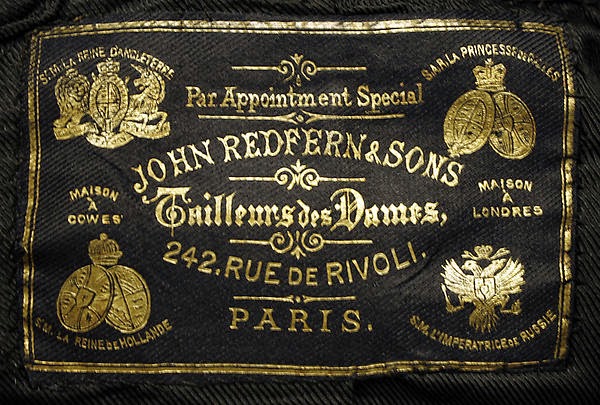
Redfern is relatively well known as an early couture and tailoring house, but the specific people involved, or their talents beyond women's suits and riding attire, are often overlooked when discussing the progress of fashion - which is usually distilled down into a few vibrant personalities and their innovations. Redfern's early years overlapped with Charles Frederick Worth, who steals the spotlight from all contemporaries. Label from walking dress, 1885-1888; MMA 49.3.32d (OASC) John Redfern (1820-1895) opened a draper's establishment in the city of Cowes on the Isle of Wight in the mid-1850s, where he was joined by his sons. In the early 1870s, his shop expanded to sell silk as well as wool, and also clothes for mourning; a little later it seems to have added yachting dress, as Cowes was historically a center for boating and regattas. The early obscurity of the business means that many sources give slightly contradictory information, but it's connected to Lil...