Posts

Showing posts with the label mythbusters

"There are so few pieces left, how can we really know?"

Image
There's an attitude that I've come across more than a couple of times in discussions centered on whether or not a certain costume in a certain film is accurate, or when someone asks about improving their own kit. It's not quite inevitable, but a good amount of the time someone else will come in and say, "Nobody really knows what they were wearing, because none of us were there." Or, "We have hardly any extant clothing, compared to the amount that existed at the time, so you don't actually know what's right and wrong." This is wrong on a few levels. 1) There are a lot more extant garments than you think. At the Metropolitan Museum of Art, when I search for 1600-1800 in the Costume Institute, there are 1,346 records. And that's just what's been photographed. The Victoria & Albert Museum, the Kyoto Costume Institute, the Los Angeles County Museum of Art, the Museu do Traje in Lisbon, the Museo del Traje in Madrid - these are all imme...

War & Peace; or, What Happened During the Napoleonic Wars? (HSM #4)

Image
The idea that English and French dress diverged because communications were disturbed due to the conflict between the two countries is very common . In actual fact , the fashion of this period did see lines drawn along national lines, but not out of necessity. Let's start at the beginning. Was there a distinct difference between English and French fashions during the period of the Napoleonic Wars (1803-1815)? A qualified yes. That there was a difference in women's styles is fairly apparent with a close look, whether it's through fashion plates: the French Journal des Dames et des Modes , 1807; the English La Belle Assemblée , 1807 or portraiture: " Félicité-Louise-Julie-Constance de Durfort ", 1808;  " Princess Amelia ", ca. 1807 or extant garments. Evening dress , French, ca. 1805; wedding dress , English, ca. 1807 French (and American) fashion left the purely Neoclassical influence behind in the first few years of the new century...

Fashion History Mythbusters: The Cage Crinoline or Hoop Skirt

Image
As Julia Thomas points out in Pictorial Victorians , the satirical cartoons and anecdotes in Punch  heavily colored contemporary (and modern) impressions of the fashions of the 1850s and 1860s. As a result, the wide skirts seem like fantastical costumes that played havoc with ordinary life and were impossible to move around in. And so the myths have proliferated. “Cool Request,” Punch, or the London Charivari , Volume 32, January 31, 1857, p. 50. - compare to the actual 1857 fashion plate below The first myth to address is the name of the garment. My impression is that most people use the term "cage crinoline"- "hoop skirt" sounds farby: it gives the impression of a cheap and flimsy petticoat worn by someone who doesn't know any better. eBay and Etsy sellers using elastic and plastic sell hoop skirts, but those who use metal and fitted waistbands (and the more established companies with their own websites) sell cage crinolines. Even when used without a neg...

Fact and Fiction: Corsetry and Feminism, Part Two

Image
Suffrage vs. Dress Reform Given that the members of the women's rights movement lived at a time when there was no scientific evidence against the intensely negative health claims, it is no wonder that they might regard the corset as a death-trap. However, early feminist opposition to the corset is vastly overstated today. To illustrate, see the fashionable photograph of Susan B. Anthony at the end of the 19th century: Susan B. Anthony, ca. 1895 Based on the smoothness of her bodice and the curve of her waist, we can say that she was clearly wearing a corset even late in her successful career. ( Other photographs of Anthony show corsetry as well, as do photographs of other proto-feminists .) The  Dress Reform  movement associated with the women's rights movement began in the 1850s, promoting the "freedom suit" or "Bloomer costume" consisting of a loose dress over full trousers, worn without a corset.  The suit  attracted ridicule from the public i...

A Difficult History: Corsetry and Feminism, Part One

Image
Recently, I began following a couple of Tumblr blogs focusing on waist training and daily corset wear. Daily wear is not for me, waist training even less so, but I find it an interesting practice. It is also a controversial one. For example, a recent Huffington Post article, " Corset Queen Penny Brown Loves Getting 'Waisted' ," drew comments which were nearly all extremely negative, as do most articles that bring the practice to mainstream attention. Usually, the mental states of the women who waist-train are called into question, and there are numerous references to feminism as incompatible with corsets. The general idea is that the first wave feminists of the late 19th and early 20th century would be horrified by women today wearing them, and that their assumed reaction is an objective statement on the practice. My feeling is that the subject is complex, and cannot be simply declared feminist or unfeminist. There are far more factors than the average internet comm...

In Defense of Pride & Prejudice (2005)

Image
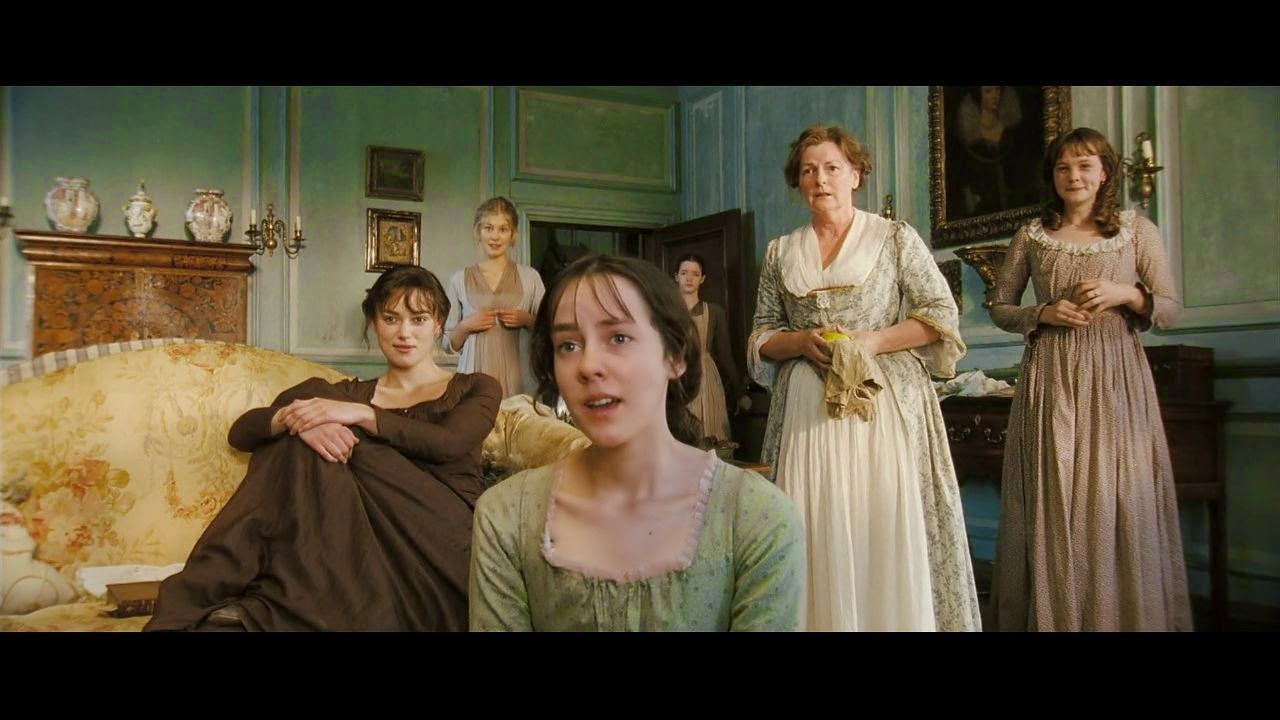
Since my Gatsby  post was so successful, I thought I'd follow up with my equally controversial thoughts on Pride & Prejudice  (2005). No, much more controversial. Sorry! But my overall opinion of the costuming is positive for a number of reasons. I have to start off with a disclaimer: I'm just talking about the costuming - my friend Rose wrote a very good post about issues with the writing, although I didn't entirely agree with her - and I'm not saying it's better in costuming or as a whole than the 1995 version. Frankly, the two are so far apart that I hardly see them as the same thing and don't really compare them. One is a faithful, longer form adaptation and one is a more romanticized retelling in shorter form. Though I do think it's odd that the more sexual additions with Colin Firth don't get the same treatment as some of the changes with Knightley and MacFadyen MOVING ON! The main trouble with the costuming in P&P2005 is that the des...

The Myth of Chanel and the 1920s: X - Rising Hems

Image
As hem lengths rose and flowerpot hats moulded themselves to the side of the head, a voluntary simplification of clothing spread across a wide spectrum of society. The hemline was on a slow rise from the beginning of the twentieth century.  The stereotypical Edwardian skirt, for example, had a shape like an upturned lily, with a train even in daywear.   According to Vogue , the skirt began to shorten in 1907, due to some sort of alleged American influence - however, looking through fashion plates and advertisements, the change is more gradual than sudden.  It is not until 1909 that fashion truly got rid of the train and showcased narrower skirts, and not until 1910 or  1911 that the top of the foot was exposed. (This post is fairly image-heavy - I feel the point's best made by showing specifics.) Debenham & Freebody advertisement, April 1915; NYPL 816928 Bradleys advertisement, September 1916; NYPL 816904 Bonwit Teller advertisement, Harper's...

The Myth of Chanel and the 1920s: IX - The Bob

Image
She cut her hair short 'because it annoyed me'.  Everyone cut off their hair in imitation. This is probably the most concretely bustable myth about Chanel.  It is very popular, appearing frequently in fashion blogs.  Even when academic writers acknowledge that she did not invent the style , she is given top billing and the bulk of the credit for popularizing such a daring innovation. The main strike against it is that the date of her bob is given as 1916 or 1917 ( one blog calls this "long before the look became popular", which will be refuted in a minute).  As was demonstrated in Part II , Chanel was successful but not the über-popular figure until later in the 1920s, and it would be difficult for her to have such a widespread effect midway through the 1910s or early in the 1920s. 1916 or 1917, that is still later than 1915, which is when the bob starts to be discussed in magazines.  In madly famous dancer Irene Castle's own words : The next time I he...

The Myth of Chanel and the 1920s: VIII - Expensive Poverty

Image
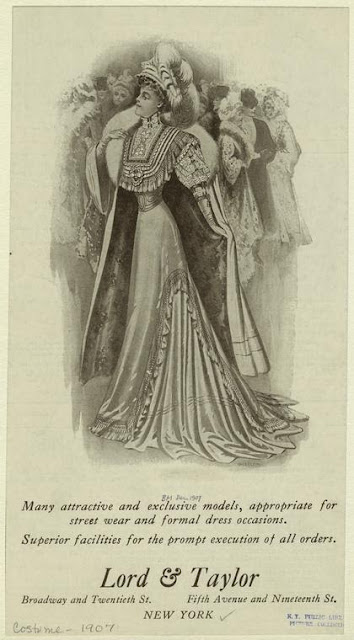
The flamboyant colors of Paul Poiret's pre-war designs and the theatricality of Bakst's influential costumes for the Ballets Russes suddenly seemed tawdry and overdone. ... A look of luxury was achievable through the severity of simplicity.  Expensive poverty was the aim.  She dared to suggest that clothes themselves had ceased to matter and that it was the individual who counted. The story of the first three decades of the twentieth century can be seen as a narrative of increasing simplicity.  Not to continually beat Poiret's drum - no single designer can be held responsible for such a grand shift in style - but his simple black kimono coat , originally introduced in 1903 (itself deriving from the frequent use of orientalism in fashion and interior design in the late nineteenth century rather than springing forth from Poiret's head fully formed) started the general trend in outerwear. Lord & Taylor advertisement, Burr-McIntosh Monthly , December 1907; N...

The Myth of Chanel and the 1920s: VII - Jersey Cloth

Image
During the war she discovered the versatility of jersey cloth as used by stable lads for shirts for training sessions, and began to make sweaters and waistless dresses for women from the same supple fabric.  The ornate Edwardian costume that according to a scornful Chanel had 'stifled the body's architecture' started to disappear.  Chanel was quite certainly not designing waistless dresses from the beginning of her dressmaking career (as evinced by the plate below), and of course the "stifling" Edwardian costume was gradually evolving on its own.  Fashionable dress was much looser at the waist, but still frequently had a defined waistline, and even Chanel partook in the general complication in decoration and fastening that fashion involved at the time. "Jersey Outfits; Designs by Gabrielle Channel [sic]", Les Elegances parisiennes , March 1917 However - again, as evinced by the plate - jersey did play a significant role in Chanel's career...