Posts

Showing posts with the label research

Ca. 1866 Brown Gown - A Close-Up Look

Image
  Hello, everyone! It’s Cassidy, Mimicofmodes here, on Twitter, on Tumblr, on Reddit, and on Etsy.  Anyway, I have a small but fantastic collection of historic clothing. Antique historic clothing, not pieces I’ve made. A few of the pieces I bought myself, at thrift shops and on eBay and Etsy, but most of it was very kindly given to me several years ago by a blogging friend, Natalie Ferguson . Unfortunately, I’ve never had the chance to do anything much with them – but I’m so excited to be able to share them with the world this way! My collection ranges from a late 18th century shift to a 1980s cocktail dress, with most pieces from the early 20th century. At first I thought I could show you this gorgeous Edwardian evening skirt – the bodice apparently didn’t survive, or maybe it was sold separately at some point – but it’s very delicate. I wouldn’t want to put it on my dress form. I also don’t have a large enough space on the floor to lay it out! However, I’m moving this winter...

Fashion History Methodology - new video!

Image
Hi, everybody – it’s Cassidy! I started this YouTube channel months ago but I’ve been really lax about actually making videos. But we’re far enough into the Coronavirus that I’m ready to work on getting into Youtube. It is hard for me, because I’m not really used to watching myself … except that I am getting more used to watching myself due to all those Zoom meetings.  (Please tell me that other people obsess about how they look even though they know nobody’s watching them …) What I’m going to try to do to get more familiar with this whole format is adapt some of my posts from AskHistorians into videos (which in theory should work a lot better than trying to do podcasts about fashion history, like I was doing for a while (and thank you to everyone who supported that venture!) since I can add in visual aids, which are pretty important to this subject). AskHistorians is a forum on Reddit where people can come in and ask questions about any aspect of human history and while they’re n...

Sixteenth Century Venetian Dress

Image
Several years ago, mid-sixteenth-century Venetian gowns were fairly popular among historical costumers, but I don't seem to see them anymore. (Or maybe I'm just not looking in the right places?) Anyway, I was always interested in them but never made one myself. Recently, I was thinking about this era of clothing again due to a personal fiction project, and I realized that while I was familiar with the standard outfit - a sleeveless or sleeved kirtle that laces up the front, revealing a white triangle or strip of gathered chemise - I didn't really know anything about its evolution. (One interesting thing its evolution shows is that the common statement that fashion only "changed" every few decades until the nineteenth century is, like many common statements about fashion history, not true. Fashions had continuing variety, though often in subtle ways.) At the beginning of the sixteenth century, Venetian dress was somewhat plainer. La Schiavona , Titian, ...

The Evolution of the French Hood

Image
The French hood of the sixteenth century is an interesting garment. Costume designers have been making theatrical version for years that miss the mark, turning them into structured headbands that arc up over the back of the head. So what exactly is a French hood? Not quite a French hood, almost a kokoshnik, from The Tudors I'm not sure what the earliest use of the term is, but Caroline Johnson notes in  The Queen's Servants  that the Princesses Margaret and Mary were issued red and black velvet for French hoods in 1501, on the marriage of Prince Arthur and Katherine of Aragon, and that Margaret brought "three yards of black velvet for hoods, oreillettes and frontlets of the French style" with her to Scotland in 1503. The version of the French hood worn at the time was far from anything that could translate into a headband - a two-layered headdress, with a (typically) black silk piece overlaid on either a band or cap of (typically) red, white, and/or gold. De...

Stay-Dating

Image
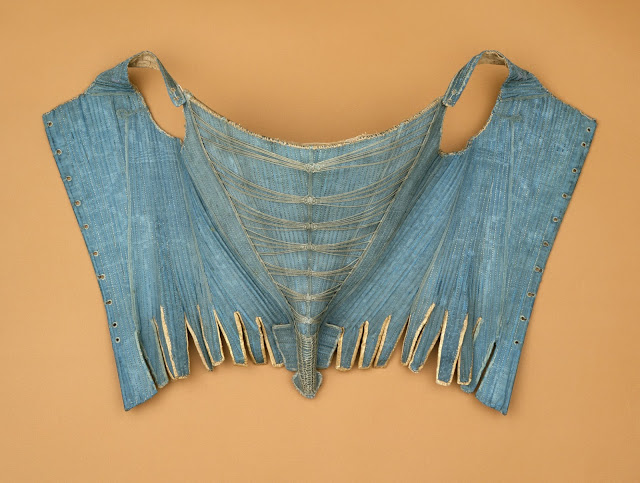
My latest project is a proposal for a book written specifically to help out costume designers and writers of historical fiction - a fashion history manual for 1700-1940 that focuses on visuals and on how the clothing works. The first chapter, on the early 18th century (1700-1739), is my sample, and it's making me realize how brushily  we tend to deal with the period before the changes of the 1770s, and especially before the 1750s. I'm pinning down a lot of stylistic changes to at least halves of decades, but I'm finding stays surprisingly difficult. Like a lot of other aspects of fashion I've had to work out, the issue's complicated by museum dates that seem overly broad or just plain wrong. And for stays, there are considerably fewer artistic representations than there are for gowns, caps, etc.! I think I've been able to identify the differences between early-century and 1775-1795 stays - which was tricky, because a lot  of earlier stays were dated later. W...

Fashion in 1867

Image
Because of the upcoming Dragonrose pattern for an 1867 evening dress, I wanted to explore the fashion of that year. The American Civil War period is very well-explored, and I've done a certain amount of research into the early bustle period, but in between those two, my impression has been comparatively vague. Godey's Lady's Book, May 1867; NYPL 803309 Bodices The most common style of bodice for daywear was, as in the previous period, a front-closing one with a jewel neckline and dropped armscye. White collars were still worn: a standing collar inside the neckline, a ruffled collar also inside the neckline, and a turn-down collar with points. Cuffs were made in similar styles, and worn on two-piece coat sleeves of a moderate width; a decorative hanging oversleeve was a fashionable addition for any situation where a long sleeve was appropriate. In evening dress a broad or squared neckline was prevalent, worn with very short sleeves. Images labeled dinner dress oft...

Jeanne Adèle Bernard (1872-1962)

Image
Maison  Jenny is one of the hardest couture firms to learn about - but if you look through fashion plates and magazines, she is all over. According to a blog , Jeanne Adèle began working under Jeanne Paquin, and then under Béchoff David (another little-known master). Her own house opened sometime between 1908 and 1910; the sources I've found disagree, but the earliest mention of Jenny that I can find is from 1910, in the caption of a photograph. There is no other text. "Dainty afternoon costume", Theatre Magazine , October 1910 But her star soon rose. In a 1912 trade magazine , specific Jenny models are noted several times, and in one case she is described as a style arbiter. In a tariff hearing in January 1913, in the testimony regarding a man accused of importing Paris labels for fraudulent purposes, all of the labels are listed - they're listed generally in order of importance, and Jenny's name rests right in the middle, between the geniuses and the unk...

Louise Chéruit (ca. 1870?-1935)

Image
Louise Chéruit ( not   Madeleine ) is another of those couturiers that has been forgotten by historical chance, whose style and contributions are almost unknown today, despite the fact that she may be the only designer mentioned in Vile Bodies . Mme Chéruit , by  Paul-César Helleu, ca. 1901 Unlike Pingat, we do know where Chéruit learned her trade - though in most sources there is a little confusion over whether it was Raudnitz et Cie , or Ernest Raudnitz. Raudnitz et Cie  was opened in the 1870s by Ernest and his sisters, and in 1883 Ernest left to form his own house at 23 Louis-le-Grand, just down the street from Pingat. As Chéruit and her sister, Marie Huet, eventually took over Raudnitz et Cie , it's most likely that that was where they were both trained. In the January 1899 edition of Le Jacquard , a trade journal for the wool industry, Huet & Chéruit are noted as having set up to sell gowns and confections in December 1898 at 13 rue Grange-Bateliè...