Posts

Showing posts with the label 1830s

Wedding dress made by Jane Warnock, 1837

Image
Hey, everybody! It's been a really long time since I posted anything substantial here, but this fall I was lucky enough to curate my first exhibition at the Fenimore Art Museum: Elegant New York , a sampling of garments from our collection that were made by professional dressmakers or tailors in New York State, as well as a few from the Parisian haute couture world. Some of these garments have never been displayed before, and they certainly aren't on any online databases or other websites. There's only so much room on a label for information about a dress, and you also have to balance the desire to inform with the need to write something the largest audience can digest. Since I am only supposed to share my own photos of collections items when they're on display, I'm going to take advantage of the opportunity to blog extensively about each piece! The first garment you see on entering the exhibition is this dress: Let's look closer! This is a one-piece gown of a v...

Hyde Hall Planning: 1830s Chemises

Image
The chemise is the first thing you put on, so it's the first garment I'll be discussing. As in other eras, the chemise was used as an underlayer to soak up the wearer's oils and sweat and protect the rest of the clothing. Throughout history, they have tended to be pretty shapeless, but there are typically various features that reflect contemporary fashion. In this period, that typically means higher and wider necklines, and short but full sleeves. Fabrics This period marks the early years of the Industrial Revolution, and the transition from linen to cotton as the basic utility fabric. Linen required a significant investment of time for processing (you have to let the harvested plant sit around in water for weeks to rot the stems and loosen the fibers), while cotton could be cleaned, carded, and spun pretty much immediately, which is part of the reason for this transition. Both linen and cotton were used for undergarments at this time. The Workwoman's Guide,  fi...

Announcing 2020's hottest new event

Image
Putting it in writing to make sure it happens - next summer, I'm going to be hosting an 1830s picnic in central New York! Hyde Hall - this was in April when it was still very cold, so it will be more lush, I promise! Hyde Hall is a gorgeous mansion on Otsego Lake in Springfield Center. It was built between 1817 and 1834, which makes it a perfect place to have a pre-Victorian event. It also has a great big grassy lawn, and I've already mentioned this to the staff there and they think it would be pretty cool! Why am I posting about this so early? Well, mainly because I planned to do it this year and it never happened (though in fairness, I spent half of July out of town, so ... that made it hard to plan or prepare), and I want to make sure that I do pick a date and that it gets held. This is also not a period that most people sew for, so it might take us all some time to create our ensembles. With that in mind, I'm going to be writing a series of posts on 1830s dres...

Portrait Analysis: Susan Brown Moody

Image
I haven't done a post about a painting in a long time! But this painting is the St. Lawrence County Historical Association 's Object of the Week, and I'm taking the opportunity to write more for those members of our Facebook page who'd like more information than will tidily fit in a post there. (And to link back to the museum where I curate for those readers here who might like to follow it!) Portrait of Susan Brown Moody, 1830-1835; SLCHA 1988-8.1 This portrait was initially purchased by the museum at Sotheby's in 1988 as "Clarissa Moody Wright in her wedding bonnet". Let's really dig into the clothing on view here, and then I'll talk some more about why this piece is of such interest to the SLCHA. A dark-colored gown is very common on sitters in folk portraits, but it's not always so common to see this much detail! Quite often, the dress is a kind of dark mass that sets off the whitework on the cap and pelerine. Here, we can see tha...

Godey's Lady's Book, December 1835

December 1835 RECEIPTS. WINE MARROW PUDDING. Boil half a pound of the finest and freshest marrow in a pint of new milk, with a bit of lemon peel, cinnamon, and half a leaf of laurel. Pour it over the sliced crumb of a three penny loaf, or the same quantity of French bread; and, covering it up, let it stand till quite cold. Beat up well, in the mean time, six yolks with three whites of eggs, a quarter of a pound of powdered loaf sugar, two ounces of blanched and pounded almonds, and a little orange-flower water; add this mixture to the cold marrow and milk, and bake it in a dish with puff paste around it. Washed and picked currants, with syrup of cloves or nutmegs, a little brandy, and some slices of candied citron and orange peel, with any other sweetmeats, may be added, if required to be very rich. The marrow, too, instead of being boiled with the milk, may be minced very small, and strewed over the French bread; or rather on Naples biscuits. Marrow puddings made in either ...

Godey's Lady's Book, November 1835

November 1835 RECEIPTS. BROWN AND WHITE VERMICELLI SOUPS. Boil two ounces of vermicelli in three quarts of beef or veal stock, for about twenty minutes; skimming it, and seasoning to palate: this will be sufficient for preparing the common brown vermicelli soup. White vermicelli soup, however, should be made in the following manner: -- Blanch two ounces of vermicelli, in the usual way, by putting it over the fire in cold water; and, on its boiling up, strain it off, and throw it into fresh cold water; for, were it to continue draining in the sieve while hot, it would become lumpy, and not again dissolve. After straining it, when quite cold, dry from the water, boil it in three quarts of veal stock, or broth, for a quarter of an hour; rub it through a tammy; season it to palate; and make a leason of four eggs, and half a pint of boiled cream gradually added, with or without a table-spoon of béchamel. Put the leason to the soup, off the fire, stirring it all the time: then set...

Godey's Lady's Book, October 1835

Image
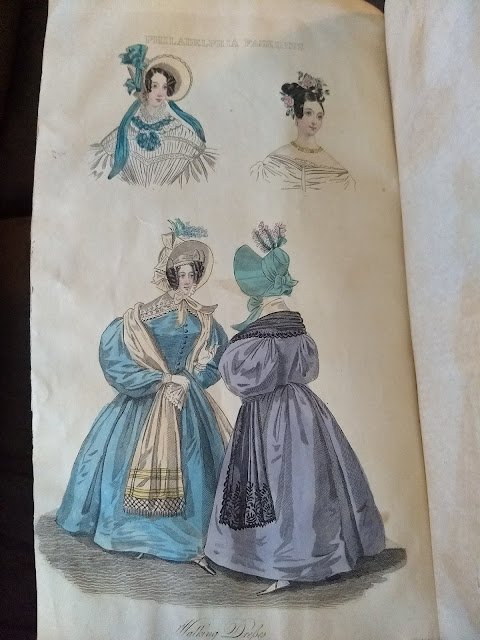
October 1835 FASHIONS FOR OCTOBER. Hats are mostly made of India silk, the colour according to fancy - dresses to please the taste of the wearer, made after the manner of the engraving. - Artificials are mostly used, thought some prefer feathers. Yes, that is all they give to explain this plate.

Godey's Lady's Book, September 1835

September 1835 RECEIPTS. EAU DE BOUQUET. Take of sweet scented honey water 1 oz., eau sans pareille,* 1 1-2 do., essence de jasmin, 5 drachms, syrup of cloves and spirit of violets, each, 4 dr., calamus aromaticus,* long rooted cyperus,* lavender, each, 2 do., essence of neroli,* 1 scruple.* Mix. Some add a few grains of musk and ambergris: it is sweet scented, and also made into a ratafia with sugar. * Eau sans pareille , "unequalled water," is another perfume, made with citrus fruits; you can see some recipes here . Calamus aromaticus is Acorus calamus , or sweet flag, and Asian plant historically used in medicine and perfumes. Cyperus  is a genus containing hundreds of species of plants; I don't know which is meant here. Neroli is bitter orange. A scruple is 1/24 of an ounce. ESSENCE DE JASMIN. The flowers are stratified with wool or cotton, impregnated with oil of behu, or nut oil, in an earthen vessel, closely covered, and kept for some time in a wa...

Godey's Lady's Book, August 1835

August 1835 THE TOILET. - No. 11 FOR CHAPPED HANDS. Take three drachms of bole ammoniac* - three drachms of myrrh, and a drachm of white lead - incorporate these with a sufficient quantity of goose-grease; and with this anoint the parts affected; and wear worsted gloves. * A drachm is a unit of weight, during this period referring to either 1/16 or 1/8 of an ounce. Bole ammoniac is Armenian bole, an iron-rich clay from Armenia ANOTHER. Take myrrh, one ounce; litharge,* one drachm; honey, four ounces; wax, yellow, two ounces; oil of roses, six ounces. Mix the whole in one well-blended mass for use. OBS. -- When the hands are chapped, avoid putting them in water. * lead oxide FOR CHAPPED LIPS. Take two tea-spoonfuls of clarified honey, and a few drops of distilled lavender water, or any other agreeable scent. Mix them together, and anoint the lips frequently. If the hands are affected, anoint them all over at going to bed, wearing gloves during the night. Wash ...

Godey's Lady's Book, July 1835

Image
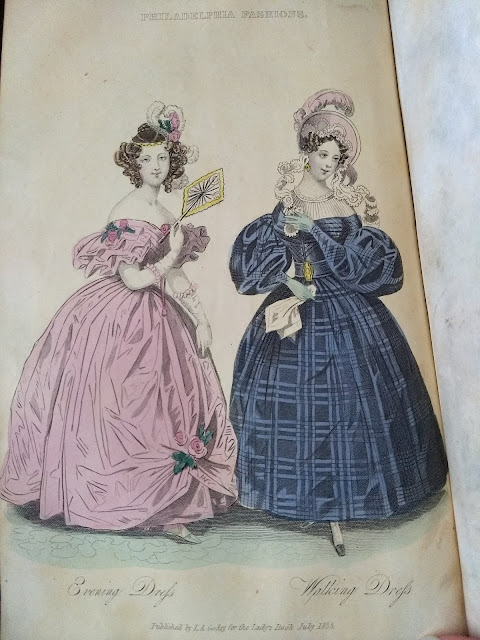
July 1835 A DESCRIPTION OF THE PRESENT FASHIONS. WALKING DRESS. -- Chip hat, ornamented with flowers or feathers according to Fancy, lined with blond lace - robe of plaid silk - the colours used are various. EVENING DRESS. -- Needs no other description than to mention that the hair is dressed much lower than usual, and that the colour of the dress depends entirely on the fancy of the wearer.

Godey's Lady's Book, June 1835

Image
June 1835 DESCRIPTION OF THE FASHIONS. FIRST DRESS. The robe is composed of satin Memphis , a black ground figured in white in an Egyptian pattern. The ground is a plain silk of the richest ground, the pattern satin. The corsage  is cut low, tight to the shape, and trimmed with a standing tucker of tulle illusion . Sleeves à la folle ,* of tulle illusion , surmounted by mancherons  of the material of the dress, bordered with satin riband, a white ground lightly figured, an edged with black. The ceinture to correspond, is tied in short bows and long floating ends. The hair is parted on the forehead, disposed in luxuriant curls at the sides, and arranged in perpendicular bows formed of plaited braids behind. It is ornamented in a light and novel style, with a half-wreath formed of puffs of rich white gauze riband, which goes round the back of the head, and terminates in knots over each temple. * à la folle  - literally "madwoman-style", from the same origin c...

Godey's Lady's Book, May 1835

May 1835 RECEIPTS. MARMALADE Differs from jelly, in being the pulp  of fruit combined with sugar rather  in excess as to quantity. PLUM MARMALADE Is made by boiling the Plums for a short time, draining them, pouring them through a sieve (of hair;) again boiling, so as to reduce the pulp considerably, and adding it (the pulp) to the clarified loaf sugar, boiling at near the crack : when you obtain a good stiff consistence on your dipper, the compound is finished. Mind to stir the mass well while on the fire . Put it in pots. CHERRY MARMALADE Always take out the stones  and stalks  of fruits for Marmalade. Use 1¾ lbs. of sugar to 1 lb. of the fruit. GREEN APRICOT MARMALADE Is made by boiling the fruit till, the down becoming loose, you can rub it off with a cloth. Mash them; dry the pulp a little; and just before your boiling sugar (as above) comes to the little ball , add the pulp; stir,  and boil the whole well together. -- Pot it...

Godey's Lady's Book, April 1835

Image
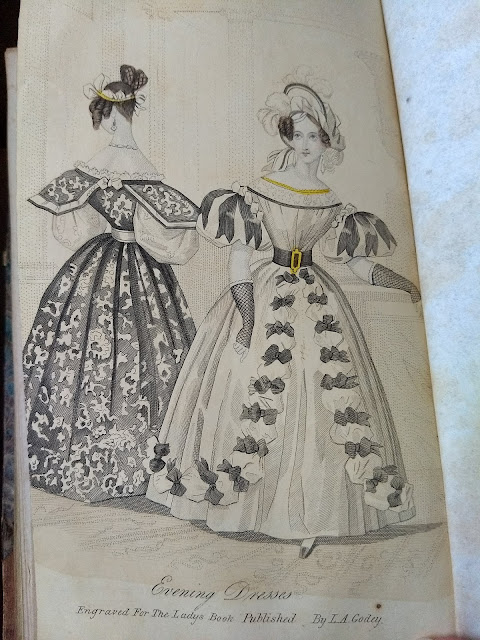
April 1835 PHILADELPHIA FASHIONS. EVENING DRESSES. Sitting Figure . -- A printed satin robe, white ground, and pattern in vivid colours of small sprigs in winding columns, and large single flowers in compartments. The corsage  is cut very low and square on the back and front of the bust, but rather higher on the shoulder than they are generally made; it sits close to the shape, terminates in a peak before, and is trimmed with a single row of narrow blond lace laid on flat. Blond lace long sleeves of the usual size at the top, and moderately full from the elbow to the wrist; they are made open from the bend of the arm, but are attached in three places by gold filigree buttons, and surmounted by mancherons*  of broad blond lace. The hair parted on the forehead, is arranged on each side in a plaited band, which is doubled and hangs low. The hind-hair, also arranged in a braid, is twined round the summit of the head. Gold ear-rings, neck chain, and bracelets. White ki...

Godey's Lady's Book, March 1835

March 1835 RECEIPTS. ICES. The Spaniards are famous for their ices; and, perhaps, this is not extraordinary, considering that their climate renders the use of them so indispensable. In this country, we are hardly permitted to form an opinion as to the exquisite relief they afford to a system, of which the energies have been in a state of retrogradation for twelve or fifteen hours. AGRAS -- that is, the Green-Grape iced  -- is the favourite. The Vessel. Mix salt and ice well together in a vessel, and place your freezing pot  in the midst: put into the last your juice, or cream, &c. and stir it about well : put on the cover of the vessel, and keep the ice-pot moving quickly round, by means of transverse handles; taking off the cover continually to stir up the contents of the freezing pot . Serve it up; or if not immediately wanted, put ice on the cover of the freezing pot. Creams for Icing. Add thirteen yolks of eggs to one and three-fourths pint of crea...

Godey's Lady's Book, February 1835

February 1835 RECEIPTS. FRUITS IMITATING NATURE. Are made by means of wooden shells ; (the color of the stone and containing an almond,) overlapped with an imitation of the Fruit  itself, made by means of leaden moulds into which sugar boiled sufficiently has been poured. When taken from the mould, the sugar is varnished with isinglass; and this last is strewn over with dry colour, to represent the peculiar bloom  of the fruit. I should have stated that the isinglass is tinted with liquid colour to represent that of the fruit while it (the isinglass) is dissolving. CHESTNUTS IN CLARIFIED SUGAR. Are a favorite little dish. The sugar (2 lbs.) is boiled, and ten yolks of eggs being beaten up with a small quantity of some choice liqueur, these last are added, and the whole is manipulated into a paste, which with powdered sugar, is formed into the appearance of chestnuts; colour them a little where necessary. FOR SCOURING GRAYS, DRAB COLOURS, FAWNS, MAROONS, AND...

Godey's Lady's Book, January 1835

Image
Recently I spent some time in St. Albans, Vermont, a town up near the Canadian border. There you will find a small bookstore called The Eloquent Page, which has an entire bookcase  full of Godeys, Petersons, and the like, and two or three more with books on fashion history written in the 20th and 21st centuries. Go there if you have the opportunity! I purchased the 1835 Godey's Lady's Book and the 1842 Ladies' Cabinet. I'll be sharing the illustrations and descriptions from each! Godey's unfortunately does not appear to have run a fashion section in every issue, but for those that don't have plates I'll try to share something else good from the month. January 1835 PREVAILING FASHIONS. Coat Dress . -- Stone coloured silk. The capes trimmed with fur or silk, with buttons in front. Cashmere shawl with gay border. Green velvet bonnet, trimmed with gauze riband, or blond lace. In some instances the 'Bird of Paradise' is added to the trimming....

Before Victoria: White Wedding Dress (Part II)

Image
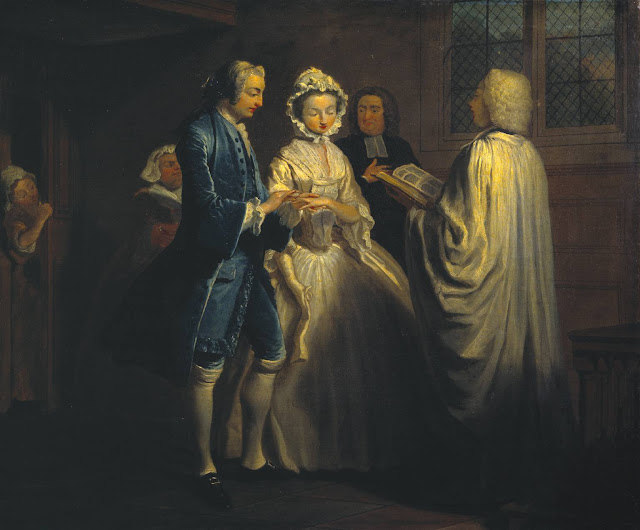
So, previously  I showed you a lot of examples of actual white or white-ish gowns worn for weddings, including fashion plates (as they are intended to be prescriptive of real clothing - they exist to tell you what you can/should wear); these prove at least that white was worn. Now I'm going to follow that up with the kind of sources that can tell us more about the reasons white gowns were chosen, and whether the examples found previously are representative. The Commonness of Bridal White Although fictional weddings are by definition not real, the choices that authors and artists make can show what's considered normal or at least ideal for their societies, and the majority of authors and artists I found chose to dress their brides in white. The marriage (ha!) of both textual and visual sources can be found in Samuel Richardson's Pamela (1742) and Joseph Highmore's painted illustrations of the same. Happily, the book describes what she wears in order to get marri...

Before Victoria: the White Wedding Dress in the 18th and Early 19th Centuries (Part I)

Image
The history of white wedding dresses is a popular topic, and a few related narratives have built up in both popular and academic writing: Queen Victoria was the first to wear a white gown for her wedding in 1840, and women began to copy her, creating a tradition. Queen Victoria was not the first to wear a white wedding dress, but it experienced a boom in popularity as a result of her marriage. Queen Victoria was not the first to wear a white wedding dress, but it was only with her marriage that it took on the connotations of purity and innocence. I could digress to talk about the perils of "Great Man" history, but that's  better for a discussion on Chanel (hey-o!), so instead let's just look at why these narratives are all incorrect, and why Victoria was not really a turning point at all. (For the use of white, that is - Cele Otnes and Elizabeth Pleck make a very convincing argument in Cinderella Dreams: The Allure of the Lavish Wedding  that Victoria's wedd...