Posts

Showing posts with the label 1890s

Waistcoats: 19th and 20th Century

Image
Apart from certain stylistic keys, I've always had a harder time dating men's clothing. It's just not as interesting to me, so I haven't taken the time to really study dated extant pieces and images and improve my skills. But lately I've come across more undated waistcoats while cataloguing - it's become something that I need to work on. And how better than by putting together a blog post? Wedding waistcoat, 1808; MMA 2009.300.7449  [OASC] At the beginning of the century, fashionable waistcoats were cut straight across at the bottom to match fashionable coats, although the vests often protruded slightly below the waistline of the coat. High collars, also matching the coats, would cover the sides of the shirt collar that extended up to the jawline. Both coats and vests could be single- or double-breasted, generally with self-covered buttons. While coat lapels were generally wide, waistcoat lapels were somewhat narrower. Toward the end of the first decade ...

Georges Doeuillet (1865-1930?)

Image
Georges Doeuillet may be the least-known couturier I've written about so far - or perhaps second, after Jenny, since his real name is generally available. The only time his name comes up is in conjunction with Doucet, when the two houses merged at the end of the 1920s. But in fact (let this not be a total shock), he was a more interesting and important figure than his present obscurity would make him appear. Born in 1865, Doeuillet was part of the same generation as Louise Chéruit, Charles Poynter Redfern, and Jacques Doucet. (That is, the second generation - the first generation being born in the early part of the century, like Charles Frederick Worth, John Redfern, and Edouard Doucet.) However, his start came a little later in life. Some   sources state that he first worked as a business manager for Callot Soeurs, which opened in 1895. It seems likely that he began working there from the beginning, so one has to wonder - what did he do until then? At thirty, he would not have ...

The House of Doucet (1816-1928)

Image
Just as John Redfern began as a mercer, the Doucet family's business began in fabric and lace. In 1841, La Mode  described the Doucets (then at 17 rue de la Paix ) has having a "numerous and noble clientele", highly stylish in late spring for "trousseaus and corbeilles " - the  corbeille  being the gift of material wealth given to a woman by her husband the morning after the wedding, a continuance of the medieval Morgengabe  - and was frequently recommended for fine  lace for ruffles, berthas, and skirt flounces. Toilettes from Petit Courrier des Dames , including chemisette and lace from Doucet, 1840; NYPL 802380 The business was split by 1862 into two parts, both housed at 21 rue de la Paix : Mme Doucet was a lingère , selling women's chemises, drawers, caps, and other linen and cotton articles, while her son Edouard was listed as a tailleur-chemisier , selling men's underwear and outerwear, and marked a "notable business". (Quite a fe...

Redfern Ltd. (ca. 1855-1940)

Image
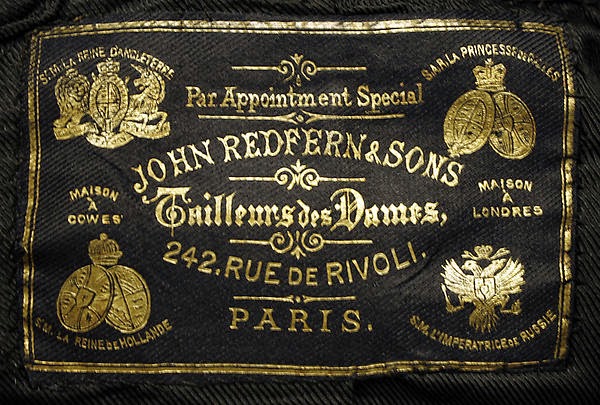
Redfern is relatively well known as an early couture and tailoring house, but the specific people involved, or their talents beyond women's suits and riding attire, are often overlooked when discussing the progress of fashion - which is usually distilled down into a few vibrant personalities and their innovations. Redfern's early years overlapped with Charles Frederick Worth, who steals the spotlight from all contemporaries. Label from walking dress, 1885-1888; MMA 49.3.32d (OASC) John Redfern (1820-1895) opened a draper's establishment in the city of Cowes on the Isle of Wight in the mid-1850s, where he was joined by his sons. In the early 1870s, his shop expanded to sell silk as well as wool, and also clothes for mourning; a little later it seems to have added yachting dress, as Cowes was historically a center for boating and regattas. The early obscurity of the business means that many sources give slightly contradictory information, but it's connected to Lil...

Emile Pingat (1820-1901)

Image
For various reasons, certain designers have stuck in the collective consciousness as being the single greatest creative minds of their times. Gabrielle Chanel and Madeleine Vionnet are good examples: as you know , some hold them up as the only important couturiers of the 1920s because they're the two remembered  couturiers of the 1920s. When it comes to the mid-to-late 19th century, a similar issue crops up with Charles Frederick Worth. One might conclude that his was the only couture house for the discerning, wealthy woman, but that's not the case. Emile Pingat was Worth's contemporary and equal in the eyes of many American and European women of the period. Very little is known about Pingat's life, early or later. In 1860 he was first listed in the Paris directory as "Pingat, Hudson et Cie ", at 30 rue Louis-le-Grand , (see  1862 ) selling " nouveautés confect[ionées] ";* by the  latter half of the decade , Hudson and Co. had gone, and Pingat was ...

Mary DeLong West's Wedding Dress, 1896

Image
1976.139.2 , pattern available on site As it says at the site, this was "w orn by Mary DeLong in 1896 when she married Charles F. West." And you can see it on Mary as well - in the photograph, there's some beaded trim running around the middle of the collar and on the edges of the cuffs, and a large bow on the back of the collar, but that hasn't survived. Personally, I think it looks better without the trim. The chiffon overlayer is not included on the pattern, but it's just rectangular blocks with slight curves cut for the neckline and armscye. Has anyone made an 1890s outfit with this sort of elastic in the skirt? That's the sort of detail that always makes me want to do a little experimental archaeology. There were two wedding dresses from the mid-1890s with provenance, but I went with this one because I love satin - it stays in such good condition. One of the 18th century gowns I patterned for my book is satin, and you'd have thought it was ...

New Museum Website!

Image
Sorry, this is taking the place of your usually-scheduled fashion plate. There is a new museum (partial) collection out there, available for your perusal! In the main, it consists of scans of photographs, especially ones of the Adirondacks taken by Seneca Ray Stoddard around the end of the 19th century, street scenes in Glens Falls, NY, and portraits of citizens of that town. Caroline Agnes Ranger, 1887; CHM 1996.58.23 And I know about it because my job for the past couple of months has been to clean up the files and get the database ready for uploading. It's been a wonderful change from office work, believe me. I've gotten to know a lot of Victorian Adirondack hotels, and done a ton of genealogical research for the people files. The benefit of having me do it is that whenever a photo is of interest to people looking for historical fashion details, it's been tagged with "Clothing & Dress" in the search terms. Check it out! I've made sure that ther...

A Successful Day

Image
Today I went down to Hudson to have lunch with a school friend (that sounds very 1930s-English, doesn't it?), and after we ate we went around to a few of the antique shops!  As I'd already bought four antique fashion magazines on eBay this morning - three were from the 1920s, so it counts as legit DressU research expenses - I didn't want to spend much, but in the last shop there were boxes of cartes-de-visite and cabinet cards.  They were priced at, respectively, $1 and $3, so I went through and picked out several that were useful research sources and a few more that were just aesthetically pleasing. I didn't notice at first, but these two have the same backing and the same stamp on the back, so they're obviously from around the same date.  (I've included scans of all the backs with writing/printing, because it's helpful to be able to connect different typography styles with different periods.  And because they're cool.)     ...