Posts

Showing posts with the label neoclassical

A New Kind of Transitional Stay

Image
Hello! It's been a while - due to American politics, personal issues, and other factors, I just haven't had the energy to spend on historical sewing or writing about fashion (beyond what I do for AskHistorians; link to my profile if you'd like to read some short articles on a variety of social history topics) - but last month, I attended the 2018 CSA Mid-Atlantic/Southeastern Biregional Symposium in Shippensburg, PA. It was quite a trip! I was so happy to meet up with so many fashion history scholars, and particularly to meet Ann Wass (of Riversdale House Museum ), Mackenzie Anderson Sholtz (of Fig Leaf Patterns ), and Lydia Edwards (author of How to Read a Dress ). You can see all of my photos of the exhibition at the Shippensburg Fashion Archives and Museum on Instagram ! I delivered a paper of my own, which I hope to turn into a podcast episode/blog post soon, but what really thrilled me was the presentation Mackenzie gave, "A Transitional Corset and its Companion ...

Thesis Update - Nearly There!

Image
I probably would have been at this point several days ago, but I went with the Theory "batiste" from my swatches , and it proved to be more like a tightly-woven percale, and I was having the hardest time getting pins and needles into it.  Let this be a lesson: always test a swatch by pleating it heavily and putting a pin into it.  Since it didn't work, I went to Joann's in Queensbury and got some rather cheap Sew Essentials muslin, which actually seems like a reasonably close approximation for period muslin, to me.  Maybe a little less transparent, but it's very light.  Anyway, I then went ahead with the petticoat of my own design.

Pictures!

Image
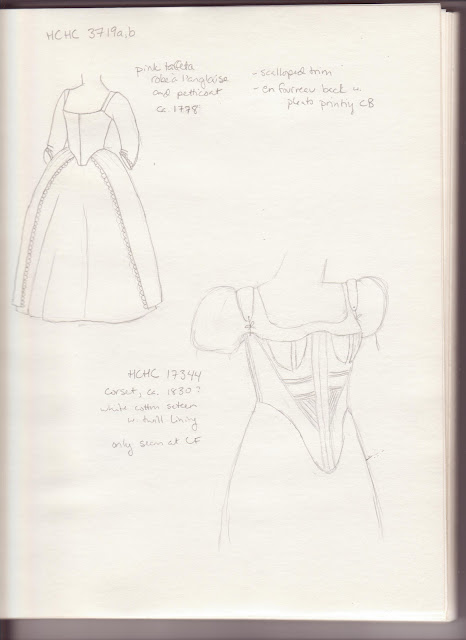
For some reason, I sketched out the pink taffeta gown and the interesting corset I examined yesterday.  (I used Patterns of Fashion as a reference for the gown but still managed to make the figure too short in the leg ... not sure how.)  And I thought I'd post the pictures I took of my thesis project pre-ensleeving, in which I look pretty darn happy.  Please ignore my weird arm position, I think it may have been to make sure you could see the silhouette properly?  Couldn't get a good picture of my back, unfortunately, as it's behind me, but you can sort of see it in the middle picture.  I think the pleats might end too high up my back, but that's very easy to fix so I'm not worried.

Artistic Neoclassical Costume

Image
I began discussing this in my post on the mantua .  As the wealthy began to create separate public and private lives, they desired paintings of themselves in private, dressed in ways they could never appear in public.  Some of the sitters wore actual negligée dress, but some were painted in an invented costume meant to invoke thoughts of the Greeks and Romans. Portrait of a Woman , William Wissing, 1687 Apart from being informal, this style of dress was meant to keep the portraits from looking as dated as those of the Elizabethans, with their supported skirts and ruffs, though it is up to the viewer to determine if it has had its intended effect.

1790s Stays

The shift was easy, apart from all of the flat-felling, but the stays are proving less so.  There don't seem to be any patterns of extant examples in the style I'm looking for - as I pointed out in my post on corsets of the period , most surviving pieces are either conical (early 1790s) or long and slender (late 1800s), but during the period there was a lot of emphasis on the natural roundness of the body* and I want to make a short corset with cups. Examples: - Kent State transitional stays (the page at KSU isn't up anymore) - V&A short stays

1790s Shift

Image
So as it says in my bio over there, I've done everything for my M. A. except my thesis/qualifying paper. In my program, there are a lot of options for that: you can do a strictly academic research paper, or conserve a difficult object, or put together an exhibition proposal - pretty much anything sufficiently complicated to merit a 30-50 page paper. My project is to sew an ensemble accurate to the period 1795-1805, when the main historicizing influence on fashion was the ancient world. (1805 is about when the Renaissance turns into the main influence, although you can still see neoclassical touches.)