Posts

Showing posts with the label redingote

Magasin des Modes, 7e Cahier, Plate I

Image
January 20, 1787 So great is the quantity of redingotes, also called Franco-Anglomane  gowns, that we've given, but it's necessary to do so again. Our Ladies have hardly any other dress. One will agree that at least we have varied the forms and the taste of all those that have been shown. That which the Woman shown in PLATE I wears, very different from the others, is made and cut like chemise gowns. Like them, it is passed over the head or stepped into. This redingote is of scarlet wool; it is fastened in front with large white buttons. Its sleeves are slit on top à la Marinière , and along on the sides, where four little white buttons are sewn. We could say that this form of redingote is particularly designed for going about in a cabriolet, for we have seen Ladies getting into or out of cabriolets in it. The Woman has a simple, puffed kerchief on her neck, with the ends falling like a man's jabot. She holds a rose in her right hand, and a cane in her left. On ...
Magasin des Modes, 5e Cahier, Plate I

Image
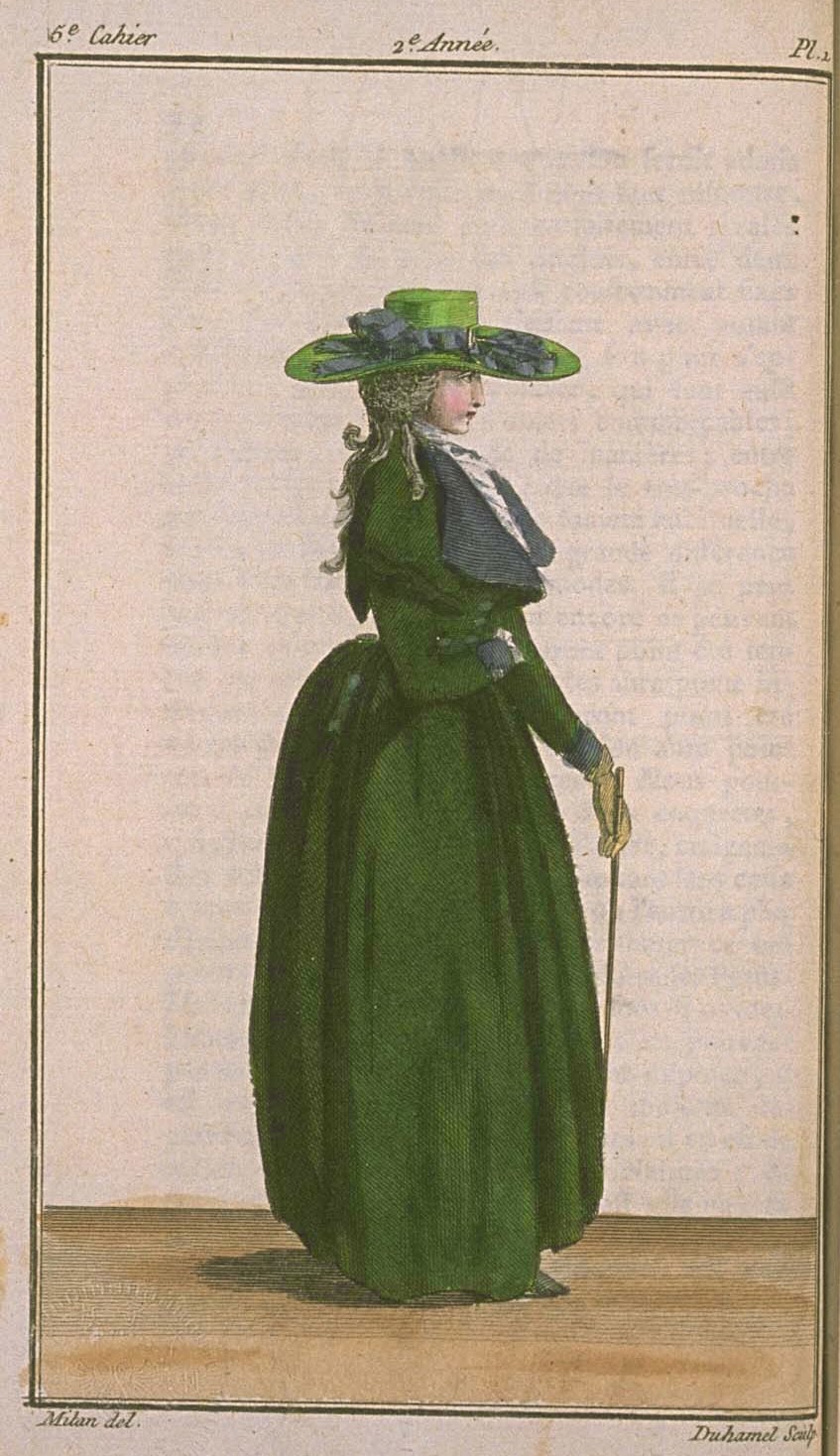
December 30, 1786 [The issue begins with a long remark on the interchange of fashion between France and England, "whose eyes are constantly fixed on one another".] Consequently, one should not be astonished if we happen to give as English Fashion what was some time ago French Fashion, and as French Fashion was we had already published as English Fashion. Men's redingotes, that we should call Franco-Anglomane  gowns, having come from Englishwomen to Frenchwomen, and this Fashion existing still in both countries, one should not be surprised today if we show Englishwomen dressed like Frenchwomen. The Englishwoman drawn in PLATE I wears a man's redingote of olivish wool, with three wide collars falling very low to below the shoulders, with large revers lined with violet satin, with violet satin cuffs, and trimmed on the cuffs, on the hips, and on the fronts with wide white mother-of-pearl buttons. A sort of belt of the same wool, trimmed with the same buttons, bin...

Magasin des Modes, 3e Cahier, Plate III

Image
December 10, 1786 ENGLISH FASHION. Never, perhaps, have colors been better united and nuanced in an entire outfit than in the one in which the young Englishwoman is shown in this Plate; never will one find colors which, taken together, would give more grace  or sweetness to the face. We do not hesitate to say that our Print presents a perfect whole. Agility in her figure, softness and liberty in her composure, harmony in her dress: everything is found here. This young Englishwoman is dressed in a violet satin redingote, with sleeves à la Marinière , trimmed with large mother-of-pearl buttons. Under this redingote, there is a gilet and a petticoat of canary's tail  satin; the petticoat is flounced with a narrow white gauze flounce. And over the front of this petticoat, a long apron of black taffeta. She wears a full gauze kerchief, trimmed in three rows. Her hair is frizzed all over in large curls, two of which fall on her chest, and behind, her ...

Magasin des Modes, 2e Cahier, Plate I

Image
November 30, 1786 Again a redingote in a new form. It is buttoned with two rows of buttons to the waist, and with only one from the waist to the bottom. This redingote is of lemon  yellow wool, with apple  green stripes. The collar and cuffs, slit à la Marinière , are of dark green satin. The buttons are of mother-of-pearl, with a little gold dot in the middle. These buttons, on the bust, pass through little flaps  of green satin, fixed on the left side, and from the bust to the bottom, through simple green silk ribbon buttonholes. The Woman who wears this redingote has her neck covered with a full gauze kerchief with two rows of ruffles, the two ends of which are tied in front as a cravat, near the bodice of the redingote, and descend like a jabot over it. On her head is a chapeau-bonnette , lined with green satin in the brim, covered with a pink satin on the same brim, and whose crown is of white gauze, very puffed, and belted with a very wide green ribbon with ...

Magasin des Modes, 1er Cahier, Planche I

Image
November 20, 1786 In summarizing all the Books where we have presented women dressed in men's redingotes, it will be easy to see which were temporary variations of Fashion. Here is another redingote which shows that its progress has not relented. It was the most difficult step to get over, and it was overcome; it was the most brilliant shape and the most agreeable to take, and it has taken hold. The Woman shown in PLATE I wears a redingote of dark green wool, embroidered with gold on the fronts, on the side pockets, cut vertically, and on the cuffs. Under this redingote, a petticoat of glossy pink. On the neck, a full gauze kerchief, en chemise , with two collars. On her feet, pink shoes, flounced with a green ribbon. On her head, a straw hat, lined with canary's tail  taffeta or satin, with black stripes, whose very full crown is of pink crêpe, with little black stripes, and which is belted with a wide pale green ribbon, edged in white, pulling up the hat on the...

Cabinet des Modés, 24e Cahier, 2e Figure

Image
November 1, 1786 Which is the young man who, seeing a woman who has a nice roundness  behind, has not run immediately ahead to see her face? Which of us all is not seduced by the elegant roundness of a young woman, or even a young man whom one has only seen from the back? It is thus more important that we would have thought first to represent a woman who must be seen from behind; were it only to see if her dress made a good effect . One cannot deny that the redingote that the Woman represented in PLATE II wears perfectly fits her shape, and hangs agreeably to her heels. All is fine, all is wide, all is smooth as a whole. The bust is very svelte. The arms are well rounded, very supple; nothing is constrained, nothing is narrow, nothing is strangled . The redigote, with two collars and sleeves à la Marinière , is of water  green cloth, spotted with a darker green. The buttons applied on the pockets, sleeves, fronts, and hips, are gilded copper, all plain. The Woman w...

Cabinet des Modes, 20e Cahier, 1ere Figure

Image
September 1, 1786  FIRST PLATE. A Lady of the highest quality, that we would have a very-great pleasure in naming, to give all our Subscribers the idea of a perfect woman, was seen, some days ago, at the Garden of the Tuileries, in the outfit that we have represented in the Ist Plate . This time, the admiration for her taste and her elegance overcame the most profound respect, that her goodness and her other virtues draw to her daily. She is beautiful in shape and face; but this dress added still more, so to speak, to her beauty. Our Print shows well enough how much art is the least of her attractions. Her dress differs a little from that of the Woman shown in the last Issue, since there are more pockets along the sides of her redingote, and a ribbon which edges the scalloped fronts of the redingote; but whether it were the color she wore, her poise, her natural graces, or finally that whole that one perceives and cannot express, gave her her seductive air, she was much bet...

Cabinet des Modes, 19e Cahier. 1ere Figure (2)

Image
August 15, 1786 See the IST PLATE: it represents a Woman dressed in a man's redingote, with three large collars falling on her shoulders. This redingote is of dark  slate blue  taffeta. It should be of a  King's blue  color; but it seems that taffeta cannot perfectly take this color. The bodice is separated from the rest of the body with two large mother-of-pearl buttons, applied on each side of the hips; three matching buttons are placed at the ends of the sleeves of the redingote, open  à la Marinière . This redingote is lined with taffeta of the same color. One could leave it without lining, or place in it a light one of white taffeta, pink taffeta, crimson taffeta, or scarlet taffeta. Under this redingote, the Woman wears a gilet cut in the manner of men's, or a pink, violet, or crimson colored corset . The petticoat is of white-glazed pink taffeta, or of white muslin, lined with another underpetticoat of pink taffeta. The Woman wears on...

Cabinet des Modes, 8e Cahier, 1ere Planche

Image
THE ELEGANCE and taste which shine in each of the Parures  of our Ladies justify our attention to make them all known, when they were not of an actual and daily fashion. The two Prints which follow in presenting a new type, which we have not spoken of yet. One could look at them as the dominant taste today: the simple poise, ease, and liberty they give to those who wear them, make them generally preferred. The gently nuanced colors of these outfits, and the manner of wearing them, enhance the brilliance of the complexion, and spreads an agreeable vivacity in all the air  of the body and face. We flatter ourselves that one knew us to willingly have published these two Fashions which reign in the homes of a very-great number of our Ladies. --- FIRST PLATE. WOMAN in adjusted Redingote . The Redingote is of Louviers wool, in Bishop's purple , and trimmed with white buttons. Little manchettes  of batiste or plain muslin are worn at the ends of the sleeves of the ...

Galerie des Modes, 61e Cahier, 6e Figure

Image
 The sulky Alviane Dressed in a Redingote à l'Amazone and Coiffed with a morning Hat. Buttons . "Over the last two years, buttons have experienced very rapid and well-marked vicissitudes; it is useless to recall them all now: but, only speaking of those with paintings, one must say that all types of paintings have successively been on them; first historical subjects, then bas reliefs, soon after faces, again soon after landscapes, and today architecture . "The most beautiful monuments of France are painted on buttons, and especially the most beautiful ones of Paris. "We have seen them, made by a young artist of much taste. All the most beautiful pieces of Parisian architecture, like the Louvre, the Saint-Denis gate, the Corn Exchange,* the School of Surgery, etc. etc. are represented on them with all possible perfection. He has been working for a year and has made a very great quantity of them ... "The buttons have only been for sale since his Maje...

Galerie des Modes, 61e Cahier, 4e Figure

Image
 The young Zuma in a Redingote closed with Buttons à l'Anglaise and in a Cap à la Courvil . "When you see a fashion begin to overburden itself, you can say: its end approaches, and in a little while it will be destroyed. As we must not stop variety in fabrics, in colors, in the distribution of these colors, in their mixing, to satisfy our taste, from the instant that this variety can no longer be felt over such fabric, such color, the mixture of these colors, their assortment, it is indispensably necessary that one changes fabric or color. However, this variety can no longer be felt as soon as the fashion of such fabric, or such a color increased as far as it could. For example, the fashion of stripes, passing from narrow to wide, whether it admitted the medium degree, or whether that was omitted, can no longer increase, because after the widest there are no more. However, not being able to increase, and to satisfy this insatiable need that we have for variety, and bei...

Galerie des Modes, 61e Cahier, 3e Figure

Image
 Young Lady in a Winter Redingote and a Hat à la Genlis.* "In the current times, when the majority of minds are much less carried by the idea of pleasures, and when people hardly take any other leisures than reciprocating visits, our ladies dress more in robes parées  or demi-négligés , than in caracos, jackets, or pierrots. These latter garments being more dedicated to balls or promenades." Le Magasin des Modes , 20 February 1788 * Probably  Stéphanie Félicité du Crest de Saint-Aubin, Comtesse de Genlis  (1746–1830), a well-educated courtier and writer.

Galerie des Modes, 58e Figure, 3e Figure

Image
Imposing Woman in the Jardin du Roi, dressed in a Redingote à l'Anglomane, Straw Hat trimmed with Folettes etc. etc. " Le Jardin du Roi ", at the top of the rue Saint-Victor, across from the Pitié .  This garden is divided into a top and bottom; in the upper part is a mound called a labyrinth: one enjoys a beautiful view there.  At the foot of this mound Cedar of Lebanon is seen.  The garden's borders were just extended to the quay by the care of M. de Buffon. "This garden furnishes a very agreeable promenade, useful to naturalists and lovers of botany, who, independently of all the types of trees and bushes, find there also all the exotic and indigenous plants, which are cultivated in hot and glassed greenhouses ... "In the new area is a vast, square pit whose bottom is at the level of the river, forming a basin ... Almanack des Voyages à Paris , 1787

Galerie des Modes, 56e Cahier, 6e Figure

Image
Young Lady in a Camlet Redingote: pink Taffeta Petticoat, Hat à la Bastienne s urmounted by Plumes and Aigrettes. (1787) "One sees ... that one doesn't wear, with redingotes, pelisses or mantelets ... They are never worn.  Pelisses and mantelets seem unknown to the English, from whom our Ladies took the fashion of redingotes. "Some Ladies have already begun to attach piping and liserés  to their redingotes.  Will they last longer than those attached to men's frock coats?  Time will tell!" Le Magasin des Modes , November 30, 1786

Galerie des Modes, 56e Cahier, 4e Figure

Image
 Redingote closed in the front to the bottom with buttons of brilliants. (1787) "The Beautiful Ladies to the Handsome Men. "Mssrs. Agreeable, who believe yourselves to be our masters, and whom we lead by the end of the nose; you who think you have such spirit and penetration: we feel very easy to see that you lack it.  How! for some years you saw us constantly dress ourselves in your hats, and you continue to wear them!  The adoption that we have made of this coiffure, has it not made you renounce it?  But no: you are so obtuse, that it is necessary to tell you everything.  Ah well, Sirs, we declare to you that we are taking the hat ... "But, you will say, what will we wear?  Ah, our dear little Friends, we leave you the large caps, the baigneuses , etc.  You see well that we don't wear them anymore ... A very clear cap, very transparent, half advanced over the face, picks up the whiteness, throws a sweet reflection on it which highlights ...

Galerie des Modes, 56e Cahier, 3e Figure

Image
Morning redingote surmounted by a wide collar. (1787) Accessories made by Rose Bertin, modiste to the Queen, for Mme the Countess Plater: " 1786, August 20 . - A hat of white straw lined with striped English gauze, 2 bias strips of the same gauze, on the crown bows of white ribbon, cy  ... 48 Livres. "A bouquet of beautiful mixed flowers ... 54 livres. "A superb rose branch with buttons ... 27 livres. "A box ... 2 livres. " August 27.  - A pot of rouge from Mlle Martin ... 24 livres. "Total ... 155 livres" Dossiers Bertin , Doucet Library

Galerie des Modes, 56e Cahier, 2e Figure

Image
Redingote with striped Sleeves and Revers, buttoned in front.  Cap à la Randan trimmed with aigrettes and Rooster plumes. (1787) "The caps à la Randan  were, in their origin, and as the actress (1) wore them, only types of turbans belted with a bandeau of muslin or white batiste, embroidered in gold, with calottes  also of white muslin, raised like a sugarloaf to almost a foot in height, surrounded with wide bands of batiste or muslin, decorated with gold fringe, and trimmed with veils, which went from the top of the calotte  in the back, and descended very low. "Today these caps no longer take the form of a sugarloaf; they are enlarged in puffs at the top.  They have retained the bandeaux, which are diversified, and in the middle of which a shield has been placed; they have retained the large bands, trimmed with gold lace, but they have adopted plumes, artificial flowers, and gold tassels, falling on the left side." Le Magasin des Modes , November...

Galerie des Modes, 54e Cahier, 5e Figure

Image
Young woman dressed in a summer redingote in red wool trimmed with fashionable buttons, chignon à la conseillere with a steel coulant:* straw hat trimmed with ribbons. (1787) "As far as we've looked into antiquity, we cannot remember having ever seen women's fashion being the same as men's in color, as well as the form of their dress.  Is it that our century, or rather our actual era, was predestined to be one of miracles?  Today, except the coats which still do not replace gowns, and the breeches which still do not replace petticoats, women's dress is the same as men's, both in cutting and color.  Shoes, stockings, gilets, vests, frisure , hats, canes, watches, gloves, shirts, cravats: everything matches in shape as in colors for the two sexes." Le Magasin des Modes , June 10, 1787 * According to French Wiktionary , a coulant  is an iron ring which forms a pincer

Galerie des Modes, 54e Cahier, 2e Figure

Image
Redingote of violet taffeta, revers, collar, and cuffs white, steel buttons, striped and spotted muslin petticoat: puce straw hat trimmed with large steel buckles: it is edged and belted with black velvet. (1787) "Women's clothing must have a sex; and this dress must contrast with ours.  A woman must be woman from head to foot: the more a woman resembles a man, the more she surely loses. "But women come as close as they can to our practices.  They actually wear men's coats, a redingote with three collars, hair tied in a cadogan, a cane in the hand, shoes with low heels, two watches and a coupé  gilet." Sébastien MERCIER, Tableau de Paris , 1788

Galerie des Modes, 54e Cahier, 1ere Figure

Image
Redingote of white taffeta relieved à la militaire with a simple collar, petticoat in pink taffeta brocaded with black and edged with white, yellow straw hat with a lilac ribbon striped with white: the ground of the top of the crown striped pink and white. (1787) "Is there a very great difference between the French and English fashions?  That is not the question that must be proposed.  But can there be a great difference between the French and English fashions?  There is the question that will be admitted for proposition; there is what we must resolve. "Between two nations as perfectly rivaled as ours and that of the English, between two nations which have their eyes constantly fixed on each other, which spy on each other with much attention, whether for imitation or applause or censure, which also makes a mutual exchange of commercial objects, morals, opinion, and manners; between two nations, in a word, whose nearest vicinity forces them to a sort of habitual...