Posts

Showing posts with the label 17th century

Book Review: Patterns of Fashion 5!

Image
Patterns of Fashion 5: The content, cut, construction and context of bodies, stays, hoops and rumps c. 1595-1795  - Years in the making, and I think we're all very excited to have it out at last! A little background, if you're not familiar with it: Janet Arnold wrote the original two Patterns of Fashion  books (1660-1860 and 1860-1940) in the 1960s, and followed them up in 1985 with a third based on 1560-1620. A fourth was published posthumously on shirts, smocks, ruffs, etc. in roughly the same time period (she worked on Elizabethan and Shakespearian dress quite a bit), based on her original material, edited and added to by Jenny Tiramani (longtime professional costume designer with a passion for accuracy) and Santina Levey (a lace/embroidery specialist). Patterns of Fashion 5  is likewise based on her patterns and notes, but has been very extensively added to by Jenny Tiramani and Luca Costigliolo (also a costume designer; the two have worked together for a long ...
AMBA: The Recent History of Mourning

Image
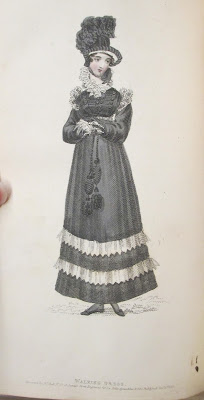
This episode took me forever to write. I was originally going to start with a blog post I wrote a few years ago, relying on primary sources on mourning from the 18th, 19th, and early 20th centuries. Then, as I started to go through it, I started to reinterpret a number of the primary sources, and then I came across Lou Taylor’s book, Mourning Dress: a Costume and Social History , and I realized that I needed to fully read it and regroup. So. (This is the transcription of the episode, for those who prefer reading to listening, or want to go back and double-check something they heard.) Walking dress and evening dress in the general mourning for Princess Charlotte, La Belle Assemblée,  Nov. 1817 Funerals and mourning goods seem to have become status symbols in Europe in the late Middle Ages, when royalty and the upper aristocracy began to indulge in long funeral processions with large numbers of mourners and horses in black draperies. Male mourners would wear loose gown...

New Collection Online!

Image
At the moment my mild-mannered alter ego is a receptionist in a doctor's office, and we are required to show YNN Capital Region all day long.  Yes.  Much of the time it is ignorable, frequently it is appalling, and occasionally it tosses up something of interest. Today, that little gem was a spot on the Albany Institute of History and Art!  It was lovely to see the inside of the vault and the collections again, and it was especially nice to see Tammis Groft, the chief curator.  But part of the point of the spot was that they've created an online collections database , which is the sort of thing we all love to see.  Now I can link you directly to Ariantje Coeymans , one of my favorite portraits out there. "Ariantje Coeymans", Nehemiah Partridge, ca. 1720; AIHA 1938.5 You can also see whole categories of objects, such as (of course) Textiles, Costume, and Accessories .  The whole collection isn't represented, not by a long shot - but what's there...

The Lady and the Highwayman (1989)

Image
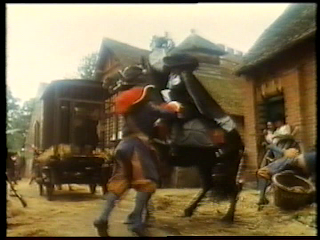
For my first review, I'd like to go with a "favorite" of mine - The Lady and the Highwayman.  It's an adaptation of a Barbara Cartland novel that, surprisingly, stars Hugh Grant (not that surprising, thought, as a lot of established actors seem to have worked on one or another of these).

Frontier Style (1700-1800) Symposium

Yesterday I attended the first half of the symposium Frontier Style: Culture and Fashion at the Edge of Empire, Mohawk Valley of New York, 1700-1800 at the Fulton-Montgomery Community College in Johnstown.  I did buy the collected papers over the mid-afternoon break, but I took notes before then - and then the penultimate presentation was from Mark Hutter , and he didn't have a printed paper so I took copious notes.  In hopes that some of this might be of interest, I've written up my notes here.

Artistic Neoclassical Costume

Image
I began discussing this in my post on the mantua .  As the wealthy began to create separate public and private lives, they desired paintings of themselves in private, dressed in ways they could never appear in public.  Some of the sitters wore actual negligée dress, but some were painted in an invented costume meant to invoke thoughts of the Greeks and Romans. Portrait of a Woman , William Wissing, 1687 Apart from being informal, this style of dress was meant to keep the portraits from looking as dated as those of the Elizabethans, with their supported skirts and ruffs, though it is up to the viewer to determine if it has had its intended effect.

The Mantua

Image
I was thinking about making this post the other night, when a profound revelation came upon me: I am a costuming/fashion history hipster.  In American Nerd , Ben Nugent defines two important aspects of hipsterism.  One is purism, as a reaction against the Baby Boomer eclecticism, and the other is an attachment to an "unfashionable" subject (although he's talking about "fake nerd" hipsters and fake attachments).  I try to always use period methods of construction and hand-sewing, and I love aspects of fashion history that happen to be overlooked or glossed over by others.  Now, some of that is because the types of clothes I like best are forerunners to styles where they, shall we say, sell out and lose their integrity, but it is not out of the question that I subconsciously prefer comparatively obscure areas because to show that I'm Interesting. Anyway.  I love the mantua so much.

English and French Women's Court Dress

Image
What I really want to do is a post just on the mantua, but I know that if I do that I'm going to have to explain court dress first to feel like it's complete.  But court dress is interesting on its own merits, anyway! In the later seventeenth century, court dress was basically the same in France and England.  It was based on ordinary clothing: a boned bodice (requiring no stays beneath) with puffed sleeves and an extremely long point in the front, and a matching petticoat.  This would all be heavily decorated, of course, with gold and silver embroidery and lace, and with ropes of pearls and precious stones. Catherine of Braganza, Queen of England , Sir Peter Lely (1618-1680), 1665