Posts

Showing posts with the label children

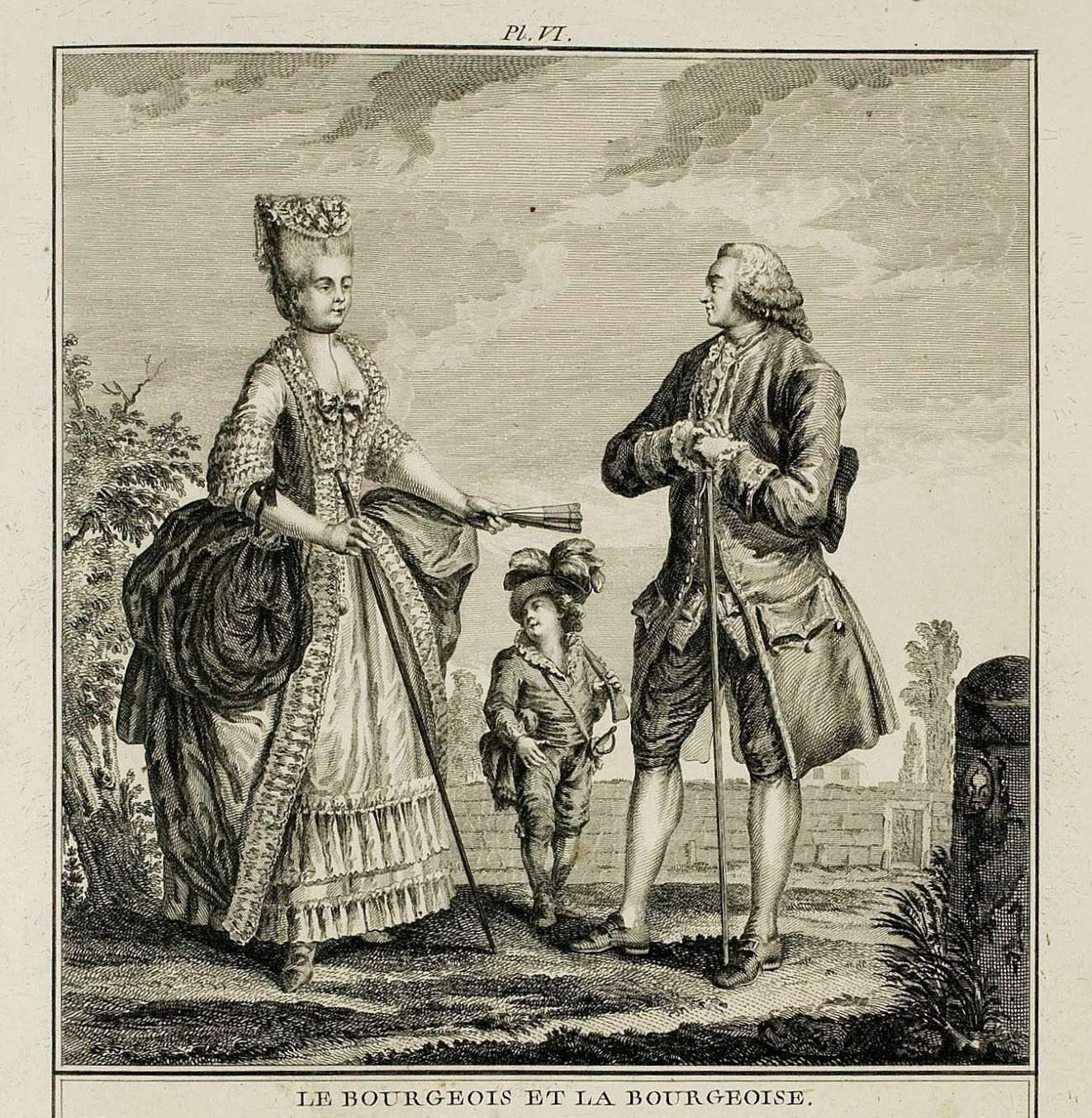
Les Costumes François, Plate 6
Image
THE BOURGEOIS  AND BOURGEOISE . The bourgeoisie  is the most considerable estate in the Kingdom, insomuch as it is the most numerous. It is the bourgeoisie  that fills the coffers of the Sovereign and that peoples the Cities. An Empire is more or less flourishing according to the affluence of the Bourgeois . The Kings of France have made such a case of this part of their subjects, that they have exempted the Bouregois  of Paris and other great cities of the Kingdom from the rights of the Frankish fiefs, of the bank and back bank, and they have been permitted to bear Arms the same as the noble Knights; but let us see what are the qualities which constitute the bourgeois . In Paris, all the Merchants pass for such and nearly all the inhabitants of Paris take the quality, without which it is contested of them; however, the Merchants and people of matching estate are never regarded as noble. When even they will have acquired the right of nobility to be Aldermen, fro...
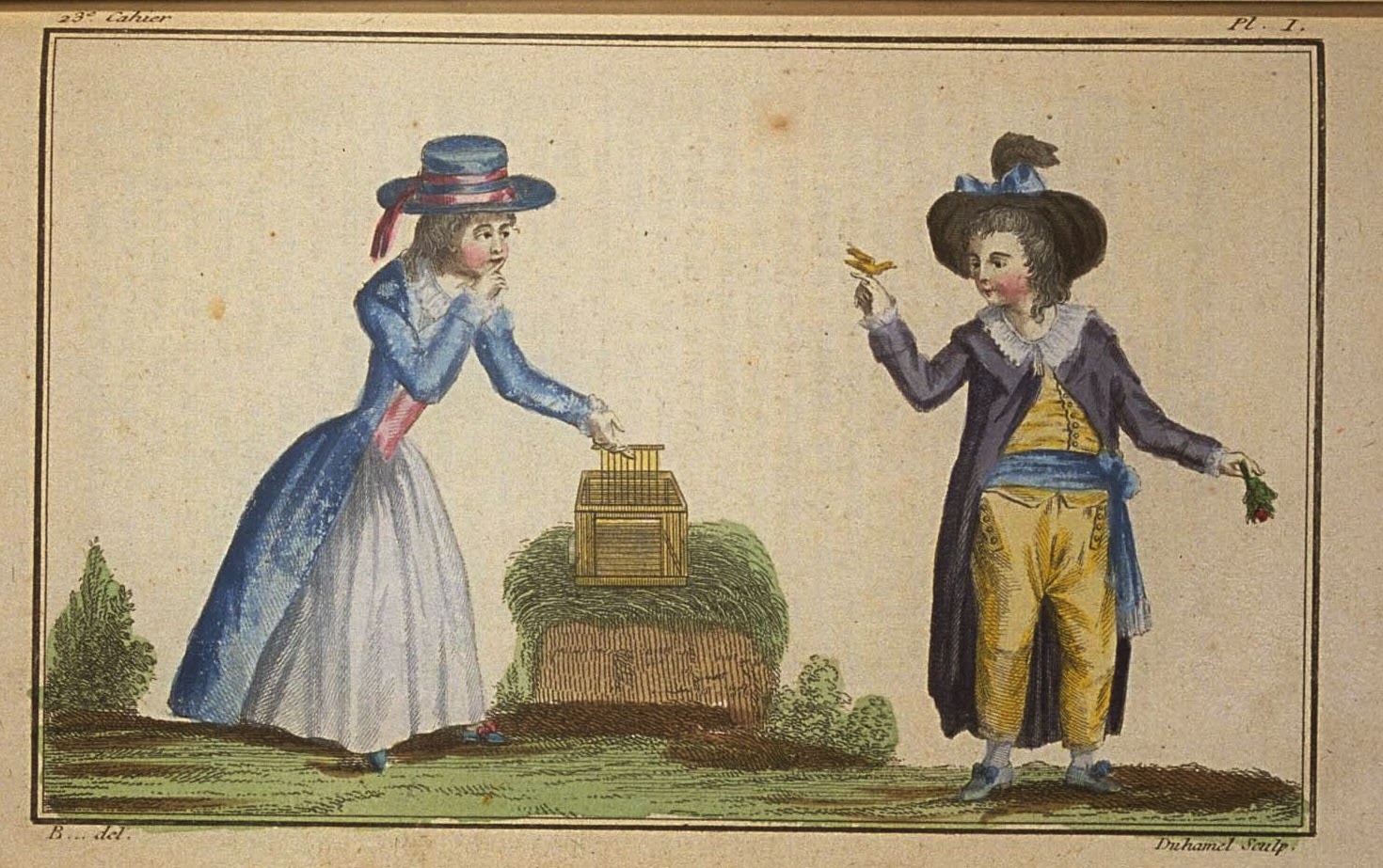
Cabinet des Modes, 23e Cahier, 1ere Figure

Image
October 15, 1786 MESDAMES, admit it; while your children are rather little, in order not to make you honest about your age, and not to shut down your coquetry, you take them with you in society, in the promenades, in all the frequented places: and even, when they are pretty, fine, playful, babbling, you glory in showing them off, because your self-esteem loves the praise accorded to them, which necessarily comes back to you; (the fathers truly have this weakness) thus you want them to be elegantly dressed, with taste, in the same fashion; you find that at this age they bring you honor. We therefore only would know best what to do to give you fashion for your children. You would not lead with pleasure children of an age already a little advanced, mainly because they would not longer have this gaiety, this vivacity, this babble capable of attracting all eyes, and of bringing them back to you. Why is this same child, who at four and five years was pretty, bright, bubbly, active, pl...

Cabinet des Modes, 6e Cahier, 1ere Planche

Image
February 1, 1786  ( Note.  Letters sent, whether to the Bookstore or to the Editor of this Work, must be franked. Those which are not will not be opened.) FIRST PLATE. It represents two children. The first is a little Boy beating a drum. Rush hat, trimmed with a bow and a blue ribbon. Shirt trimmed, with a collarette . Jacket with cut sleeves, of carmelite  satin. Gilet of pink satin, the ends of the sleeves carmelite . Belt of blue ribbon. Breeches of pink satin, à la marinière . White stockings, of silk or cotton. On the shoes, bows of blue ribbon. Young Boys are still dressed with a lilac  jacket, in the shape of that above, gilet and breeches of white linen, cotton, grey hat. Or green jacket, gilet and breeches in canary's-tail color, of a light silk stuff. Or white jacket, together with the breeches and gilet, of cotton, or any other fabric. Rush hat. The second child is a young Girl, holding a rose in her left hand. Fo...

Galerie des Modes, 63e Cahier, 6e Figure

Image
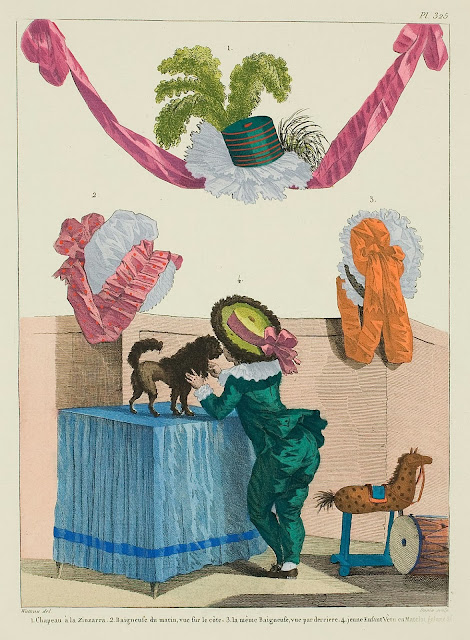
1. Hat  à la Zinzarra . 2.   Morning  baigneuse , seen on the side. 3. the same  Baigneuse , seen from the back. 4. young Child Dressed in a galant Matelot  etc. "Children ... also have fashions, that their fathers and mother are not vexed to learn; for they are often confused to know how to dress them. "Little girls almost always follow women's fashions; but little boys, that are dressed in matelots , have particular clothes. "One sees by the representation of the little boy, that he wears matelot  breeches of silk; ... a gilet with wide stripes ...; a long silk jacket ... edged with a piping ... and that this jacket is trimmed with half-sleeves of white batiste at the end of which are attached manchettes . "His shirt is trimmed with a wide frill or collarette with double flounces. "His hair, only straight, hangs in curls on his shoulders. "... He wears little yellow  brodequins  on his legs ..." Le Magasin des Modes , 10 ...

Galerie des Modes, 63e Cahier, 5e Figure

Image
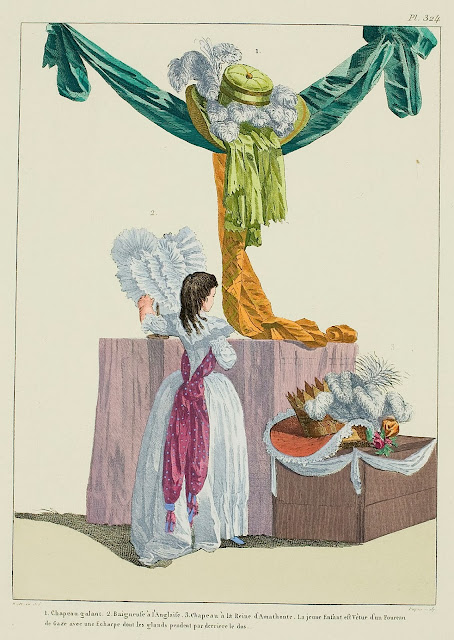
1.  Galant  hat. 2 . Baigneuse à l'Anglaise.  3. Hat  à la Reine d'Amathonte.*  The young Child is Dressed in a Fourreau  of Gauze with a Scarf whose tassels hang behind her back. "... The little girl is dressed in a gown of white linen, whose bodice and sleeves are taffeta: this gown is tied with a long and wide belt ...; she wears under this gown an all-white petticoat; she wears on her neck a very puffy  menteur  kerchief, trimmed with a pinked double flounce; ...her hair hanging à la Conseillère  in back ... "Her shoes are unbleached linen, trimmed with a white ribbon ..." Le Magasin des Modes , 10 July 1787 * "Queen of Amathus", an ancient royal city of Cyprus, which had a cult of Aphrodite. Possibly a references to Scylla et Glaucus , an opera set in Amathus.

Galerie des Modes, 63e Cahier, 4e Figure

Image
1. Galant hat. 2.  Baigneuse à la Voluptueuse.  3. young Girl in a little morning Chemise. 4. a little Gentleman in a Matelot , with a Hat  à l'Espagnol. "If we revisit in our minds all the modifications of Fashions, it will be very easy for us to convince ourselves that Fashion, called so variable, is yet regular in its march, and that it is always put together in the same manner. First is the simple style, or simple forms: then there are decorated, embellished forms; then there are overloaded forms, and, after, the Fashion disappears. "While the embellishments are still simple, there are those that believe the Fashion will last for a long time (a long time for it); but soon the embellishments are overloaded, there is reason to believe that the Fashion has only a short time to last." Le Magasin des Modes , 20 October 1787

Galerie des Modes, 63e Cahier, 3e Figure

Image
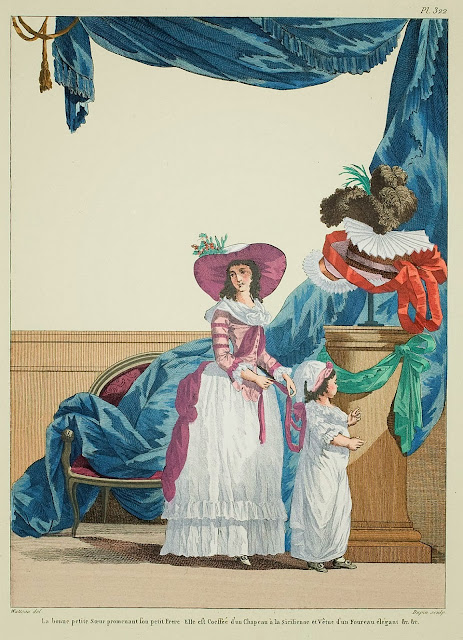
The good little Sister walking her little Brother. She is Coiffed with a Hat à la Sicilienne and Dressed in an elegant Fourreau etc. etc. "Mesdames, admit it: while your children are little enough not to make you ashamed of your age and not to shut down your coquetry, you still lead them into society, in the promenades, in all the frequented places and even, when they are pretty, fine, playful, babbling, you make yourself a glory from showing them off, because your pride enjoys the praises which are accorded to them, and which are naturally reflected on you; (the fathers are so weak:) thus you want them to be dressed elegantly, with taste, in the same fashion; you find that it is thus why at this age they give you honor. So we should only do better to give you fashion for your children. "You would not lead with pleasure children of a slightly advanced age, mostly because they would no longer have this gaiety, this vivacity, this babble capable of attracting all looks...

Galerie des Modes, 63e Cahier, 2e Figure

Image
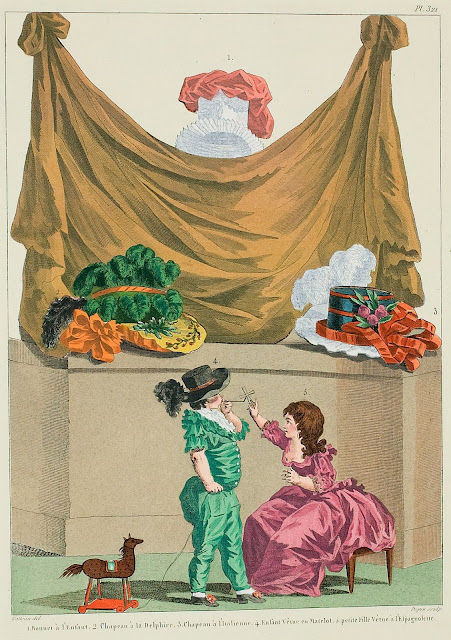
1. Cap à l'Enfant . 2. Hat à la Delphire . 3. Hat à la Italienne . 4. Child Dressed in a Matelot . 5. Little Girl Dressed à l'Espagnolette . Children . - "Children in Paris are very pretty until the age of seven to eight years. As they are elevated to the place of a numerous crowd of individuals, they contract early an air of ease; they do not have a vacant air; they are not too astonished at the habits of life, nor the worries of the city; a little air of assurance says that they were born in the capital and already molded in its great movement; they have no dread of what happens around them. Put properly, in general, in a simple and easy manner, they owe the liberty of their dress to the writings of J.-J. Rousseau." SEBASTIEN MERCIER. Tableau de Paris , 1788

Galerie des Modes, 63e Cahier, 1ere Figure

Image
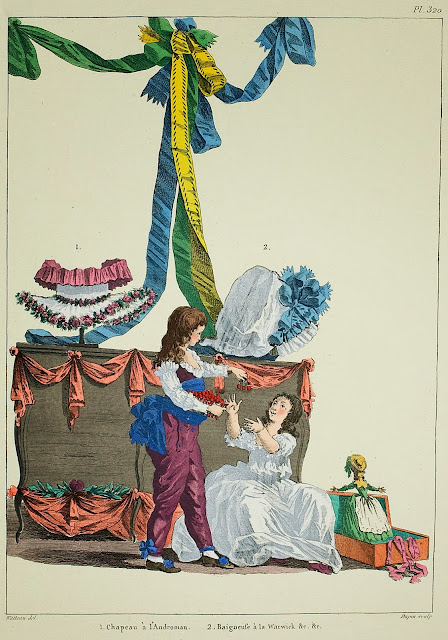
1. Hat à l'Androsman . 2. Baigneuse à la Warwick* etc. etc. "Caps and poufs are made of goffered gauze and trimmed with plain, goffered ribbons. This goffering is done with irons, which are furrowed in a thousand rather wide and deep stripes. These irons are heated, and the gauzes and ribbons are heated with them, which thus form a thousand little pleats. "The most fashionable ribbons today are plain, goffered ribbons. The colors of these ribbons are left to each person's imagination. Pinks, jonquil yellows, violets, and apple greens are however the most generally adopted." Le Magasin des Modes nouvelles , 20 July 1787 * Possibly derived from the Countess of Warwick, Henrietta Greville (m. 1776)?

Galerie des Modes, 60e Cahier, 1ere Figure

Image
The pretty Mama in the Jardin du Roi , in an Informal morning Gown, with her little child dressed à l'Americaine . "Women's hanging hair spoils coaches and armchairs, but one loves to see this ornament of their heads floating and caressing their belts; there are no beautiful women without long hair." SEBASTIEN MERCIER, Tableau de Paris , 1788

Galerie des Modes, 41e Cahier (bis), 1ere Figure

Image
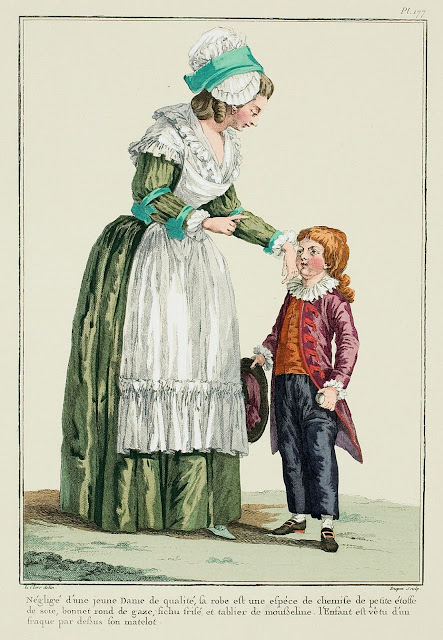
Négligé of a young Lady of quality, her gown is a type of chemise of thin silk stuff, round gauze cap, frilled kerchief and apron of muslin.  The child is dressed in a frock coat over his matelot. (1784) "In the tenderest infancy, one inculcates, so to speak, women's love for vanity and lightness!  Everyone contributes to this: the papa, the mama, the nursemaid, and family friends; the dancing master who educates the young girl has precedence over the reading master, who must inspire in her the fear of God and love of her future duties.  The marchande des modes and the seamstress are beings whose importance she will evaluate before hearing of the existence of the shape which nourishes her and of the weaver who dresses her ... "We deign to regard with reflection these marionettes that are seen in our promenades, to prelude with silliness the errors of the rest of their lives.  The little gentleman , in a cloth suit, and the little lady , coiffed in the mann...

Galerie des Modes, 36e Cahier, 4e Figure

Image
The children of M . le Comte d'Artois, to wit, Monseigneur le Duc d'Angoulême, eldest Son, Monseigneur le Duc de Berri and Mademoiselle, accompanied by their Governesses, one of which holds in her arms the Duc de Berri, youngest of the three. (1781) Although it is not necessary to accord a grand iconographic value to this plate, it is interesting to recall what the destiny was of the children whose portraits Le Clerc gave here. The oldest of the boys, the duc d'Angoulême , born in 1775, after having emigrated, was the grand admiral of France, commanded the Spanish expedition of 1823 and just when his father, King Charles X, abdicated in 1830, he renounced himself as dauphin, his rights to the crown.  He took the name of comte de Marne and died in 1844, seven years before his wife, Marie-Thérèse-Charlotte, daughter of Louis XVI. The smallest, the duc de Berry , born in 1778, also emigrated, returning to France in 1814, married Caroline of Naples, sister of the ki...

Galerie des Modes, 36e Cahier, 3e Figure

Image
Madame, only Daughter of the King, on the knees of her Governess. (1781) This plate is from the Museum of Fine Arts Boston, 44.1515 .

Galerie des Modes, 33e Cahier, 6e Figure

Image
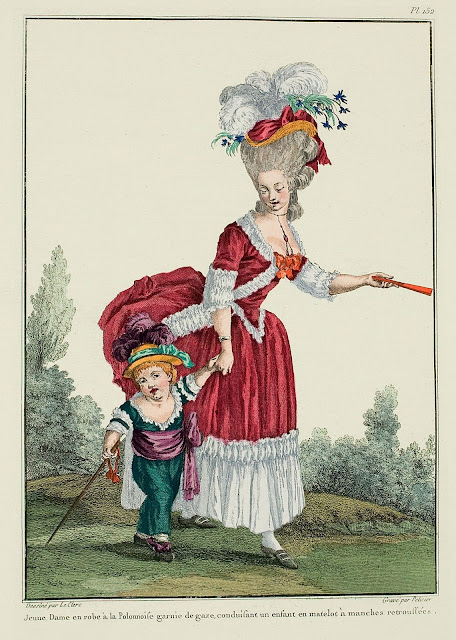
Young Lady in a robe à la Polonaise trimmed with gauze, escorting a child in a matelot with turned up sleeves. (1780) One knows that the industry of women's dress was divided between three principal groups: the staymaker , which we call corsetiers, which make equally court gowns, camisoles , children's jacquettes and fourreaux ; the marchandes de mode who sew and mount caps, trim gowns with ribbons, flounces, etc.; and finally the seamstresses .  The Dictionary of the Abbé Jaubert (1773) thus enumerates these different phases of the making of a gown; the seamstress first cuts the back, composed of two pieces , then the fronts, the petticoat, the sleeves, manchettes , and trims.  Then she assembles them, after having basted the lining, if approp riate, in sewing the fronts to the back, then the sleeves between the backs and fronts, then the manchettes to the sleeves, finally the trim.  Finally she assembles the pieces of the pettic oa t, she edges them on the ...

Galerie des Modes, 32e Cahier, 6e Figure

Image
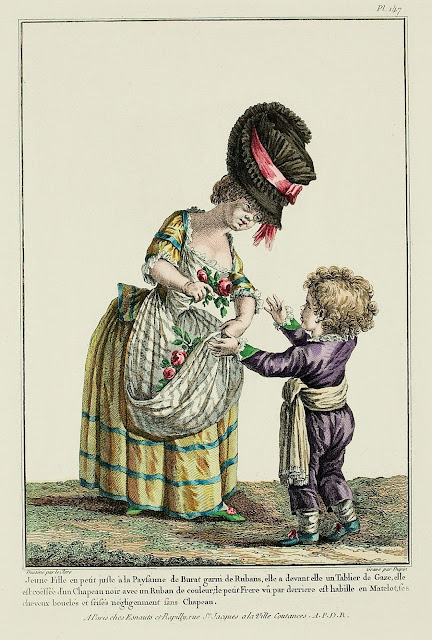
Young Girl in a little jacket à la Paysanne of Buras, trimmed with Ribbons, she has in front a Gauze Apron, she is coiffed with a black Hat with a colored Ribbon; the little Brother seen from the back is dressed in a Matelot, his hair, curled and frised negligently, without a hat. (1780)

Galerie des Modes, 32e Cahier, 5e Figure

Image
This little Girl is dressed in a Fourreau of painted Linen trimmed with Bands and pulled up à la Polonaise over a white petticoat trimmed with a large Muslin volant; her Coiffure is a Bandeau over the hair en herisson.  The youngest of the Children is coiffed with a Toquet à l'Anglaise. (1780)

Galerie des Modes, 32e Cahier, 4e Figure

Image
The little Girl seen full-face is dressed in a Fourreau of Taffeta trimmed with Gauze; she has a Gauze Apron; her Fourreau is made à l'anglaise.  Henri IV hat.  The other little Girl has a Buras Fourreau pulled up à la Polonaise.  The little Boy has a simple Matelot with pulled-up Sleeves. (1780)

Galerie des Modes, 32e Cahier, 3e Figure

Image
The littlest of these children is dressed in a chemisette or blouse dress, very convenient for children of this age, especially in summer.  The Girl is dressed in a Lévite and the little Boy has a sailor suit with bavaroises of another color.  Corsica hat . (1780)

Galerie des Modes, 32e Cahier, 2e Figure

Image
Young Governess of a child helping a very young child to walk; he is dressed in a little S ailor suit, but he is equipped with a Pudding Cap and also wears leading strings. (1780)

Galerie des Modes, 32e Cahier, 1ere Figure

Image
Young Lady carrying her child in a Cradle to breastfeed while walking.  She is dressed in a Lévite whose Collar is painted all around and trimmed with Gauze, as are the parements of the Sleeves.   (1780)