Posts

Showing posts with the label 1790s

Tableau Général de Goût, no. 2 pl. 3

Image
16 Vendémiaire an 7 (7 October 1798) YOUNG WOMAN ON A PROMENADE Blonde wig à la Naiad.  The triumph that wigs have carried over natural hair will last a long time: it is more ornamental than hair. Our elegant women have cut their hair as if they have taken the veil, a strange coiffure, and one that only looks well on some very young people. Can you believe that we have seen (such is the power of fashion, that it often blinds self-love itself!) women coiffed à la Titus  with grey hair? This women's mania for looking shorn could not last. Wigs retook favor, and with them, the inappreciable advantage for coquetry to be able to change the color of one's hair as one changes clothing. Hat topped with a green toque and two white and black plumes. This hat is wrapped with white taffeta with black velvet net.  It is difficult to determine which type of coiffure is triumphing among the beauties. They vary infinitely and it is rare to meet two elegant ladies in a brillia...

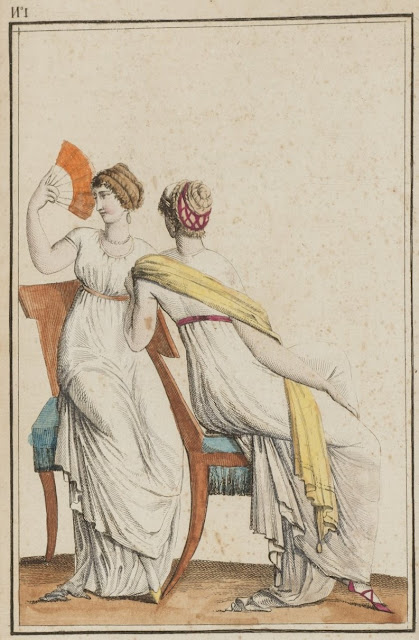
Tableau Général de Goût, no. 1 pl. 2

Image
YOUNG PERSON IN MORNING DRESS Blonde wig à la Flore.  The fashion of hair worn flat and cut à la Titus  begins to pass. Now the hair is curled. Wigs that imitate this coiffure have been subjected to hooks, at least for the part of the hair which goes around the face. The top of the wig is wrapped with a bandeau of orange crepe. Gold chain à l'esclavage . These gold chains, with flat links, are also used in the hair, where they serve as a bandeau. They are also seen used as belts, but this fashion has not been followed. Chemise gown without sleeves.  This chemise gown must have a long train: this gives it curvature. Which curvature? Without a doubt, the fashionable one. Plain orange shawl thrown with abandon.  This manner of throwing the shawl is picturesque and must please artists. It is equally advantageous and elegant. Bag.  The bag replaces pockets, banished henceforth from the trousseau of a pretty woman. It is never left off, they are made in ...

Tableau Général de Goût, no. 1 pl. 1

Image
1 Vendemier, an 7 (22 Sept. 1798) TWO WOMEN DRESSED A LA ROMAINE. No. 1 Hair braided and arranged in a spiral, enclosed in a net of red wool. This coiffure imitates the antique, and goes with their dress. It is not rare, though it is ridiculous, to see undress caps, velvet hats, cornettes of linen gauze, satin bonnets trimmed with plumes, toques of bouillonnée  gauze, turbans topped with a feather - one or another of these modern headdresses decorating the head of a woman in a tunic, in cothurnes ,* and draped  à la romaine . This discrepancy shocks good taste, but to each her own, and the proverb is right. White tunic.  This dress requires a good figure and a trim waist: these tunics are sleeveless, but often the rigors of the weather or a purer motive accessorizes them with very tight sleeves of knitted silk. The fashion of these sleeves has, however, fallen into disuse; since it has become trivial, nudity is preferred. Shawl.  The tassel attached to...

Transitional Stays Pattern

Image
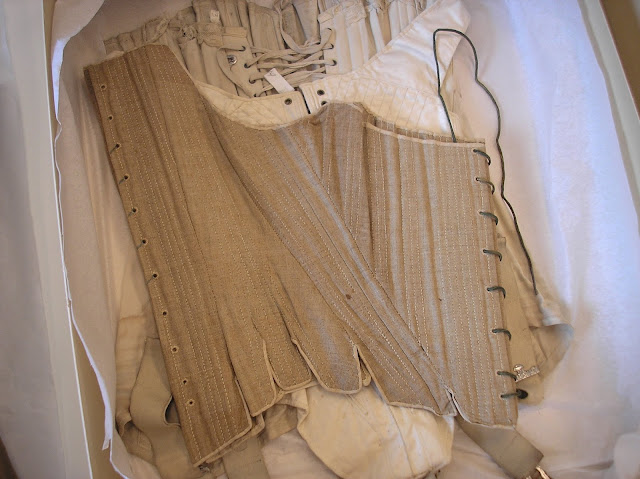
Hello, strangers! I'm back to post again about those underbust stays from the pre-Regency, in preparation for the Short Stays Sew-Along . I saw these, as the label suggests, at Historic Cherry Hill in Albany, NY. (I don't believe there was any definite provenance, but the house was owned by the Van Rensselaers and most if not all of the collection is original to the family.) They're quite simple to put together. The above pattern is 1" per grid box, and drawn without seam allowances. Here's my guide for scaling up patterns!  The marks at the bottom of the seams should be lined up, and the seams only run down to them. Materials used in the original: unbleached linen canvas linen tape (off-white, but not unbleached) - cotton twill tape is an acceptable substitution linen thread (off-white, but not unbleached) whalebone - cane or plastic are acceptable modern substitutes Process (requires hand-sewing): 1. The two side pieces are cut out of two...

A New Kind of Transitional Stay

Image
Hello! It's been a while - due to American politics, personal issues, and other factors, I just haven't had the energy to spend on historical sewing or writing about fashion (beyond what I do for AskHistorians; link to my profile if you'd like to read some short articles on a variety of social history topics) - but last month, I attended the 2018 CSA Mid-Atlantic/Southeastern Biregional Symposium in Shippensburg, PA. It was quite a trip! I was so happy to meet up with so many fashion history scholars, and particularly to meet Ann Wass (of Riversdale House Museum ), Mackenzie Anderson Sholtz (of Fig Leaf Patterns ), and Lydia Edwards (author of How to Read a Dress ). You can see all of my photos of the exhibition at the Shippensburg Fashion Archives and Museum on Instagram ! I delivered a paper of my own, which I hope to turn into a podcast episode/blog post soon, but what really thrilled me was the presentation Mackenzie gave, "A Transitional Corset and its Companion ...

Before Victoria: Royal Weddings (Part III)

Image
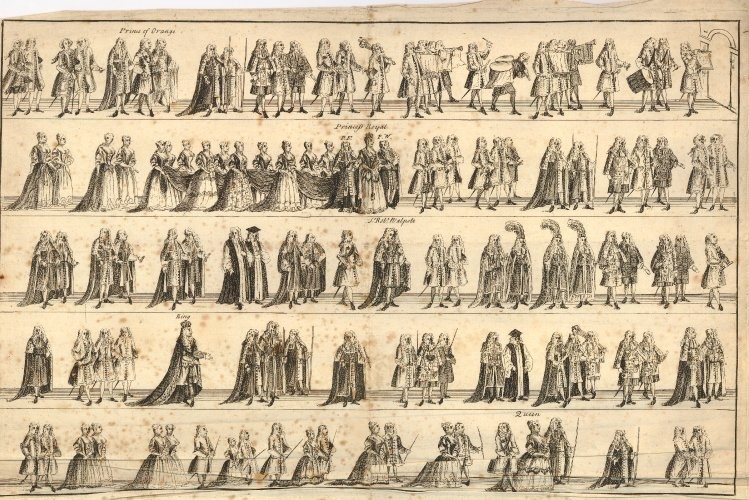
( Part I of this series and part II , if you're not coming to this from one or the other.) Royal weddings need to be dealt with on their own, because their dress traditions differed from those of ordinary and even aristocratic women. These differences are key to understanding the context of the gown that Queen Victoria chose for her own wedding, and what exactly was the tradition she was setting with it. I know that many of you are aware that royal weddings employed silver fabrics, but I think you might be surprised at the amount of white incorporated as well. "The Ceremony of the Marriage of the Princess Royal with the Prince of Orange," 1734; British Museum Mm,3.5 Anne, Princess Royal, was married to William, Prince of Orange, in 1734. The bride and her eight bridesmaids were all in the "stiff-bodied gown" – a two-piece gown made with a boned, back-lacing bodice. This style of dress had been fashionable in the 17th century and had held on as English c...

Before Victoria: the White Wedding Dress in the 18th and Early 19th Centuries (Part I)

Image
The history of white wedding dresses is a popular topic, and a few related narratives have built up in both popular and academic writing: Queen Victoria was the first to wear a white gown for her wedding in 1840, and women began to copy her, creating a tradition. Queen Victoria was not the first to wear a white wedding dress, but it experienced a boom in popularity as a result of her marriage. Queen Victoria was not the first to wear a white wedding dress, but it was only with her marriage that it took on the connotations of purity and innocence. I could digress to talk about the perils of "Great Man" history, but that's  better for a discussion on Chanel (hey-o!), so instead let's just look at why these narratives are all incorrect, and why Victoria was not really a turning point at all. (For the use of white, that is - Cele Otnes and Elizabeth Pleck make a very convincing argument in Cinderella Dreams: The Allure of the Lavish Wedding  that Victoria's wedd...

Lesser-Known Regency Accessories (HSM #7.2)

Image
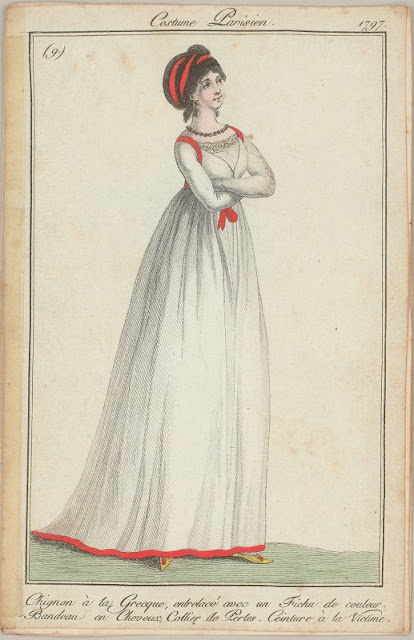
The Ceinture à la Victime References in French fashion to the Revolution's victims are not exactly unknown - in fact, they've achieved an almost mythological status. They seem to be thought of as a flash-in-the-pan pertaining only to the Directoire  era (1795-1799) and its uncertainty, but in actuality, they lost the connection to the guillotine and continued to be worn once society had become more stable. The earliest appearance in a fashion plate that I'm aware of is the above, from Journal des Dames et des Modes  in 1797. Variations, such as the " croisures à la victime " below (1797), appeared soon after. Both styles feature a bright, contrasting ribbon crossed over the back, wrapped around the shoulders, and tied at the waist. I don't find the references to the Terror's victims after 1797, but ribbon belts or sashes worn crossed over the back and around the waist continued to be depicted in fashion plates for about twenty years afterward...

In Defense of Pride & Prejudice (2005)

Image
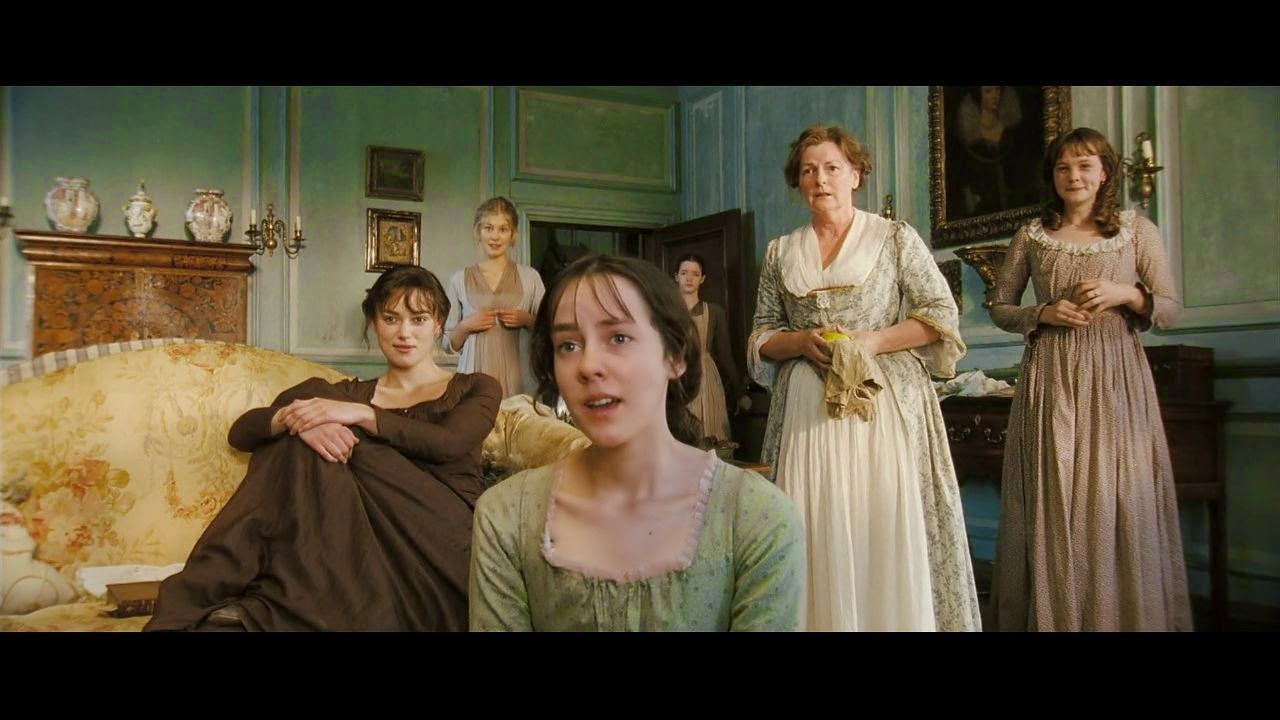
Since my Gatsby  post was so successful, I thought I'd follow up with my equally controversial thoughts on Pride & Prejudice  (2005). No, much more controversial. Sorry! But my overall opinion of the costuming is positive for a number of reasons. I have to start off with a disclaimer: I'm just talking about the costuming - my friend Rose wrote a very good post about issues with the writing, although I didn't entirely agree with her - and I'm not saying it's better in costuming or as a whole than the 1995 version. Frankly, the two are so far apart that I hardly see them as the same thing and don't really compare them. One is a faithful, longer form adaptation and one is a more romanticized retelling in shorter form. Though I do think it's odd that the more sexual additions with Colin Firth don't get the same treatment as some of the changes with Knightley and MacFadyen MOVING ON! The main trouble with the costuming in P&P2005 is that the des...

The Last 18th Century Patterning Visit*

Image
(* until I become a big name and they let me pattern at the Met and I do a second edition of the book with MMA 1991.6.1a, b  in it**) (** and until I start patterning outerwear and underwear, so maybe this was a poor choice of title) I actually made a visit prior to this one that was intended to be the last, but it transpired that I could not pattern four gowns and a petticoat in a day, so the second round of New York State Historical Association (at the Farmer's Museum) patterning took two visits.  Since I never posted about the last one, I'll condense them here. This is (the back of) a gown for a quite pregnant woman.  In my opinion, it was cut down from a gown or sacque that was made in the mid-to-late 1770s to fit with the styles of the late 1790s - I would have simply considered it a fashionable update, except that there are a few aspects that are decidedly unfashionable and the front shaping implies that it's for maternity wear.  And there's a small ho...