Posts

Showing posts with the label historical sew monthly

HSM #8 - Pattern: A Victorian Quilt

Image
Well, it was intended to be a Victorian quilt, but I'm not sure about the overall effect. Photographed on my bed for scale, but the quilt is now in Ohio with Julie. I've always meant to do some quilting, but it's never come up. In 2015, I went so far as to buy the fabric to make this one as a wedding present, but the actual Hallowedding bridesmaid dress was more pressing, so I backburnered this and ... forgot about it, pretty much. Then, earlier this year, when I was thinking about the "pattern" challenge, it occurred to me that patchwork quilting is definitely all about patterns. For inspiration and an idea of what I could sew that wouldn't take me too many months, I visited Warmth, Remembrance, and Art: 200 Years of Quilts and Comforters in Northern New York  at TAUNY, to which the St. Lawrence County Historical Association had loaned a couple of antiques. I was a little overwhelmed, but this brick pattern struck me as a good one for a first quilt...

HSM 2016 Challenge #5: Holes

Image
Sorry, I've pretty much given up on trying to get a good background in a photo in this apartment. The Challenge: #5, Holes - how would a corset function without the eyelets to lace it together? Fabric/Materials: Off-white cotton twill from my corset stash and heavy white twill tape. Originally I was going to cover it with satin, but in the end I'm glad I decided to make this a wearable mockup, as the pattern needs a little tweaking. Pattern: Based on this corset patent applied for by Mina Sebille, with some alterations and boning arrangement based on this corset at the Victoria & Albert Museum. I've been using one of your standard ungored, shaped-pieces corsets for a few years, and while it's been working well, it doesn't have enough hip spring to give me waist reduction. I figured a corset that had a separate hip piece would help me get the flare I needed. Which it does, to some extent! At least, I'm not getting much more reduction, but I am al...

HSM 2016 Challenge #4: Gender Bender

Image
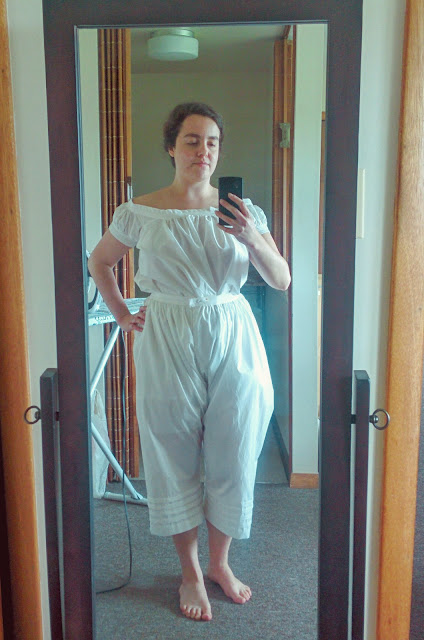
The Challenge: #4, Gender Bender. I know what you're thinking, but if we go back a few decades drawers were really controversial  for women - they simply didn't wear bifurcated garments. So even though I'm not aware of the attitude that drawers were inherently gender-bending still existing in the middle of the nineteenth century, I'm counting it because I really need drawers for my presentation. Fabric/Materials: White Pimatex cotton from Dharma Trading Co. at $6.79/yd. I'm not sure of exactly how many yards I ended up using - after making my chemise, there was only enough left for one leg, so I bought two more yards and didn't use all of that. I think it's probably about two yards in total? Pattern: From the drafting instructions by Liz Clark on the Sewing Academy Compendium. I was going to get out a pair in the collection and pattern them and base mine off that, but then I realized that that made no sense. The instructions are very clear and sim...

HSM 2016 Challenge #3: Protection

Image
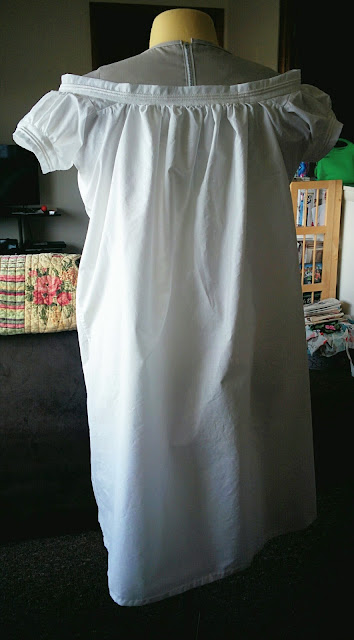
For the "Protection" challenge, I made a chemise to wear for the Civil War Weekend. Chemises, of course, protect your skin from the corset, and your corset (and other clothes) from your skin, and so are a perfect thing to make as an example of a protective garment. This is the pattern I used , which I took while working at the Chapman Historical Museum. It would be a very good one for a first attempt at scaling up a pattern - I strongly recommend it if you have any interest in practicing that skill. That said, the actual making is tricky. There's a lot of gathering, and since the original had the bands attached by machine I didn't do stroked gathers, which are in a way simpler and hang better. I really should have used a smaller cording (the original has five rows) and should have started it much closer to the fold, so as to have more room for the seam allowances. I had to trim them quite close. Setting in the neckline gussets was also a tricky annoyance. Th...

HSM 2016 Challenge #2: Tucks and Pleats

Image
Last year at my museum's Civil War Weekend, I was not very well kitted out. I had a decent corset, a good cage from Kay Gnagey (worth the money, by the way), a secondhand dress that fit perfectly, an 1840s chemise that's too tight under the arms, and a knee-length 1950s-style crinoline I used as a petticoat (which was awful but better than nothing). So the plans I laid out in December have been changed, because without firm deadlines I won't finish anything. Instead, I'm using the first half of the year to get everything together, starting with a pair of petticoats. This is especially important as I'm going to do a "Dressing the Fashionable Woman" presentation and need to have every layer in viewable condition. Petticoat, 1850-1865; MMA 2009.300.3256 (OASC) Liz Clark's instructions for petticoats describe pretty much what I did; I used the patterns at the end of Patterns of Fashion I  to calculate how much yardage to buy, and otherwise just sor...

HSM 2016 Challenge #1: Procrastination

Image
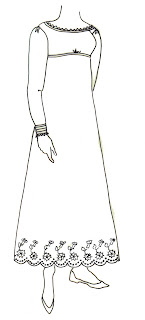
Talk about procrastination! I started this dress the same time last year, after I finished a sloppy version of Sabine's short corset to wear under it. I got as far as attaching the front of the bodice to the skirt before feeling like it just wasn't working, and not having the prospect of any era-appropriate events in the near future, set it to one side. But then Regency Women's Dress  came out, and I moved up to the Canadian border, and I was asked to speak about women's clothing at an event this winter, and I needed to finish this. Although it's turned out that I won't be able to do that event, I still needed to finish it! Sometime after moving, I found a wearable mockup long corset I'd made and never gotten around to copying and doing up properly. (NB: I still haven't!) it didn't/doesn't fit quite properly, but the important thing is that it creates the 1810s silhouette, lifting the bust above the natural level. Because of this, I was abl...

A Very Accurate Costume (HSM #12, Redo - #10, Secret)

Image
It took me forever to figure out what to write for this! I knew that the Redo challenge needed to be October's Secret challenge, which I missed, but Secret was much easier to do while sewing, putting a little secret embroidery or hidden pocket. At last I remembered an historic dress that has its own secret. Evening dress; Old Sturbridge Village 26.33.132 This gown, in the collection of Old Sturbridge Village, was among the ones I evaluated for patterning when I went there last year. And because it appears to be a lovely early 1820s evening dress, I patterned it. But while I was patterning, I realized that this lovely gown holds a terrible secret - it's not from the period! It's the best costume/reproduction I've ever seen in a museum, to the point where I really grappled with myself in deciding what was going on with the gown: idiosyncratic Regency garment, or very well-made costume? In the end, I decided it was likely a costume, despite the fact that it's e...

Historical SEW Monthly 2016 - First Seven Months

Image
While I'm still working on December's post, doing the "Secret" challenge I missed in October (translation: still trying to figure out what I should write about), I finally took a look at next year's challenges. Because I did so much sewing this year - compared to previous years' output, in both clothes to wear in everyday life and historical clothes - I finally feel like it's possible for me to make sensible choices for projects, and actually follow through on them! In order to facilitate that following-through and have a published record of what I should be doing, here are my thoughts on (some of) the 2016 HSM challenges . January: Procrastination – This one is very easy. I've had a Regency morning dress half-done for about a year now, which I will need for the Battle of Ogdensburg in February, where I will be speaking! It's a lovely soft cotton twill, smallish checks on a beige ground, and the pattern is taken from Regency Women's Dress  (...

The Hunger Games (Silver Screen - HSM #11)

Image
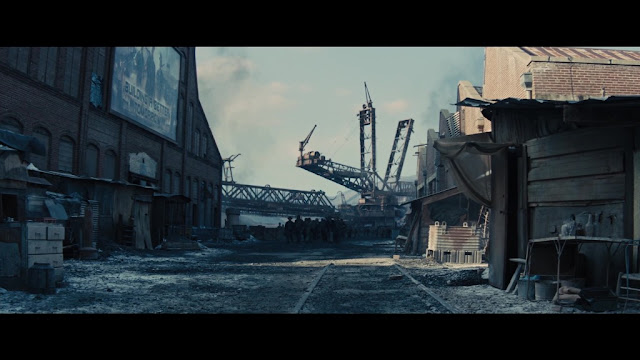
Sorry that I missed October! I promise to get to "secrets" in December for the re-do challenge - there was a lot going on and that's a tricky one for writing. The Hunger Games  and its sequels are set in the far future, in an America ravaged by climate change and changed politically beyond recognition. However, there's so much influence from the 1930s and early 1940s in the costuming and design that I tend to spend a lot of my time watching for that. This is really an image-heavy post rather than a text-based one, because I want to highlight these design elements that your eye might have skated over. Warning: there's a spoiler for the latest movie in here. It's from the book, but if you're a movie-only fan ... Very little in the various districts would look out of place for rural Depression-era towns. The buildings are dilapidated shanties or abandoned factories, with nothing futuristic about them. Two views of District 12. Compare to th...