Posts

Transitional Stays Pattern
Image
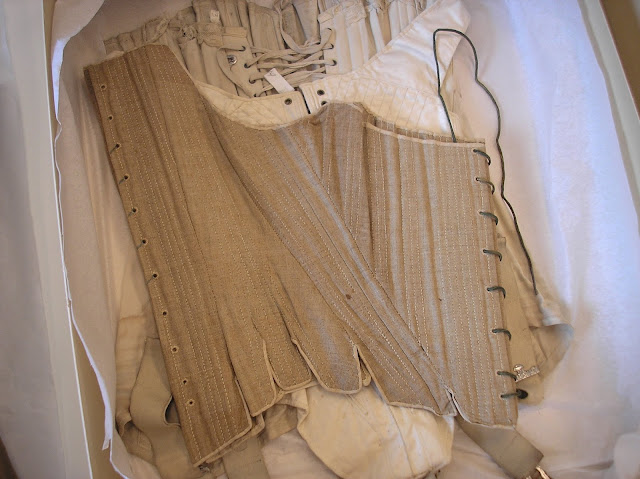
Hello, strangers! I'm back to post again about those underbust stays from the pre-Regency, in preparation for the Short Stays Sew-Along . I saw these, as the label suggests, at Historic Cherry Hill in Albany, NY. (I don't believe there was any definite provenance, but the house was owned by the Van Rensselaers and most if not all of the collection is original to the family.) They're quite simple to put together. The above pattern is 1" per grid box, and drawn without seam allowances. Here's my guide for scaling up patterns!  The marks at the bottom of the seams should be lined up, and the seams only run down to them. Materials used in the original: unbleached linen canvas linen tape (off-white, but not unbleached) - cotton twill tape is an acceptable substitution linen thread (off-white, but not unbleached) whalebone - cane or plastic are acceptable modern substitutes Process (requires hand-sewing): 1. The two side pieces are cut out of two...

Book Review: Patterns of Fashion 5!

Image
Patterns of Fashion 5: The content, cut, construction and context of bodies, stays, hoops and rumps c. 1595-1795  - Years in the making, and I think we're all very excited to have it out at last! A little background, if you're not familiar with it: Janet Arnold wrote the original two Patterns of Fashion  books (1660-1860 and 1860-1940) in the 1960s, and followed them up in 1985 with a third based on 1560-1620. A fourth was published posthumously on shirts, smocks, ruffs, etc. in roughly the same time period (she worked on Elizabethan and Shakespearian dress quite a bit), based on her original material, edited and added to by Jenny Tiramani (longtime professional costume designer with a passion for accuracy) and Santina Levey (a lace/embroidery specialist). Patterns of Fashion 5  is likewise based on her patterns and notes, but has been very extensively added to by Jenny Tiramani and Luca Costigliolo (also a costume designer; the two have worked together for a long ...

“Dresses All Worn Long in the Evening”: Fashion in the “Provincial Lady” Diaries of E. M. Delafield

Image
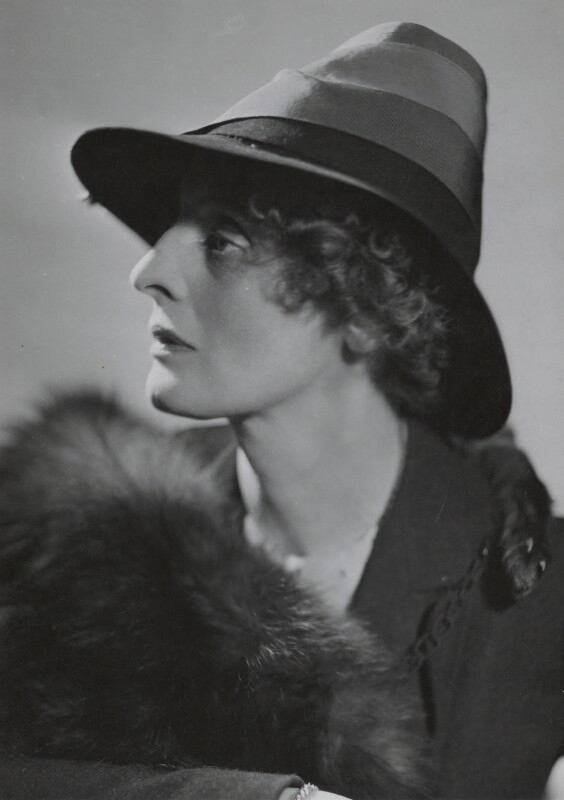
(In October, I attended the Costume Society of America Southeastern/Mid-Atlantic Symposium in Shippensburg, Pennsylvania. My debut as a conference speaker! I presented this paper.) "Edmée Elizabeth Monica Dashwood (née de la Pasture)", Howard Coster, ca. 1938; National Portrait Gallery x10669 Edmée Elizabeth Monica de la Pasture Dashwood (1890-1943), better known by her punning nom de plume E. M. Delafield, penned dozens of novels and plays about middle- and upper-class British society in her short life. She was already a successful author when Margaret Mackworth, Viscountess Rhondda, asked her to write a "space-filler" for the feminist literary magazine, Time and Tide , in 1929. This filler, very much based on the author's life and acquaintances, was titled Diary of a Provincial Lady , serially printed, and eventually published in book form in 1930. The unnamed protagonist's social standing is only indirectly stated: she is certainly below the elega...

A New Kind of Transitional Stay

Image
Hello! It's been a while - due to American politics, personal issues, and other factors, I just haven't had the energy to spend on historical sewing or writing about fashion (beyond what I do for AskHistorians; link to my profile if you'd like to read some short articles on a variety of social history topics) - but last month, I attended the 2018 CSA Mid-Atlantic/Southeastern Biregional Symposium in Shippensburg, PA. It was quite a trip! I was so happy to meet up with so many fashion history scholars, and particularly to meet Ann Wass (of Riversdale House Museum ), Mackenzie Anderson Sholtz (of Fig Leaf Patterns ), and Lydia Edwards (author of How to Read a Dress ). You can see all of my photos of the exhibition at the Shippensburg Fashion Archives and Museum on Instagram ! I delivered a paper of my own, which I hope to turn into a podcast episode/blog post soon, but what really thrilled me was the presentation Mackenzie gave, "A Transitional Corset and its Companion ...

Magasin des Modes, 5e Cahier, Plate II

Image
December 30, 1786 FRENCH FASHIONS. We said in the second Book of this second Year that women hardly go out in the morning but in night caps, when they aren't dressed; we should add here that many wear a chapeau-bonnette  over the night cap. In this manner, they give an air of half-dress which saves them from the great undress that the simple night caps, which would never be supportable without fashion, present to the eye. How was this fashion begun? We dig into our heads to imagine it, and do not succeed. It is impossible for us to conceive it, when we think that there are so few women who have a seductive air in a night cap. Everything that we can find is that women have decided to renounce looking pleasant during this part of the day. Could we concede this beautiful invention without fear that we will be reproached for pronouncing some blasphemy against the Ladies' taste? The Woman dressed in a violet satin gown wears over the night cap a gauze  chapeau-bonnett...

Magasin des Modes, 5e Cahier, Plate I

Image
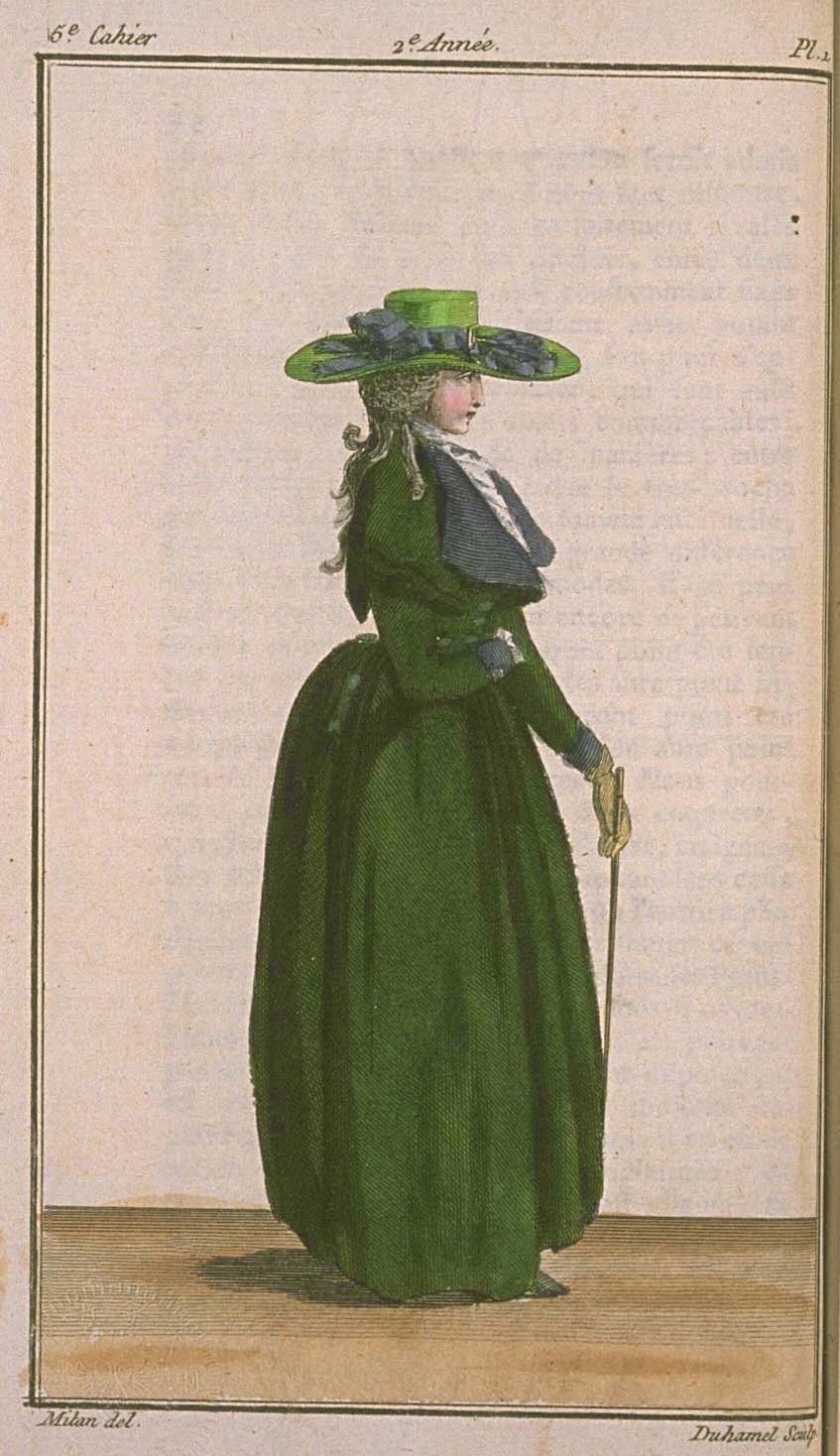
December 30, 1786 [The issue begins with a long remark on the interchange of fashion between France and England, "whose eyes are constantly fixed on one another".] Consequently, one should not be astonished if we happen to give as English Fashion what was some time ago French Fashion, and as French Fashion was we had already published as English Fashion. Men's redingotes, that we should call Franco-Anglomane  gowns, having come from Englishwomen to Frenchwomen, and this Fashion existing still in both countries, one should not be surprised today if we show Englishwomen dressed like Frenchwomen. The Englishwoman drawn in PLATE I wears a man's redingote of olivish wool, with three wide collars falling very low to below the shoulders, with large revers lined with violet satin, with violet satin cuffs, and trimmed on the cuffs, on the hips, and on the fronts with wide white mother-of-pearl buttons. A sort of belt of the same wool, trimmed with the same buttons, bin...

Magasin des Modes, 4e Cahier, Plate III

Image
December 20, 1786 FRENCH FASHIONS. Two women's Busts. The first, dressed in a pink satin gown, wears a hat with a very high crown, made of satin with pink stripes and Sky blue stripes, trimmed on the front in three rows of large bows of yellow ribbons with green plain stripes down the middle and pinked pink stripes on the edges, and on the back with three large bows of matching ribbons. In the middle of the three rows of large ribbon bows rises an aigrette of seven medium plumes in white, pink, black, and green. A veil of satin matching that used on the hat hangs from the back. The crown of this hat is, so to speak, the only hat crown which is worn today. They are made in different satins with stripes of different colors - blue and white, black and pink, yellow and black, violet and white, etc. The Woman's hair is all frizzed en tapet , and six curls, placed in three rows, hang over her chest. Her hair, behind, is pulled up in a floating chignon . On her neck, a ...