For the study of historical dress; consisting of analyses of costume in paintings, translations of and research into fashion plates, and occasionally actual sewing.
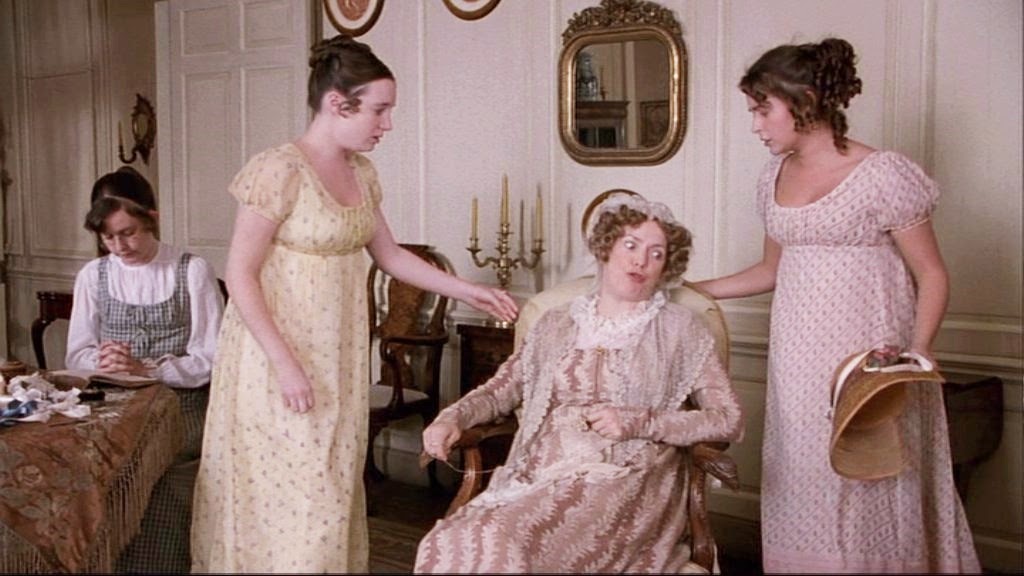
I did threaten to write about the Ehle/Firth Pride and Prejudice , and since I'm in a writing mood without a topic I decided to make good. Regency adaptations tend to go for an overall accurate look, interpreting age and income within the confines of realistic silhouettes and colors, and so they avoid the scrutiny and reputation that a more obviously artistic and unrealistic production garners. But just as this version of P&P is not entirely faithful in every respect (e.g. the added Darcy-perspective scenes, the actors nearly all being significantly older than their characters - perhaps the most egregious example being Julia Sawalha in her late twenties playing teenage Lydia), Dinah Hill's costuming is not entirely accurate - mainly in ways that make the period more appealing to modern tastes. The exact date when the story is set is never given; generally, the movie's taken to be set in 1813, when the book was published. I'm not going to go into the full story of...
Recently, I began following a couple of Tumblr blogs focusing on waist training and daily corset wear. Daily wear is not for me, waist training even less so, but I find it an interesting practice. It is also a controversial one. For example, a recent Huffington Post article, " Corset Queen Penny Brown Loves Getting 'Waisted' ," drew comments which were nearly all extremely negative, as do most articles that bring the practice to mainstream attention. Usually, the mental states of the women who waist-train are called into question, and there are numerous references to feminism as incompatible with corsets. The general idea is that the first wave feminists of the late 19th and early 20th century would be horrified by women today wearing them, and that their assumed reaction is an objective statement on the practice. My feeling is that the subject is complex, and cannot be simply declared feminist or unfeminist. There are far more factors than the average internet comm...
What I really want to do is a post just on the mantua, but I know that if I do that I'm going to have to explain court dress first to feel like it's complete. But court dress is interesting on its own merits, anyway! In the later seventeenth century, court dress was basically the same in France and England. It was based on ordinary clothing: a boned bodice (requiring no stays beneath) with puffed sleeves and an extremely long point in the front, and a matching petticoat. This would all be heavily decorated, of course, with gold and silver embroidery and lace, and with ropes of pearls and precious stones. Catherine of Braganza, Queen of England , Sir Peter Lely (1618-1680), 1665



Comments
Post a Comment