Posts

Announcing 2020's hottest new event

Image
Putting it in writing to make sure it happens - next summer, I'm going to be hosting an 1830s picnic in central New York! Hyde Hall - this was in April when it was still very cold, so it will be more lush, I promise! Hyde Hall is a gorgeous mansion on Otsego Lake in Springfield Center. It was built between 1817 and 1834, which makes it a perfect place to have a pre-Victorian event. It also has a great big grassy lawn, and I've already mentioned this to the staff there and they think it would be pretty cool! Why am I posting about this so early? Well, mainly because I planned to do it this year and it never happened (though in fairness, I spent half of July out of town, so ... that made it hard to plan or prepare), and I want to make sure that I do pick a date and that it gets held. This is also not a period that most people sew for, so it might take us all some time to create our ensembles. With that in mind, I'm going to be writing a series of posts on 1830s dres...

The Art of the Lingère - Chapter VII: Second Part of the Works of the Lingère

Image
The Layette In an earlier chapter, marriage gave the lingère the work of making and furnishing a convenient trousseau. Once the wife is pregnant, she must still resort to the lingère: she contemplates the fact that she is going to become a mother, and therefore it is time to prepare the layette for her and the infant that she will bring into the world. "Layette", which etymologically means a "little box", refers today to an assemblage of all the clothes and necessary items for the infant born by its mother during the time of her confinement. With regard to the newborn, whether a boy or a girl: the sexes are not distinguished by different clothing until the age where the infant is no longer an infant. The layette can be magnificent like the trousseau, and for the same reasons a magnificent one will be described: it will contain every possible item. How and when it is put on the infant will also be indicated, and what is called the "suit": this item...

The Art of the Lingère - Chapter VI: The Seaming Stitches in use in Lingerie; Marking Linens; and the Sewing of Lace.

Image
Lingères not only sell and cut linens, laces, etc., but as they are charged most often to make garments that are finished and ready to be worn, they send them out for seaming, assembling, mounting, and marking to their Linen Workers. Sometimes the assembling is also done in households of women or by maids who have some knowledge in that respect, or even by thrifty ladies who do it for their amusement: this is why we will explain the seaming stitches used in linen-making as clearly as possible, together with the method of sewing the different marks on the linen that make it known to the laundresses, or any other launderers, to whom they belong. The different Stitches are: The overcast stitch, which joins fabrics at the edges. The whipstitch, which holds fells at the edges. The backstitch, which joins fabrics flat. The running stitch, same. The flat-felled seam joins and holds the edges. The knotted or buttonhole stitch, which prevents edges from frayi...

Tableau Général de Goût, no. 2 pl. 3

Image
16 Vendémiaire an 7 (7 October 1798) YOUNG WOMAN ON A PROMENADE Blonde wig à la Naiad.  The triumph that wigs have carried over natural hair will last a long time: it is more ornamental than hair. Our elegant women have cut their hair as if they have taken the veil, a strange coiffure, and one that only looks well on some very young people. Can you believe that we have seen (such is the power of fashion, that it often blinds self-love itself!) women coiffed à la Titus  with grey hair? This women's mania for looking shorn could not last. Wigs retook favor, and with them, the inappreciable advantage for coquetry to be able to change the color of one's hair as one changes clothing. Hat topped with a green toque and two white and black plumes. This hat is wrapped with white taffeta with black velvet net.  It is difficult to determine which type of coiffure is triumphing among the beauties. They vary infinitely and it is rare to meet two elegant ladies in a brillia...

Tableau Général de Goût, no. 1 pl. 2

Image
YOUNG PERSON IN MORNING DRESS Blonde wig à la Flore.  The fashion of hair worn flat and cut à la Titus  begins to pass. Now the hair is curled. Wigs that imitate this coiffure have been subjected to hooks, at least for the part of the hair which goes around the face. The top of the wig is wrapped with a bandeau of orange crepe. Gold chain à l'esclavage . These gold chains, with flat links, are also used in the hair, where they serve as a bandeau. They are also seen used as belts, but this fashion has not been followed. Chemise gown without sleeves.  This chemise gown must have a long train: this gives it curvature. Which curvature? Without a doubt, the fashionable one. Plain orange shawl thrown with abandon.  This manner of throwing the shawl is picturesque and must please artists. It is equally advantageous and elegant. Bag.  The bag replaces pockets, banished henceforth from the trousseau of a pretty woman. It is never left off, they are made in ...

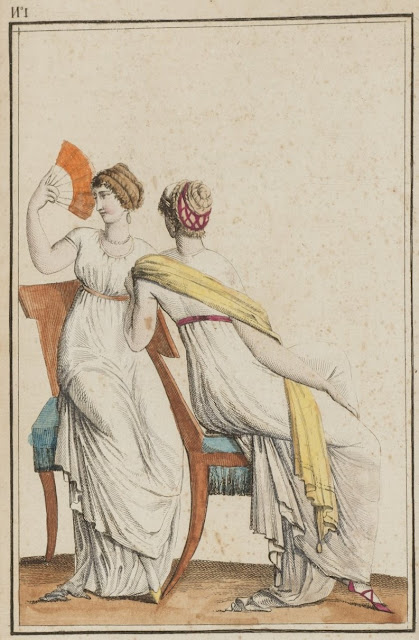
Tableau Général de Goût, no. 1 pl. 1

Image
1 Vendemier, an 7 (22 Sept. 1798) TWO WOMEN DRESSED A LA ROMAINE. No. 1 Hair braided and arranged in a spiral, enclosed in a net of red wool. This coiffure imitates the antique, and goes with their dress. It is not rare, though it is ridiculous, to see undress caps, velvet hats, cornettes of linen gauze, satin bonnets trimmed with plumes, toques of bouillonnée  gauze, turbans topped with a feather - one or another of these modern headdresses decorating the head of a woman in a tunic, in cothurnes ,* and draped  Ã  la romaine . This discrepancy shocks good taste, but to each her own, and the proverb is right. White tunic.  This dress requires a good figure and a trim waist: these tunics are sleeveless, but often the rigors of the weather or a purer motive accessorizes them with very tight sleeves of knitted silk. The fashion of these sleeves has, however, fallen into disuse; since it has become trivial, nudity is preferred. Shawl.  The tassel attached to...

My First Bib-Front Gown

Image
Somehow, I'd never made a bib-front gown before. But when I was given a length of cotton by a new friend at the 2018 regional CSA symposium, I knew it was going to be for something from  Regency Women's Dress - and as that was the place where I realized that the awkwardly-fitting stays I'd made years before were actually transitional , I wanted to sew a transitional gown as well to wear over them. The one I eventually made is based on both bib-front patterns in  RWD : the bodice is from the one with long sleeves (at the Fenimore Art Museum, p. 42), and the skirt from the other (at Old Sturbridge Village, p. 46). Scaling and sizing it up was not too problematic - I think the trickiest part was figuring out the appropriate size for the bib. The sleeves I didn't even touch, as the sleeve head is very large and my forearms are slim, but the fit was ... very close. They're also long, cut to scrunch up on the arm, which I love Me and Katie Lovely ! Both of us in pr...