Posts

Tableau Général de Goût, no. 2 pl. 3

Image
16 Vendémiaire an 7 (7 October 1798) YOUNG WOMAN ON A PROMENADE Blonde wig à la Naiad.  The triumph that wigs have carried over natural hair will last a long time: it is more ornamental than hair. Our elegant women have cut their hair as if they have taken the veil, a strange coiffure, and one that only looks well on some very young people. Can you believe that we have seen (such is the power of fashion, that it often blinds self-love itself!) women coiffed à la Titus  with grey hair? This women's mania for looking shorn could not last. Wigs retook favor, and with them, the inappreciable advantage for coquetry to be able to change the color of one's hair as one changes clothing. Hat topped with a green toque and two white and black plumes. This hat is wrapped with white taffeta with black velvet net.  It is difficult to determine which type of coiffure is triumphing among the beauties. They vary infinitely and it is rare to meet two elegant ladies in a brillia...

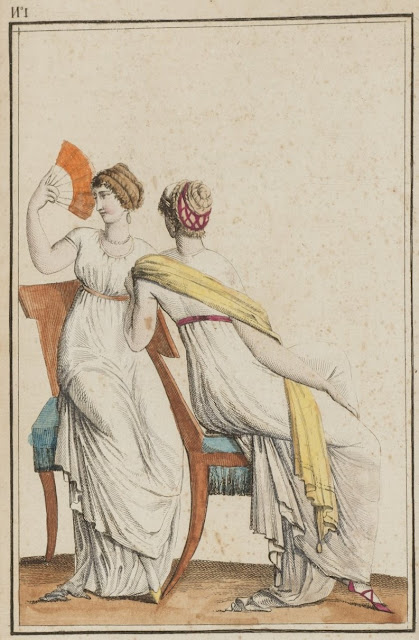
Tableau Général de Goût, no. 1 pl. 2

Image
YOUNG PERSON IN MORNING DRESS Blonde wig à la Flore.  The fashion of hair worn flat and cut à la Titus  begins to pass. Now the hair is curled. Wigs that imitate this coiffure have been subjected to hooks, at least for the part of the hair which goes around the face. The top of the wig is wrapped with a bandeau of orange crepe. Gold chain à l'esclavage . These gold chains, with flat links, are also used in the hair, where they serve as a bandeau. They are also seen used as belts, but this fashion has not been followed. Chemise gown without sleeves.  This chemise gown must have a long train: this gives it curvature. Which curvature? Without a doubt, the fashionable one. Plain orange shawl thrown with abandon.  This manner of throwing the shawl is picturesque and must please artists. It is equally advantageous and elegant. Bag.  The bag replaces pockets, banished henceforth from the trousseau of a pretty woman. It is never left off, they are made in ...

Tableau Général de Goût, no. 1 pl. 1

Image
1 Vendemier, an 7 (22 Sept. 1798) TWO WOMEN DRESSED A LA ROMAINE. No. 1 Hair braided and arranged in a spiral, enclosed in a net of red wool. This coiffure imitates the antique, and goes with their dress. It is not rare, though it is ridiculous, to see undress caps, velvet hats, cornettes of linen gauze, satin bonnets trimmed with plumes, toques of bouillonnée  gauze, turbans topped with a feather - one or another of these modern headdresses decorating the head of a woman in a tunic, in cothurnes ,* and draped  à la romaine . This discrepancy shocks good taste, but to each her own, and the proverb is right. White tunic.  This dress requires a good figure and a trim waist: these tunics are sleeveless, but often the rigors of the weather or a purer motive accessorizes them with very tight sleeves of knitted silk. The fashion of these sleeves has, however, fallen into disuse; since it has become trivial, nudity is preferred. Shawl.  The tassel attached to...

My First Bib-Front Gown

Image
Somehow, I'd never made a bib-front gown before. But when I was given a length of cotton by a new friend at the 2018 regional CSA symposium, I knew it was going to be for something from  Regency Women's Dress - and as that was the place where I realized that the awkwardly-fitting stays I'd made years before were actually transitional , I wanted to sew a transitional gown as well to wear over them. The one I eventually made is based on both bib-front patterns in  RWD : the bodice is from the one with long sleeves (at the Fenimore Art Museum, p. 42), and the skirt from the other (at Old Sturbridge Village, p. 46). Scaling and sizing it up was not too problematic - I think the trickiest part was figuring out the appropriate size for the bib. The sleeves I didn't even touch, as the sleeve head is very large and my forearms are slim, but the fit was ... very close. They're also long, cut to scrunch up on the arm, which I love Me and Katie Lovely ! Both of us in pr...

The Art of the Lingère - Chapter V: Explanation of the Terms of Art

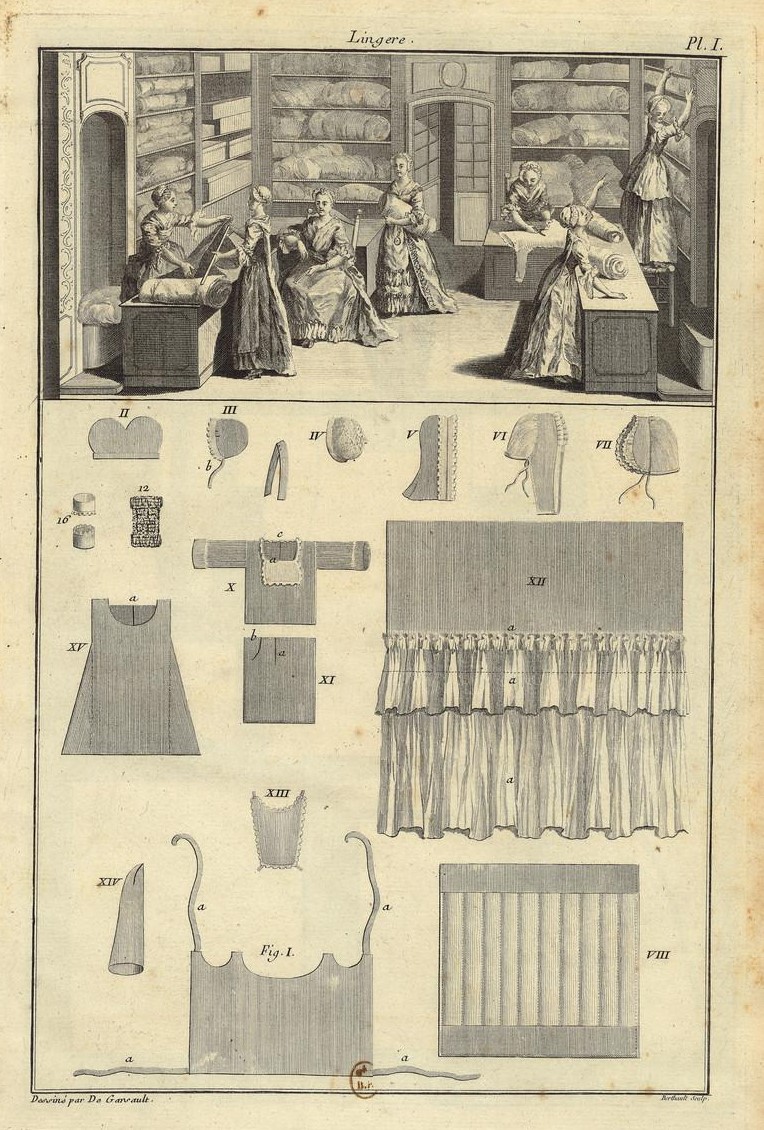
FIFTH CHAPTER Explanation of the Terms of the Art, spread through in the previous Article and in the following. We thought that it would be more convenient and more comfortable to the reader to find the explanation of the terms of art used in the previous and following articles here, than to have to go look at the end of the book. The term “row” is applied not only to the ruffles of a cap, but also to the sleeve ruffles, when there are several layers of cloth or lace one over the other; that's why one says, “Cap with two rows”, “Manchettes with three rows”, etc. The term “band” is applied not only to coiffures and caps, but also to all lengths of linen, muslin, etc. of small width, which are used to edge several pieces of lingerie. The “trimming” consists of bands that are placed around the edges of certain pieces of lingerie. “The selvage at the bottom, on the front, etc.” are expressions which signify that the piece must be cut so that the selvage of the fabr...

The Art of the Lingère - Chapter IV: First Part of the Works of the Lingère

Image
The Trousseau. Two great events in life exercise the art of the  lingère  more than any other: marriage and birth, and it is not to be doubted that marriage precedes legitimate birth. When a marriage is decided, fathers and mothers, a relative, etc. ordinarily prepare the trousseau for the wife. "Trousseau" means everything that is necessary to enter into housekeeping, excepting bedclothes and table linen, which the husband must provide. The rich and the great make it of what is most beautiful and most sought-after. We will use this type for an example, because its description will present most of the pieces which are used by women. So we begin with the list for a most opulent trousseau: the yardage of the pieces will be next detailed, then their cut and their fashioning for those who need it. The same will be done for an infant's layette, which will be followed by several pieces of linen which are neither part of the trousseau nor the layette, and we will finis...

The Art of the Lingère - Chapter III: On Measuring

There is no question that this art rests on exact measures, given that its products are made to be extremely comfortable and ample enough to keep from interfering with the body's movements, and so washing the cloth before using it can hardly be dispensed with. By this precaution, which tightens it up, you can be assured that they will remain in the same state: you must do this to measure them well. And when the fabric is taken up to be used for any garment whatsoever, the only thing that the lingère has to do is to find out if the person is fat or thin, tall or short, which is sufficient to determine the amount needed to make the number of garments requested. For it is very rare that a single piece of body linen is made at a time, not only because there will be a greater waste of fabric, but also because linen worn on the skin gets dirty promptly, so that one is obliged to change it. Thus it is more common to speak here of pairs, half-dozens, and dozens, than one. Next: on the d...