Posts

The Clarissa Dress (Part One)

Image
I like giving my projects names - in this case, it's the "Clarissa dress" because I made it to portray Clarissa Moody Wright (1804-1871) in Canton's Dairy Festival Parade. It was difficult to figure out exactly what date to aim for: Clarissa was ten years younger than her husband, but the man who was going to portray Silas* is ... well, there's a larger age difference; I also look young for my age by modern standards and very  young by early nineteenth century standards. So should I dress as Clarissa would have as a long-married woman, or as the age that I look? In the end, I decided that a) it's not much of an educational event, as I won't be doing any actual interpreting, b) nobody in the crowd bar three or four people is going to have any idea that I'm representing a real person, let alone who she is and when she was alive, and c) I really wanted to sew the green checked dress from the mid-1820s from Regency Women's Dress . That seems fair to me...

Petticoat (and Stomacher) Situations

Image
The Facebook discussion on my last blog post was really helpful - it made me realize that I should have been much  more explicit about what I was discussing regarding timeframe and class level, and I plan to update the other post to reflect that in a bit. But I also thought it would be worthwhile to talk about the situations where my suggestion is not useful, for balance (and because it lets me talk about the early 18th century, i.e. the best part of the 18th century). To recap and clarify: my point was that portraits and images of fine clothes from the 1750s, 1760s, and early 1770s (in the Anglo-American, British, and French contexts) generally show women with gown, petticoat, and stomacher made of one fabric, and that when they are not all the same, you are more likely to see the stomacher not match the other two than a petticoat that contrasts with a matching gown and stomacher, and that the stomacher and petticoat matching each other and contrasting with the gown is an even r...

Some (Unasked-For) Advice

Image
So, there's a stylistic issue that's started to stand out to me in 18th century costuming. And you can feel free to disregard this post if you want to; I'm not the reenactment police. The issue is: stomachers and petticoats that match each other while contrasting with the gown. Outlander  here serves as a great example, since so many 18th century films are either set in the 1780s or have anachronistic stomacher-less bodices in earlier decades. But others do it too! The look of a stomacher that matches the petticoat seems to have been really attractive to people through the nineteenth century, and continues to be so up to today! For starters, this illustration dates to only a couple of generations after stomacher'd gowns were being regularly worn: Image of marriage from The Stages of Man, ca. 1815; the Abby Aldrich Rockefeller Folk Art Collection Many museums have dressed mannequins like this through the years , matching up a gown they own with a lone pet...

The Invention of the Fashion Label

Image
Almost a year ago, I wrote a post about  re-evaluating the many claims made about Charles Frederick Worth's innovations in the couture industry . It included a paragraph on how there aren't any labels in dresses that predate Worth's career (or, technically, the existence of  Worth & Bobergh , 1858-1871) and on the existence of labels in other items of clothing from the late 18th century, but ultimately didn't come to a conclusion on the matter. A recent discussion on a fashion history board brought the issue to mind again. Lacking documentary evidence for sewing brand labels inside gowns - even  Ingrid Mida  says in  The Dress Detective  that Worth is only "said to have been the first", and  The Opulent Era : Fashions of Worth, Doucet, and Pingat , which might be one of the best sources on late 19th century haute couture, says that "whether this house was the first dressmaking establishment to identify its creations is not known ..." ...

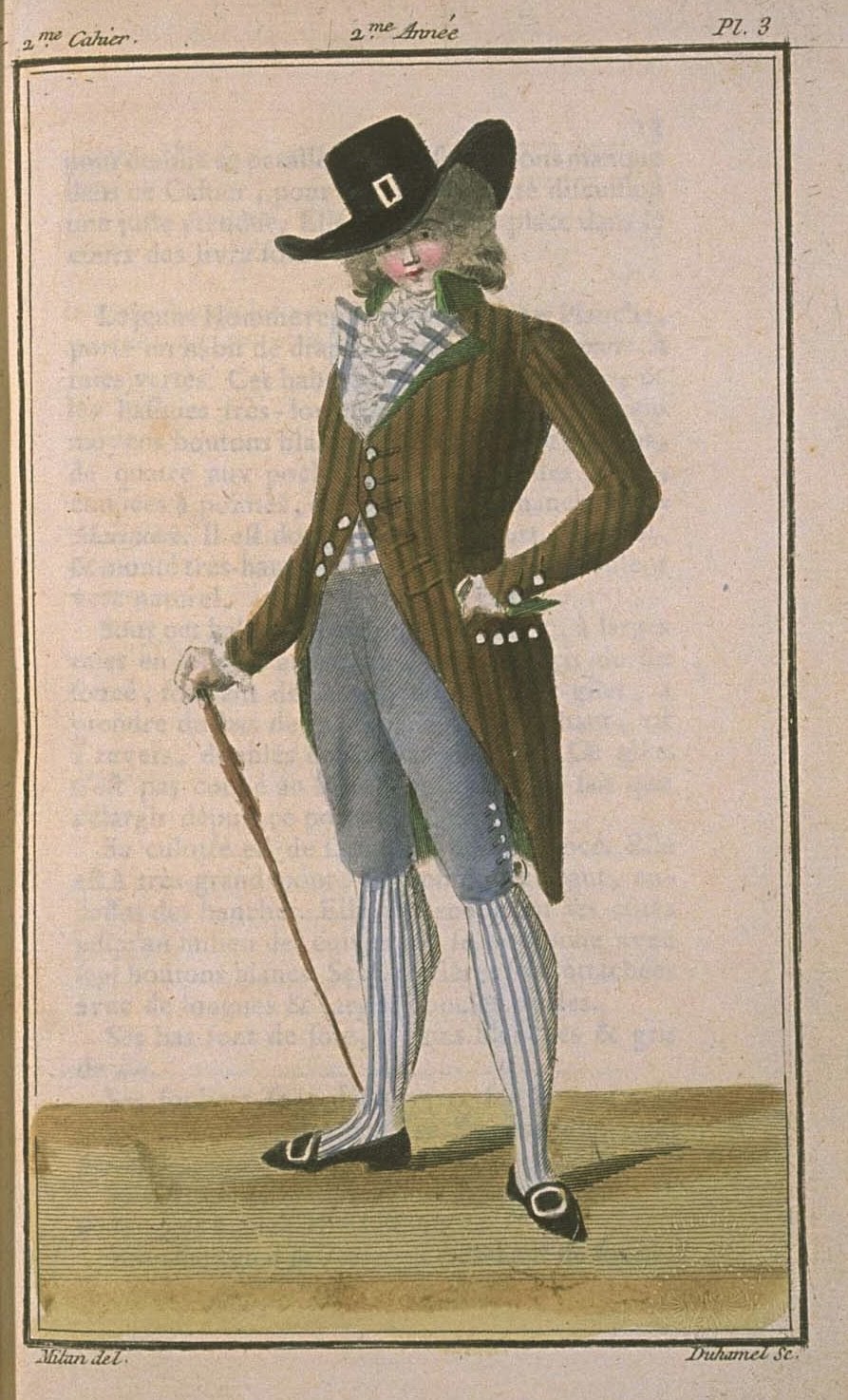
Magasin des Modes, 2e Cahier, Plate III

Image
November 30, 1786 ENGLISH FASHIONS. May young people not follow the fashion of the cramped  and stiff attitude of the young Englishman shown in this Plate; may they feel that this young man lacks the liberty, the ease which makes grace, that the French possess more than any other Nation, and which must be recherchée  at least by all the Votaries of Fashion. We only give English Fashions in order that those who will desire it will adopt the costume, which does not allow being piquant , but never in order for them to adopt the discomfort, the contortion, which would give, it is true, a foreign air, but not an agreeable and seductive one. We will never argue here whether English dress is preferable to French dress, which differed so much hardly twelve years ago; whether it makes the body better, pronounce accents better, and give it more grace: we have not yet produced enough Prints of this to establish this comparison, and we lack the space in this Book to give this dis...

Review: Stays and Corsets, by Mandy Barrington

Image
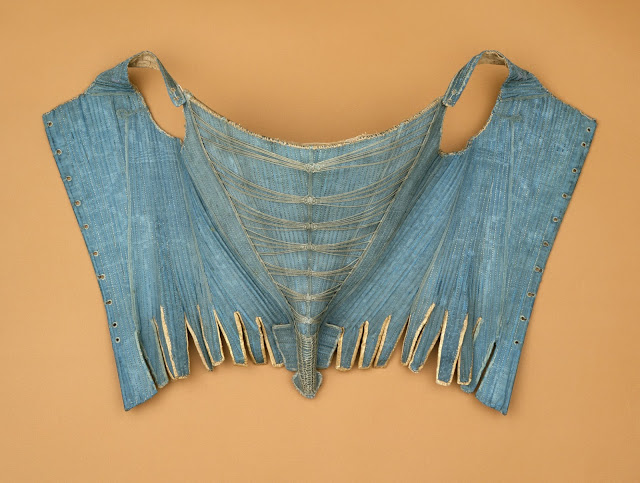
I feel terrible that it took me so long to write a review of this book, seeing as I was sent a copy by Focal Press - but I promise it was only because I intended to use it to make a set of stays and/or corset first! And then, unfortunately, I did next to no sewing since receiving it, and so I'm reviewing from a more theoretical basis. Stays and Corsets: Historical Patterns Translated for the Modern Body  is by Mandy Barrington, a senior lecturer in costume at Arts University Bournemouth. (She hasn't posted to Tumblr in a while, but you can see some great images of her work there!) The book consists of thorough instructions on drafting corset patterns based on patterns of extant pieces and modern bodice slopers, similar to the system used in Creating Historical Clothes . (And, incidentally, it teaches you how to draft your own slopers from scratch.) The patterns it contains are as follows: - 1735-1750 sleeved stays (with stomacher; sleeves not included) - 1776 half...

Stay-Dating

Image
My latest project is a proposal for a book written specifically to help out costume designers and writers of historical fiction - a fashion history manual for 1700-1940 that focuses on visuals and on how the clothing works. The first chapter, on the early 18th century (1700-1739), is my sample, and it's making me realize how brushily  we tend to deal with the period before the changes of the 1770s, and especially before the 1750s. I'm pinning down a lot of stylistic changes to at least halves of decades, but I'm finding stays surprisingly difficult. Like a lot of other aspects of fashion I've had to work out, the issue's complicated by museum dates that seem overly broad or just plain wrong. And for stays, there are considerably fewer artistic representations than there are for gowns, caps, etc.! I think I've been able to identify the differences between early-century and 1775-1795 stays - which was tricky, because a lot  of earlier stays were dated later. W...