Posts

HSM 2016 Challenge #5: Holes

Image
Sorry, I've pretty much given up on trying to get a good background in a photo in this apartment. The Challenge: #5, Holes - how would a corset function without the eyelets to lace it together? Fabric/Materials: Off-white cotton twill from my corset stash and heavy white twill tape. Originally I was going to cover it with satin, but in the end I'm glad I decided to make this a wearable mockup, as the pattern needs a little tweaking. Pattern: Based on this corset patent applied for by Mina Sebille, with some alterations and boning arrangement based on this corset at the Victoria & Albert Museum. I've been using one of your standard ungored, shaped-pieces corsets for a few years, and while it's been working well, it doesn't have enough hip spring to give me waist reduction. I figured a corset that had a separate hip piece would help me get the flare I needed. Which it does, to some extent! At least, I'm not getting much more reduction, but I am al...

Liebster Blog Award!

Image
I was nominated for the Liebster Blog Award back in January by Nessa of Sewing Empire , but I completely forgot about it! However, I've found it again just in time for CoBloWriMo , or Costume Blog Writing Month, which I'm attempting to participate in to at least some degree. The rules, as you may know, are to answer the interview questions set to you, list eleven bloggers with fewer than 200 followers* to receive the award (and notify them of their nomination), and come up with eleven questions for them  to answer. It's interesting, though, how memes change - when I went back in my blog to get the URL from when I uploaded the graphic years ago, I found that the interview aspect wasn't a part of it then, apparently. * I'm treating this as a guideline, because hardly anybody seems to have follower counts anymore Nessa's questions: What is your favourite fabric color / pattern you enjoy working with the most? Blue. It's my favorite color and I g...

Swirl Housedress, 1950s

Image
The housedress as we know it - a very informal garment to wear at home while lounging or working, loosely-fitted and easy to wash - seems to date to the early twentieth century. Previously, the term could be used to refer to more elaborate  and structured clothing, essentially what I'd label "day dress", made of less expensive fabric for the morning and more expensive fabric for the afternoon; around 1910 a shift in usage  occurred where people started to label much less formal wrappers, kimonos, and tea gowns as house dresses - although it most commonly seems to have been applied to plain wash dresses (ie, dresses that could be fully laundered). Basically, the nineteenth century housedress was something you were considered "dressed" in, and the twentieth century housedress was coming to be something that was more suitable for doing the morning housework, or just sitting around in. From the Dry Goods Reporter , July 1915 I forget how I first found out abou...

Vintage Lingerie (2011) by Jill Salen

Image
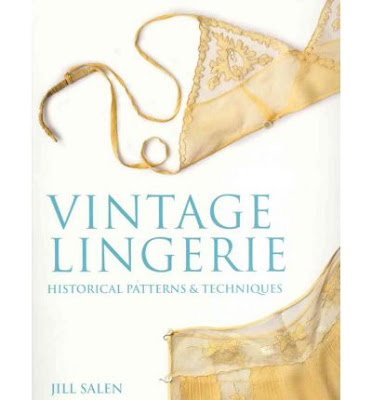
As I've gotten into vintage sewing alongside my regular historical work, I decided to buy Jill Salen's book on vintage lingerie - Corsets is very good, so I was fairly sure Vintage Lingerie would be as well. And it is! This book is an excellent resource for both vintage enthusiasts and fashion historians/collections managers who have anything to do with 20th century dress. Where Corsets overlapped with Waugh's Corsets & Crinolines  (just as Patterns of Fashion  and Cut of Women's Clothes  overlap), Vintage Lingerie  really stands alone - no other books that I'm aware of give patterns for so many pieces of lingerie, especially going so far into the 20th century. The value of the book is in the patterns. The text itself has a tendency to editorialize about corsetry - which, as you're probably aware, is one of my big pet peeves - eg, "inconvenient, unsightly, even tormenting control," "finally achieved freedom from restrictive garments,...

A Disturbing Tale

Image
I was searching for information in old newspapers to document the layout and tone of Canton's Miner Street when I came across this story: From the Potsdam Commercial Advertiser , April 24, 1895 In case you can't read the scanned text, I'll excerpt the important bits. DON'T SPARE THE ROD. Parents Should Do as Tom Did, and Nip Wantonness in the Bud.  Tom Helmer, of Stovepipe avenue, does not believe in sparing the rod and spoiling the child: only, he uses his hand instead of a rod.  On a recent evening his thirteen-year-old daughter Mabel asked permission to go to a show at the Town Hall, saying that she would accompany her aunt. To this the father assented. Along in the evening, however, he found the child on the street accompanied by the notorious Net Cameron. He ordered his girl to go home, and it appears slapped her quite soundly when she failed to comply with his commands.  This little scene took place on Miner street and was witnessed by Mrs. Charl...

HSM 2016 Challenge #4: Gender Bender

Image
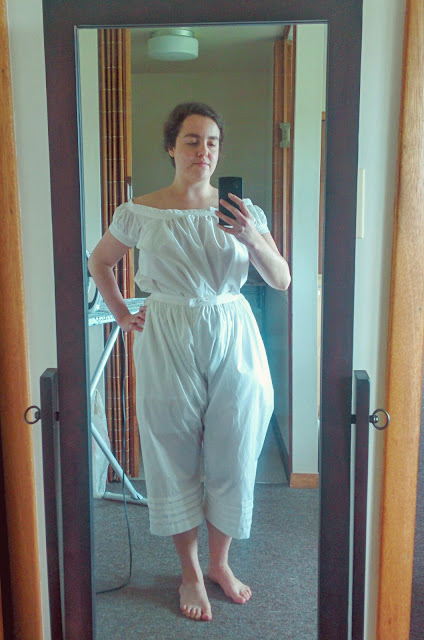
The Challenge: #4, Gender Bender. I know what you're thinking, but if we go back a few decades drawers were really controversial  for women - they simply didn't wear bifurcated garments. So even though I'm not aware of the attitude that drawers were inherently gender-bending still existing in the middle of the nineteenth century, I'm counting it because I really need drawers for my presentation. Fabric/Materials: White Pimatex cotton from Dharma Trading Co. at $6.79/yd. I'm not sure of exactly how many yards I ended up using - after making my chemise, there was only enough left for one leg, so I bought two more yards and didn't use all of that. I think it's probably about two yards in total? Pattern: From the drafting instructions by Liz Clark on the Sewing Academy Compendium. I was going to get out a pair in the collection and pattern them and base mine off that, but then I realized that that made no sense. The instructions are very clear and sim...

Nostalgia for the Ordinary

Image
This past month, my director was out on medical leave and I was technically acting director, if only in my mind. (To people walking through the door, I was still "probably the receptionist".) This led to my having to write down notes to remember to ask the director about when she came back, and the writing led to more ideas. Like ideas for exhibitions! Last month we also had a children's program on one-room schools, with a guest speaker who actually put the kids through their paces in writing and arithmetic. It was so popular! Making the past personal helps everyone connect to it. So what about an exhibition looking into the inhabitants of an ordinary street in a St. Lawrence County village? In order to tie this to Remington for the  Remington Arts Festival , the street I chose in 1900 housed both a paternal uncle's family and a maternal uncle's family. The census doesn't list street numbers, though! So I've been on a quest to both research about ten h...