Posts

Pride and Prejudice 1995: The Little Things
Image
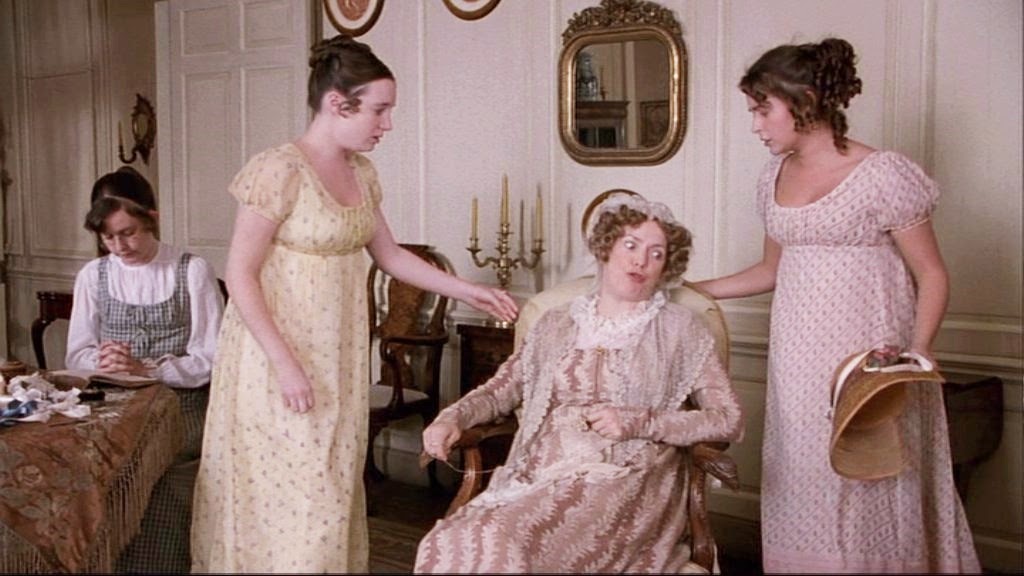
I did threaten to write about the Ehle/Firth Pride and Prejudice , and since I'm in a writing mood without a topic I decided to make good. Regency adaptations tend to go for an overall accurate look, interpreting age and income within the confines of realistic silhouettes and colors, and so they avoid the scrutiny and reputation that a more obviously artistic and unrealistic production garners. But just as this version of P&P  is not entirely faithful in every respect (e.g. the added Darcy-perspective scenes, the actors nearly all being significantly older than their characters - perhaps the most egregious example being Julia Sawalha in her late twenties playing teenage Lydia), Dinah Hill's costuming is not entirely accurate - mainly in ways that make the period more appealing to modern tastes. The exact date when the story is set is never given; generally, the movie's taken to be set in 1813, when the book was published. I'm not going to go into the full story of...

Day Dress (1865-1868)

Image
Day dress, 1865-1868; CHM 1990.56.1 (pattern available at link) It's been a little while since I've shown a patterned garment from the Chapman, so I thought I would give you another. This one also goes very well with my previous post From Hoop to Bustle , as it comes from the years when women wore the elliptical hoop at its widest: as you can see in the pattern , the skirt panels are quite flared. I might have made the date range a little wide - 1865 is a little early. The center back is cartridge pleated, which is characteristic of the end of the 1860s; earlier gored skirts (1860-1865) were more usually pleated all the way around. At the end of the 1860s dresses most usually had a short overskirt, but as you can see in the wonderful comparandum plate below, this was not a requirement. Fashion plate, probably from Peterson's Magazine , 1868; NYPL 803083 The thing I love about this dress is that it strikes me as an attempt to get at a princess-cut gown, which was...

From Hoop to Bustle: 1856-1875 (HSM #1)

Image
(For a while I intended to join in on the Historical Sew Monthly 2015, using it to put together an outfit for a Halloween wedding, but I realized that the themes were not lining up exactly with what I needed to sew. Before I thought I might participate properly in '15, I came up with the idea of participating by writing an in-depth post on the subject for each period, and I decided to go back to that idea. For January - Foundations - I'm looking at the development and evolution of the mid-nineteenth century hoop skirt to the bustle.) Something I find very interesting about the history of clothing is the contrast between the fluidity and briefness of periods of various fashions, and the way we solidify them by naming them and choosing to concentrate on specific periods. That's a very  jargony way of putting it, sorry; an example would be that the trend of a bell-shaped hoop lasted for only about five years, but somebody who chooses to recreate that period is, in a way, m...

2014 In Review - Writing-Style

Image
I very briefly considered looking at my sewing output from the last year, but as it consists of the Cranford dress, a yoked circle skirt, a pair of pants, and two knit tops, it was too depressing to contemplate. As my true work is in writing, I thought that instead of depressing you with more self-criticism of my fitting skills, I would put together a Best Of 2014 by-the-month compilation instead. January Cabinet des Modes, 5e Cahier, 1ere Planche   (January 15, 1786): Nakara  satin robe à la turque  with white satin corset  and petticoat. February Cabinet des Modes, 10e Cahier, 2e Planche   (April 1, 1786): A woman in a white gauze baigneuse  and veil with nakara  ribbon, and a woman in a hat à la Maltoise . March Cabinet des Modes, 13e Cahier, 1ere Planche : (May 15, 1786): Woman in a blue  pékin   turque , trimmed with white crêpe and artificial roses, and in a chapeau-bonnette . April Cabinet des ...

Waistcoats: 19th and 20th Century

Image
Apart from certain stylistic keys, I've always had a harder time dating men's clothing. It's just not as interesting to me, so I haven't taken the time to really study dated extant pieces and images and improve my skills. But lately I've come across more undated waistcoats while cataloguing - it's become something that I need to work on. And how better than by putting together a blog post? Wedding waistcoat, 1808; MMA 2009.300.7449  [OASC] At the beginning of the century, fashionable waistcoats were cut straight across at the bottom to match fashionable coats, although the vests often protruded slightly below the waistline of the coat. High collars, also matching the coats, would cover the sides of the shirt collar that extended up to the jawline. Both coats and vests could be single- or double-breasted, generally with self-covered buttons. While coat lapels were generally wide, waistcoat lapels were somewhat narrower. Toward the end of the first decade ...

Tableaux Vivants at Clermont

Image
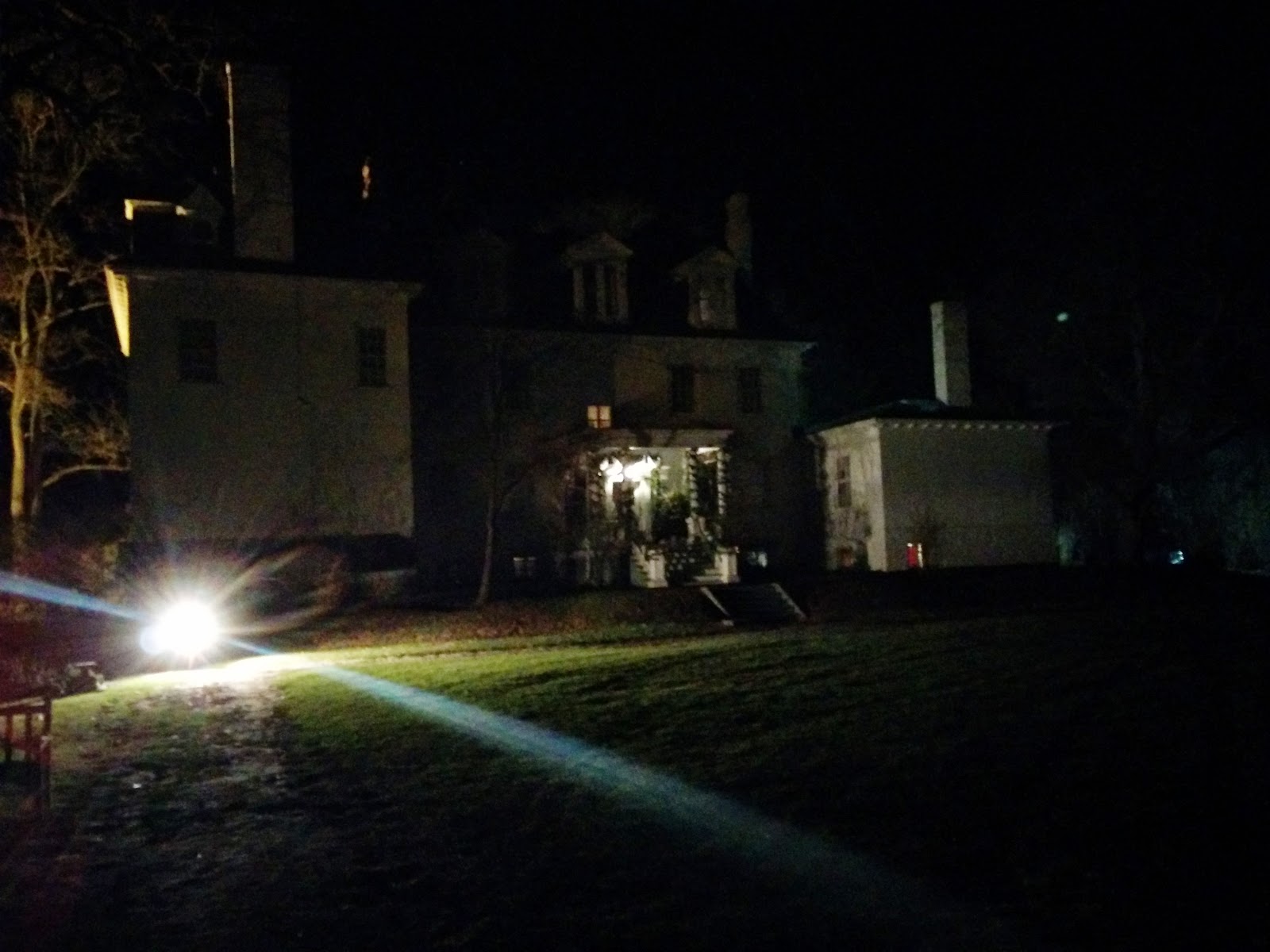
Clermont at night On Sunday, I volunteered at the Candlelight Evening at Clermont - playing Cornelia Livingston in 1843 as she sewed a Christmas present while her sister-in-law read and a servant decorated a small tree. Here are some photos of the other rooms (1776, 1778, 1808, and 1860s), please check them out! For the event, I rewore my Cranford dress with some alterations. The main thing was that I took the bodice side seams in about 3" in total, I think: it really didn't fit before (where now it has "fit issues"). I still need to mess some more with the armscyes and add bust padding to achieve a decent smoothness, and need to cut about an inch off the bottom, but I'm much happier with it than I was before. I also wore it over two more petticoats, one of which is made of crinoline and wired, and that helped the silhouette enormously. This period requires a mass of petticoats to create a softly belled shape, which I believe I came closer to achie...

Fashion History Mythbusters: The Cage Crinoline or Hoop Skirt

Image
As Julia Thomas points out in Pictorial Victorians , the satirical cartoons and anecdotes in Punch  heavily colored contemporary (and modern) impressions of the fashions of the 1850s and 1860s. As a result, the wide skirts seem like fantastical costumes that played havoc with ordinary life and were impossible to move around in. And so the myths have proliferated. “Cool Request,” Punch, or the London Charivari , Volume 32, January 31, 1857, p. 50. - compare to the actual 1857 fashion plate below The first myth to address is the name of the garment. My impression is that most people use the term "cage crinoline"- "hoop skirt" sounds farby: it gives the impression of a cheap and flimsy petticoat worn by someone who doesn't know any better. eBay and Etsy sellers using elastic and plastic sell hoop skirts, but those who use metal and fitted waistbands (and the more established companies with their own websites) sell cage crinolines. Even when used without a neg...