Posts

Magasin des Modes, 6e Cahier, Plate II
Image
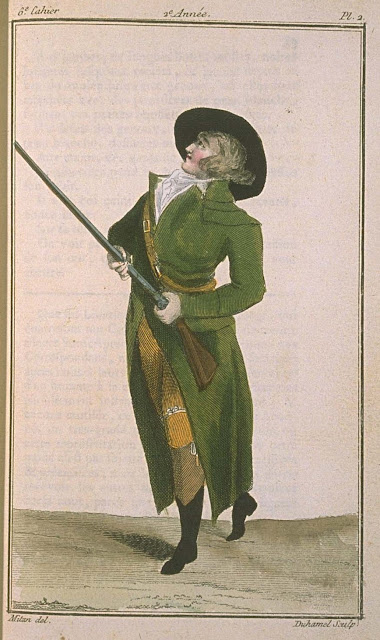
January 10, 1787 PLATE II. An Englishman in hunting dress à l'abattue .* The English felt that coats trimmed with buttons told the gun dog to relax, to drop the trail, and even to go off alone, because it was confused by the buttons; they wear them for the hunt only fastened with pins. Is it to avoid that danger, or to have the limbs more free, or only not to be caught by tree branches in the wood, that nearly all our hunters go out in shooting  or drawing  vests? We don't know. Whatever the motive, the English coat for going hunting seems to us to be preferred. It covers better, and deprives the eye of the tall and thin figure a man in a vest presents. The dress of the Englishman shown in this Plate is a great redingote of bottle-green wool, with very long skirts, very short waist, and three collars. This redingote is without buttons, and is only fastened with pins. Under this redingote, natural-colored leather vest and breeches. On the legs, long soft boot...

Wedding dress made by Jane Warnock, 1837

Image
Hey, everybody! It's been a really long time since I posted anything substantial here, but this fall I was lucky enough to curate my first exhibition at the Fenimore Art Museum: Elegant New York , a sampling of garments from our collection that were made by professional dressmakers or tailors in New York State, as well as a few from the Parisian haute couture world. Some of these garments have never been displayed before, and they certainly aren't on any online databases or other websites. There's only so much room on a label for information about a dress, and you also have to balance the desire to inform with the need to write something the largest audience can digest. Since I am only supposed to share my own photos of collections items when they're on display, I'm going to take advantage of the opportunity to blog extensively about each piece! The first garment you see on entering the exhibition is this dress: Let's look closer! This is a one-piece gown of a v...

Ca. 1866 Brown Gown - A Close-Up Look

Image
  Hello, everyone! It’s Cassidy, Mimicofmodes here, on Twitter, on Tumblr, on Reddit, and on Etsy.  Anyway, I have a small but fantastic collection of historic clothing. Antique historic clothing, not pieces I’ve made. A few of the pieces I bought myself, at thrift shops and on eBay and Etsy, but most of it was very kindly given to me several years ago by a blogging friend, Natalie Ferguson . Unfortunately, I’ve never had the chance to do anything much with them – but I’m so excited to be able to share them with the world this way! My collection ranges from a late 18th century shift to a 1980s cocktail dress, with most pieces from the early 20th century. At first I thought I could show you this gorgeous Edwardian evening skirt – the bodice apparently didn’t survive, or maybe it was sold separately at some point – but it’s very delicate. I wouldn’t want to put it on my dress form. I also don’t have a large enough space on the floor to lay it out! However, I’m moving this winter...

Fashion History Methodology - new video!

Image
Hi, everybody – it’s Cassidy! I started this YouTube channel months ago but I’ve been really lax about actually making videos. But we’re far enough into the Coronavirus that I’m ready to work on getting into Youtube. It is hard for me, because I’m not really used to watching myself … except that I am getting more used to watching myself due to all those Zoom meetings.  (Please tell me that other people obsess about how they look even though they know nobody’s watching them …) What I’m going to try to do to get more familiar with this whole format is adapt some of my posts from AskHistorians into videos (which in theory should work a lot better than trying to do podcasts about fashion history, like I was doing for a while (and thank you to everyone who supported that venture!) since I can add in visual aids, which are pretty important to this subject). AskHistorians is a forum on Reddit where people can come in and ask questions about any aspect of human history and while they’re n...

Magasin des Modes, 6e Cahier, Plate I

Image
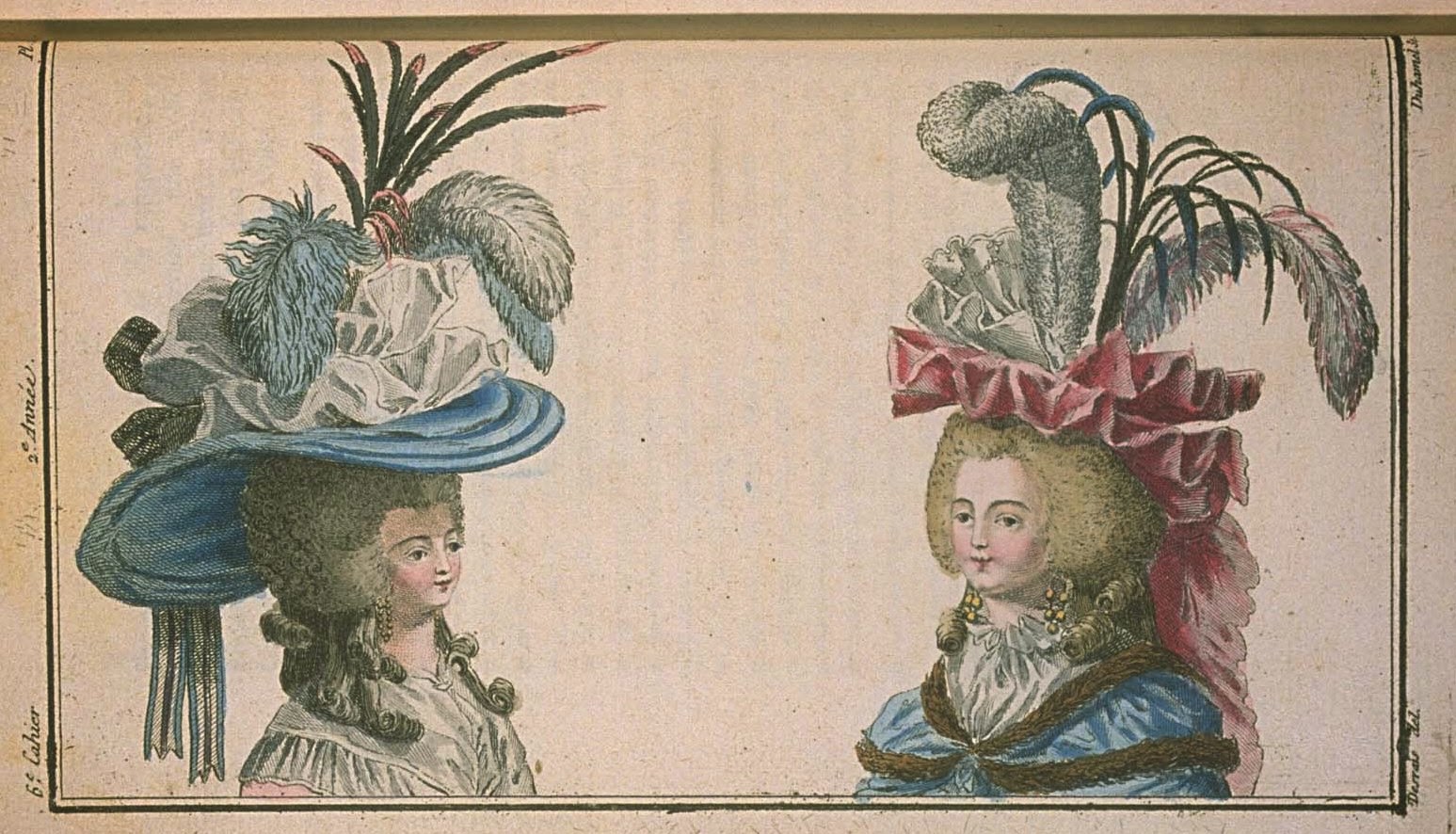
January 10, 1787 No-one can deny that our French Ladies cause their fashions to be adopted by Ladies of nearly all other Kingdoms; however, we must admit that there are restitutions that they make to nearly all. Did they not borrow, at least two years ago, Polonaises , Anglaises , Turques , Chinoises ? Now they borrow Espagnoles . It is true that they return versions that are much better than those they received, and, to be exact, they only borrow the names, and they create the things themselves. When they copy, they correct and embellish. When they imitate, they create. From a too inventive imagination, too fecund to stick slavishly to their models, they borrow, they create. They become, in a word, the masters  of the originators. This talent shines in the modern Spanish hats and cap, as it shined in the robes à la Polonaise , in the English hats, in the Turkish caps, and in the poufs à la Chinoise . The Woman dressed in a pink satin gown wears a hat à l'Espagnole . This hat...

The Pink Pingat

Image
I haven't written anything here in a while! The main reason is that I started to take a pattern from a corset at work to share, as I don't have one in my notebook already for the 1830s, and then started considering whether that's against policy, so decided I should stop until I discussed it with someone ... and then didn't ... and then, you know, the museum was closed and we all had to go home. So. In the meantime, I have  been working on Mimic of Modes patterns! (Everything's 50% off this week!) You may have noticed if you follow this blog's page on Facebook. I've made: The Very Easy Crinoline I don't know how much demand there is for this, given that crinolines can be purchased easily from Pin Up Girl and Unique Vintage and other shops, but I wanted more practice figuring out how to grade patterns and write instructions. There is also an excellent vintage clothing store here in Oneonta, and I purchased a whole bunch of things to pattern in the fu...

Sixteenth Century Venetian Dress

Image
Several years ago, mid-sixteenth-century Venetian gowns were fairly popular among historical costumers, but I don't seem to see them anymore. (Or maybe I'm just not looking in the right places?) Anyway, I was always interested in them but never made one myself. Recently, I was thinking about this era of clothing again due to a personal fiction project, and I realized that while I was familiar with the standard outfit - a sleeveless or sleeved kirtle that laces up the front, revealing a white triangle or strip of gathered chemise - I didn't really know anything about its evolution. (One interesting thing its evolution shows is that the common statement that fashion only "changed" every few decades until the nineteenth century is, like many common statements about fashion history, not true. Fashions had continuing variety, though often in subtle ways.) At the beginning of the sixteenth century, Venetian dress was somewhat plainer. La Schiavona , Titian, ...