Posts

Showing posts with the label Galerie des Modes

Galerie des Modes, 39e Cahier, 5e Figure

Image
Boston MFA 44.1536 Coiffure from  Iphigénie en Tauride Hat à la Pennsylvania  or the New Clarisse* Hat à la Zinsarra Riding hat * Probably a reference to Dereste's Emilie, ou, la Nouvelle Clarisse  or a different version of the same story Hat à l'économie du Siècle Hat à la Printemps Hat à la Grenade  or the Glorious Destiny Hat au désir de plaire Hat à la brunette Anglaise Hat à la Redoute Chinoise Hat à l'Indolente Hat à la Vache  ( 1783 )

Galerie des Modes, 39e Cahier, 4e Figure

Image
Boston MFA 44.1535 Coiffure à la Rethel-mazarin* Coiffure à la Villers Coiffure à la Veuve de Malabar** Coiffure à la Cleophile * The duchy of Rethel became the duchy of Mazarin in 1663 ** A tragedy by Antoine-Marin Lemierre originally of 1770 Coiffure à la Fleuricourt Coiffure of Venus's cape Coiffure à la Montmédy Coiffure au plaisir des Dames Coiffure of Mlle. Colombe in la Colonie* Coiffure à la belle Saison Coiffure à la Semiramis** Coiffure of Iris's cape ( 1783 ) * Mlle Colombe ( Marie-Theodore Thérèse Ruggieri)  was an actress; the V&A has two prints depicting her as Belinda in the play La Colonie ** An Assyrian queen who gave inspiration for many operas and plays

Galerie des Modes, 39e Cahier, 3e Figure

Image
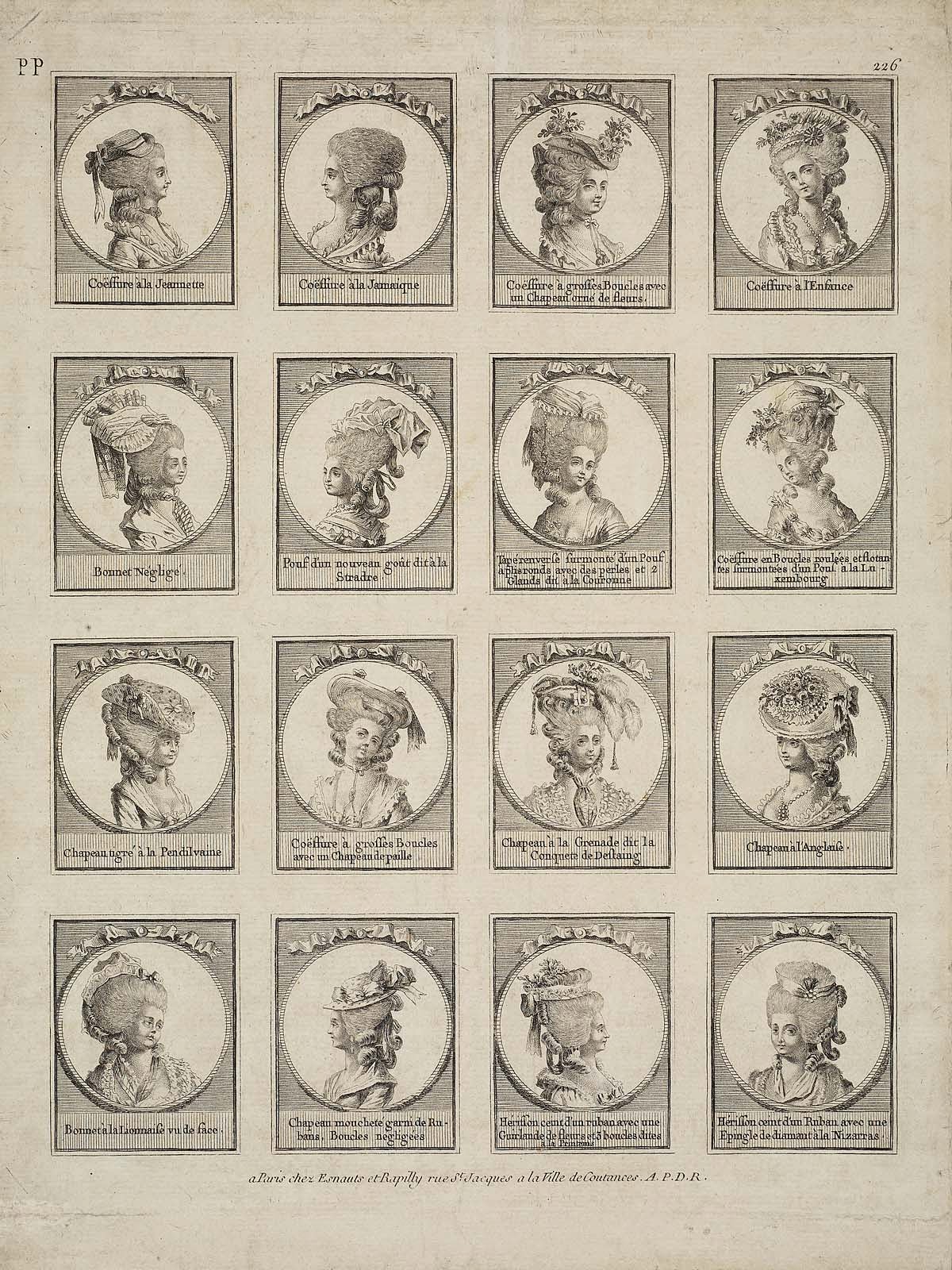
Boston MFA 44.1534 Coiffure à la Jeannette Coiffure à la Jamaique Coiffure with large Curls with a Hat decorated with flowers Coiffure à l'Enfance Negligé Cap Pouf of a new taste called à la Stradre* Reversed tapet  surmounted by a Pouf with box pleats, pearls, and two Tassels called à la Couronne Coiffure in rolled and hanging Curls surmounted by a Pouf à la Luxembourg * surname, unknown significance Streaked hat à la Pendilvaine* Coiffure with large Curls and a straw Hat Hat à la Grenade  called "the Conquest of Destaing " Hat à l'Anglaise * unknown significance, but used elsewhere in the GdM  so unlikely to be a typo for "Pensilvaine" Cap à la Lyonnaise  seen from the front Spotted hat trimmed with Ribbons, negligent Curls Hérisson  girded with a ribbon, with a Garland of flowers and three curls, called à la Printemps Hérisson  girded with a Ribbon with a diamond pin à la Nizarras (1783)

Galerie des Modes, 39e Cahier, 2e Figure

Image
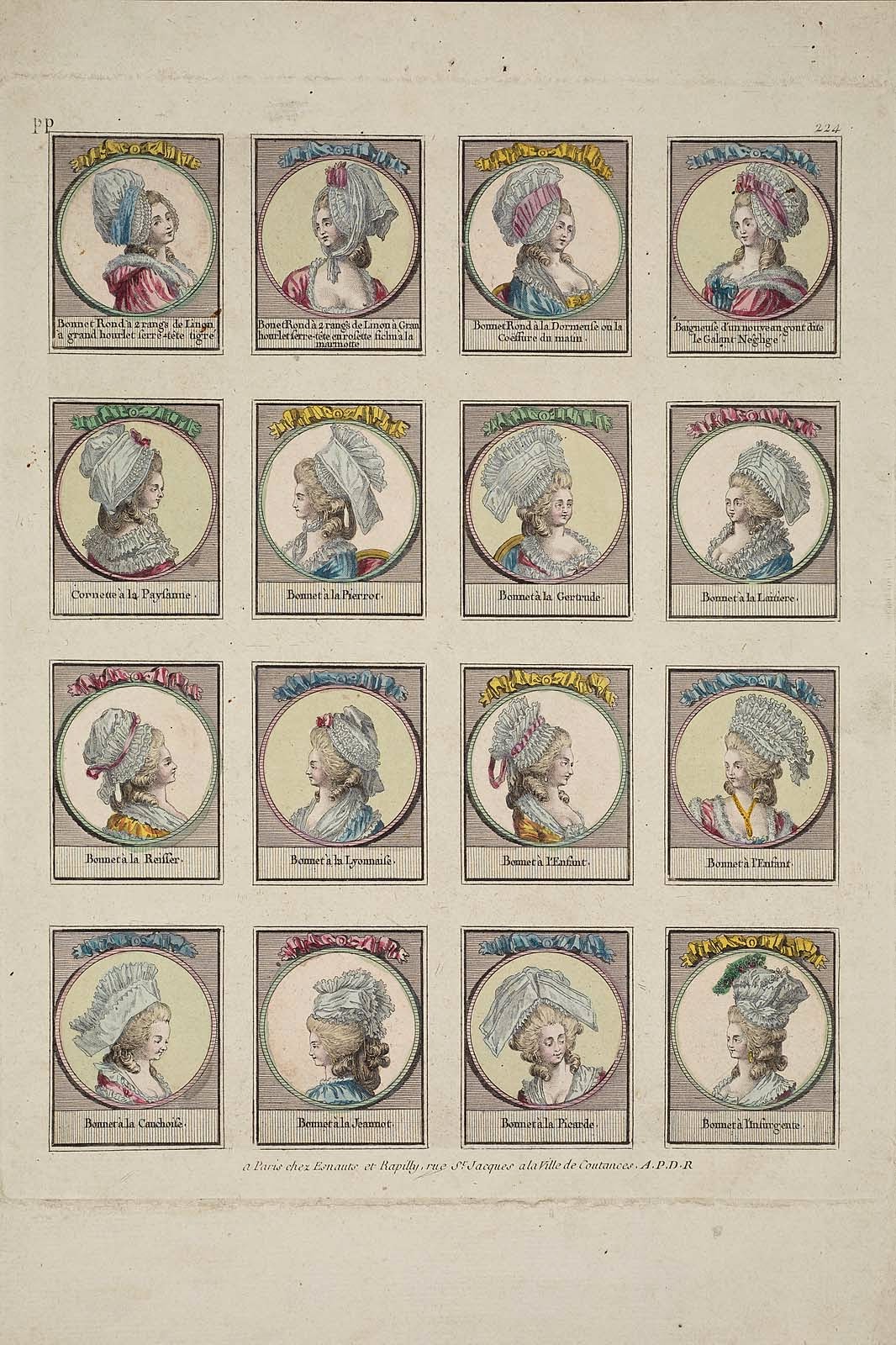
Boston MFA 44.1533 Round Cap with two rows of Linen [ruffles] with wide hems, streaked ribbon Round Cap with two rows of Linen [ruffles] with wide hems, ribbon tied in a bow, with a kerchief à la Marmotte Round Dormeuse  Cap or morning coiffure Baigneuse  of a new taste called the Galant  Negligé Peasant cornette Cap à la Pierrot Cap à la Gertrude Cap à la Laitière * * milkmaid Cap à la Reisser Cap à la Lyonnaise Cap à l'Enfant Cap  à l'Enfant Cap à la Cauchoise Cap à la Jeannot Cap à la Picarde Cap à l'Insurgente ( 1783 )

Galerie des Modes, 39e Cahier, 1ere Figure

Image
Boston MFA 44.1532 Galant  hat with a kerchief à la Mirza Hat of a new taste called à la St. Leger  in the comté of Chiny New hat called à la Longwi , near Luxembourg Hat à la Granville  in the Duchy of Bar Hat à l'Augustine Hat à l'Epernaise , a province of Champagne Hat à la Berthelot ,* otherwise called à la Comtoise Hat à la Jeannot  of the Varietés Amusants ** * Possibly for Jeanne Agnès Berthelot de Pléneuf, marquise of Prie ** Jeannot was a play which premiered in 1780, by Beaunoir (Alexandre-Louis-Bertrand Ronineau) Hat à la Napolitaine The same Hat seen from the front Hat à l'Alexandrine Hat à l'Amazone Straw hat called à la Bergère* Hat à l'Irlandaise Hat à la Colinette galante Hat à l'Anglomane** ( 1783 ) * Shepherdess ** One who has "Anglomania"

Galerie des Modes, 38e Cahier, 5e Figure

Image
Boston MFA 44.1530 Coiffure called " à la Lévite ": the front frizzed, with rolled curls all around and four baton-curls behind; loose curls on the side. ( 1781 )

Galerie des Modes, 38e Cahier, 6e Figure

Image
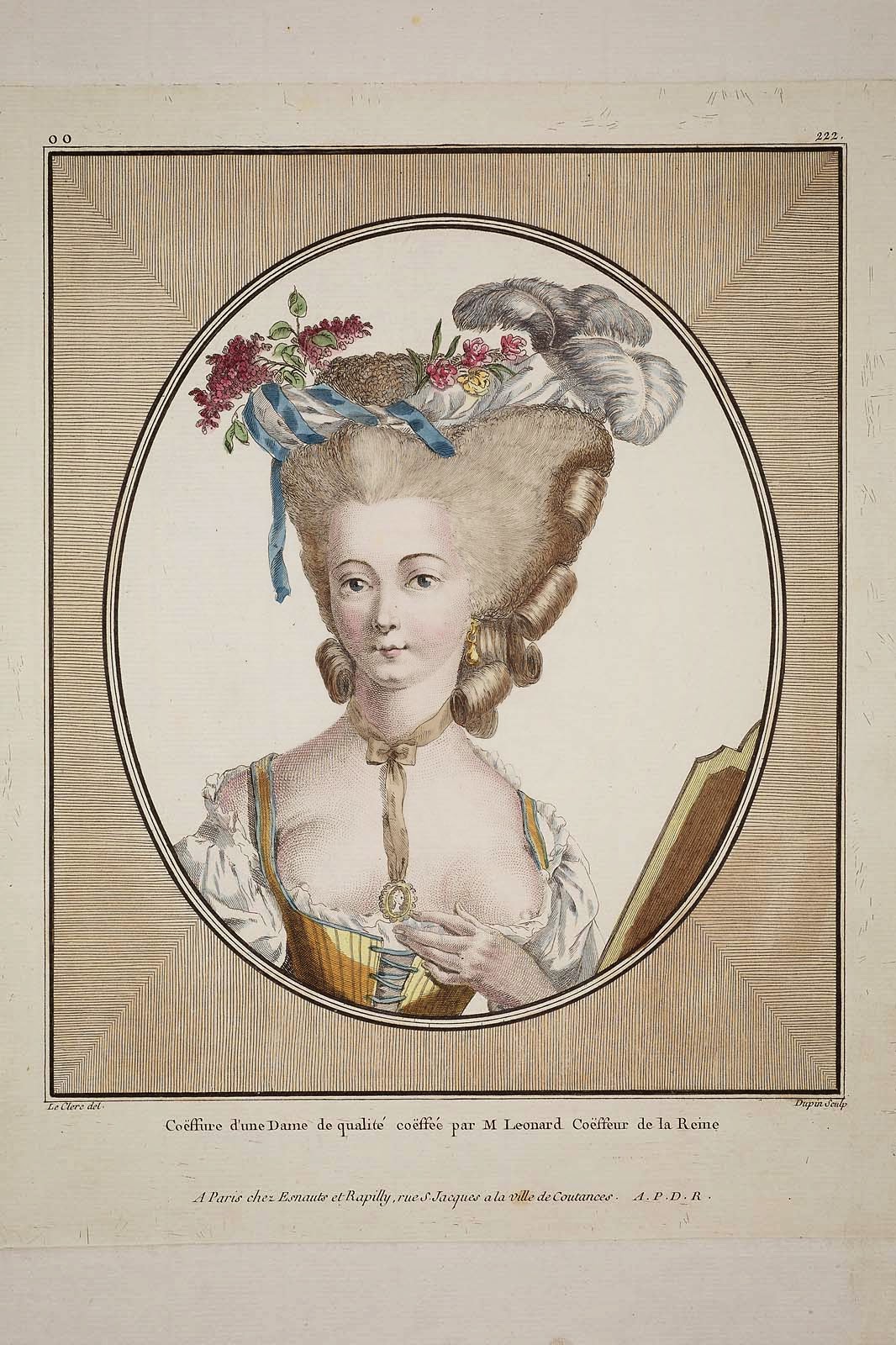
Boston MFA 44.1531 Coiffure of a Lady of quality, done by M. Leonard, Hairdresser to the Queen. ( 1781 )

Galerie des Modes, 38e Cahier, 4e Figure

Image
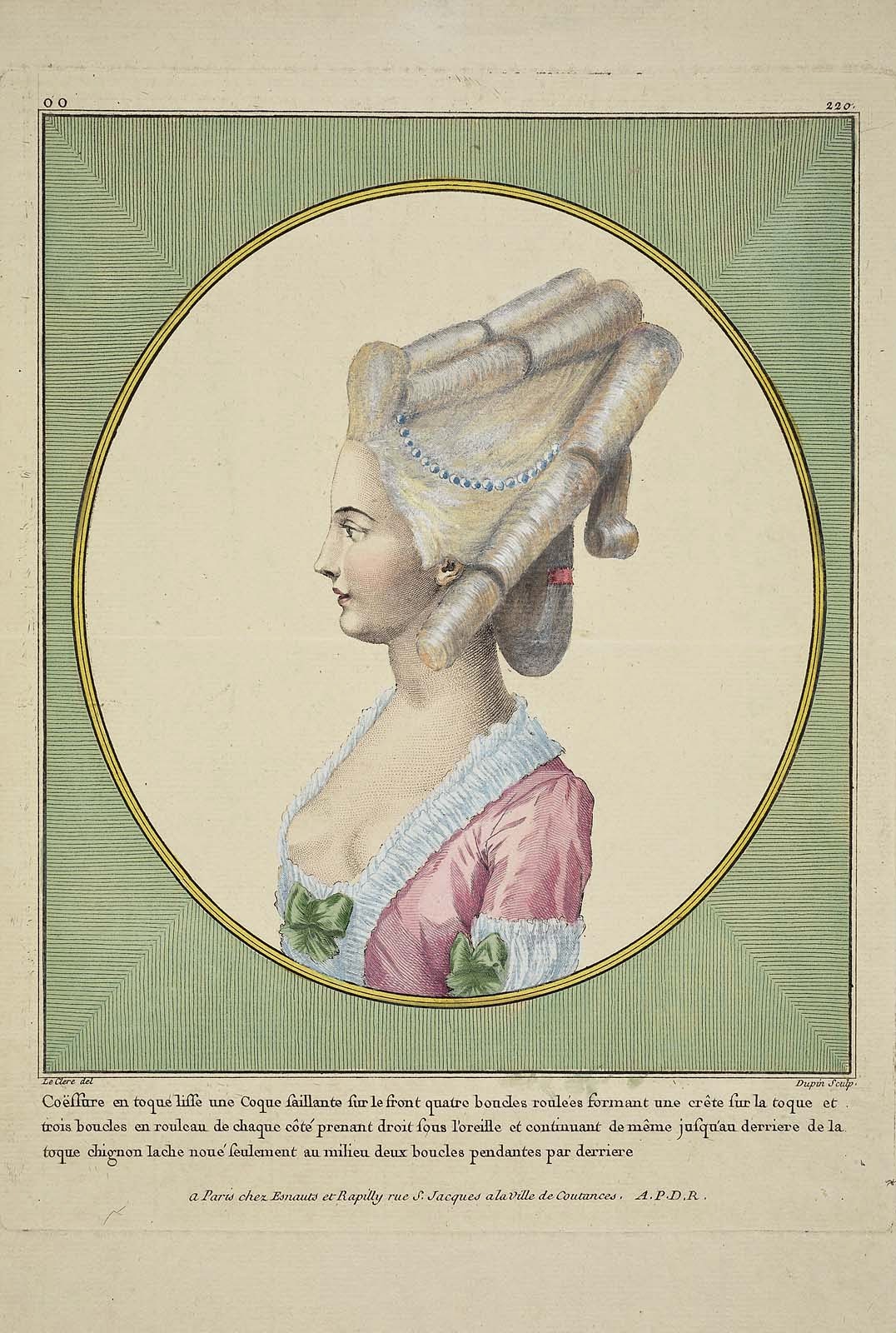
Boston MFA 44.1529 Coiffure in a straight  toque , a  Coque  protruding over the forehead; four rolled curls forming a crest on the toque  and three rolled curls on each side, going straight from under the ear, continuing in the same way to behind the toque ; loose chignon  tied only in the middle; two curls hanging in back. ( 1781 )

Galerie des Modes, 38e Cahier, 3e Figure

Image
Boston MFA 44.1528 Coiffure called à la Princesse : a low toque in front, the Coque  a little protruding, a frizzed area raised over the whole, edged with a row of little curls in hair roses, separated from the toque by a ribbon bandeau. Three curls on the sides, two hanging baton curls at the height of the loose Chignon. A gauze Pouf  artistically placed at the top of the head; a panache  on the left side of the front, composed of two aigrette plumes, a Heron feather, and a very supple one called a Follette , because it plays with grace. If you want, flowers may be added to this Coiffure, as shown here. ( 1781 )

Galerie des Modes, 38e Cahier, 2e Figure

Image
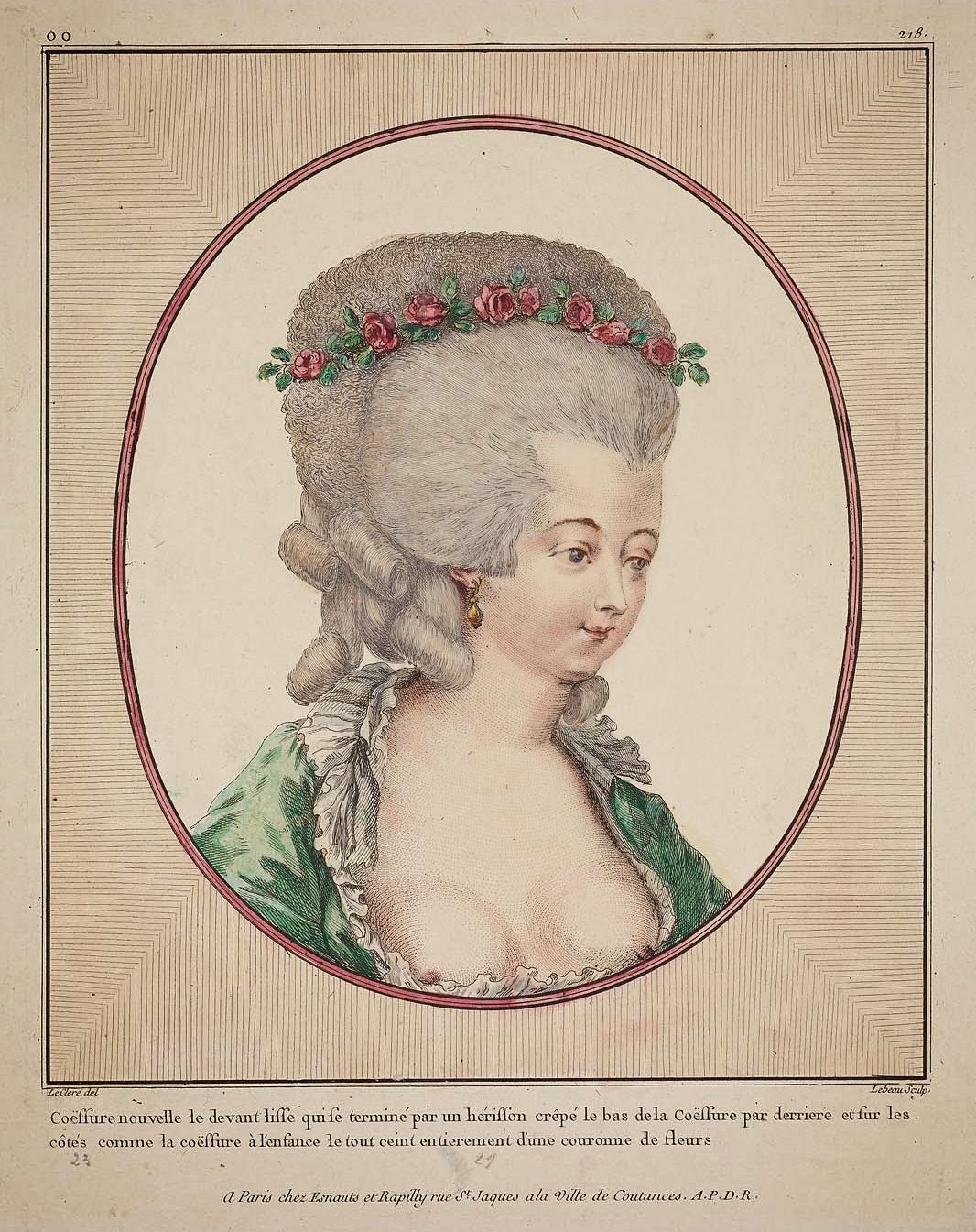
Boston MFA 44.1527 New coiffure: the front straight, ending in a frizzed  hérisson , the bottom of the Coiffure in the back and on the sides like the coiffure à l'enfance . The whole wrapped with a flower crown. ( 1781 )

Galerie des Modes, 38e Cahier, 1ere Figure

Image
(Way back when I was translating the Galerie , I came to two books - the 38th and 39th - which weren't included in the reprint. From the index, I could see that they were coiffures, and since they seemed less pressing than the gowns I let them wait. And then I forgot about them.) Boston MFA 44.1526 Coiffure of a white straw hat edged with a colored ribbon. Crown surrounded by a wide ribbon, with a bow in the front. It is decorated with flowers and covered with straight hair over a toque which is low in front and larger in the back. Two curls and a favori; loose chignon and two curls hanging in back. ( 1781 )

Galerie des Modes, 63e Cahier, 6e Figure

Image
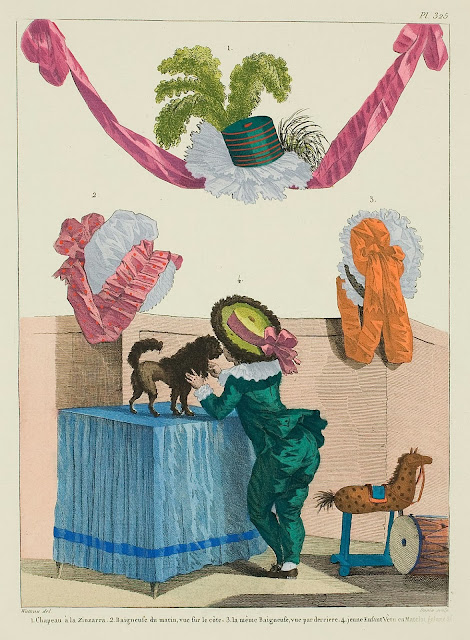
1. Hat  à la Zinzarra . 2.   Morning  baigneuse , seen on the side. 3. the same  Baigneuse , seen from the back. 4. young Child Dressed in a galant Matelot  etc. "Children ... also have fashions, that their fathers and mother are not vexed to learn; for they are often confused to know how to dress them. "Little girls almost always follow women's fashions; but little boys, that are dressed in matelots , have particular clothes. "One sees by the representation of the little boy, that he wears matelot  breeches of silk; ... a gilet with wide stripes ...; a long silk jacket ... edged with a piping ... and that this jacket is trimmed with half-sleeves of white batiste at the end of which are attached manchettes . "His shirt is trimmed with a wide frill or collarette with double flounces. "His hair, only straight, hangs in curls on his shoulders. "... He wears little yellow  brodequins  on his legs ..." Le Magasin des Modes , 10 ...

Galerie des Modes, 63e Cahier, 5e Figure

Image
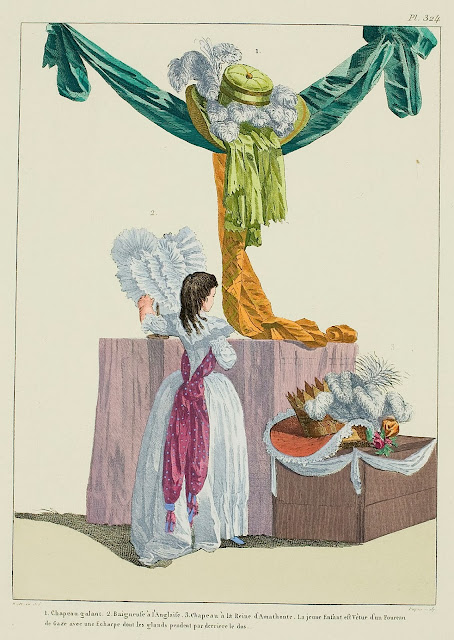
1.  Galant  hat. 2 . Baigneuse à l'Anglaise.  3. Hat  à la Reine d'Amathonte.*  The young Child is Dressed in a Fourreau  of Gauze with a Scarf whose tassels hang behind her back. "... The little girl is dressed in a gown of white linen, whose bodice and sleeves are taffeta: this gown is tied with a long and wide belt ...; she wears under this gown an all-white petticoat; she wears on her neck a very puffy  menteur  kerchief, trimmed with a pinked double flounce; ...her hair hanging à la Conseillère  in back ... "Her shoes are unbleached linen, trimmed with a white ribbon ..." Le Magasin des Modes , 10 July 1787 * "Queen of Amathus", an ancient royal city of Cyprus, which had a cult of Aphrodite. Possibly a references to Scylla et Glaucus , an opera set in Amathus.

Galerie des Modes, 63e Cahier, 4e Figure

Image
1. Galant hat. 2.  Baigneuse à la Voluptueuse.  3. young Girl in a little morning Chemise. 4. a little Gentleman in a Matelot , with a Hat  à l'Espagnol. "If we revisit in our minds all the modifications of Fashions, it will be very easy for us to convince ourselves that Fashion, called so variable, is yet regular in its march, and that it is always put together in the same manner. First is the simple style, or simple forms: then there are decorated, embellished forms; then there are overloaded forms, and, after, the Fashion disappears. "While the embellishments are still simple, there are those that believe the Fashion will last for a long time (a long time for it); but soon the embellishments are overloaded, there is reason to believe that the Fashion has only a short time to last." Le Magasin des Modes , 20 October 1787

Galerie des Modes, 63e Cahier, 3e Figure

Image
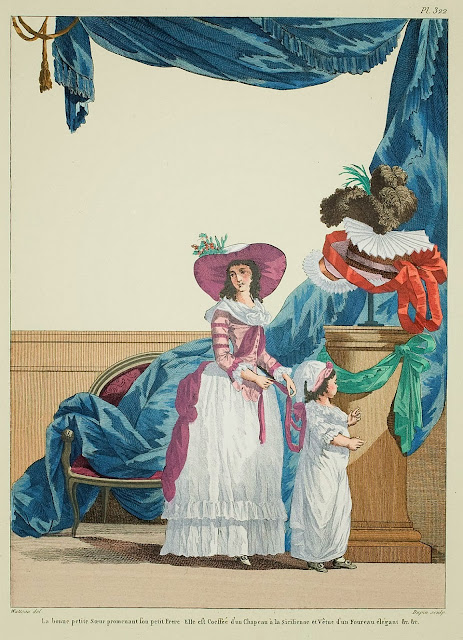
The good little Sister walking her little Brother. She is Coiffed with a Hat à la Sicilienne and Dressed in an elegant Fourreau etc. etc. "Mesdames, admit it: while your children are little enough not to make you ashamed of your age and not to shut down your coquetry, you still lead them into society, in the promenades, in all the frequented places and even, when they are pretty, fine, playful, babbling, you make yourself a glory from showing them off, because your pride enjoys the praises which are accorded to them, and which are naturally reflected on you; (the fathers are so weak:) thus you want them to be dressed elegantly, with taste, in the same fashion; you find that it is thus why at this age they give you honor. So we should only do better to give you fashion for your children. "You would not lead with pleasure children of a slightly advanced age, mostly because they would no longer have this gaiety, this vivacity, this babble capable of attracting all looks...

Galerie des Modes, 63e Cahier, 2e Figure

Image
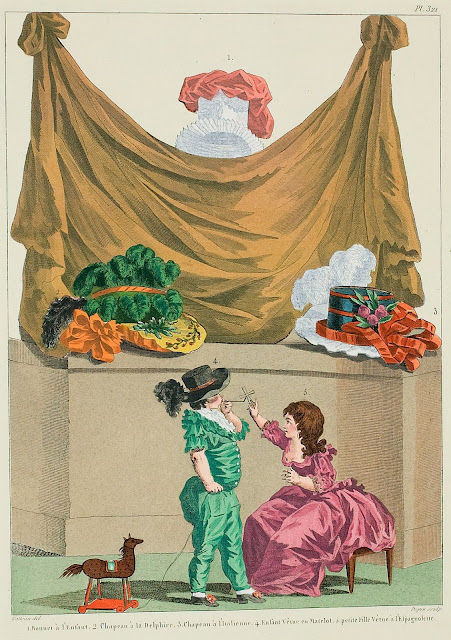
1. Cap à l'Enfant . 2. Hat à la Delphire . 3. Hat à la Italienne . 4. Child Dressed in a Matelot . 5. Little Girl Dressed à l'Espagnolette . Children . - "Children in Paris are very pretty until the age of seven to eight years. As they are elevated to the place of a numerous crowd of individuals, they contract early an air of ease; they do not have a vacant air; they are not too astonished at the habits of life, nor the worries of the city; a little air of assurance says that they were born in the capital and already molded in its great movement; they have no dread of what happens around them. Put properly, in general, in a simple and easy manner, they owe the liberty of their dress to the writings of J.-J. Rousseau." SEBASTIEN MERCIER. Tableau de Paris , 1788

Galerie des Modes, 63e Cahier, 1ere Figure

Image
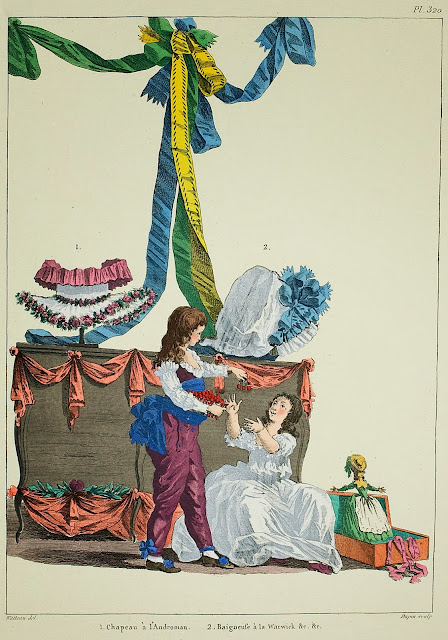
1. Hat à l'Androsman . 2. Baigneuse à la Warwick* etc. etc. "Caps and poufs are made of goffered gauze and trimmed with plain, goffered ribbons. This goffering is done with irons, which are furrowed in a thousand rather wide and deep stripes. These irons are heated, and the gauzes and ribbons are heated with them, which thus form a thousand little pleats. "The most fashionable ribbons today are plain, goffered ribbons. The colors of these ribbons are left to each person's imagination. Pinks, jonquil yellows, violets, and apple greens are however the most generally adopted." Le Magasin des Modes nouvelles , 20 July 1787 * Possibly derived from the Countess of Warwick, Henrietta Greville (m. 1776)?

Galerie des Modes, 62e Cahier, 6e Figure

Image
Lady of quality getting up from bed, taking the fresh air at the Tuileries, busying herself with her work to keep herself from being bored. She is Dressed in a white Gown and a Mantelet of spotted Gauze etc. Tuileries ...  "Art cannot embellish nature of its own charms, and the most precious lack solitary promenades. I confess simply that the effects of a happy distribution of walkways, lawns, flowers, and basins only inspire in me a cold and sterile admiration. What  is sadder than these monotonous beauties! What is more ravishing than these triple rows of charming women who border the beautiful walkway of the Tuileries , in a summer soirée, in the most serene days of autumn and spring! All these groups vary infinitely which break down without ceasing to make up mutually establish between a thousand different circles in a continual circulation of meetings, ideas which increase, develop in passing from one group to another with the members always fluttering from these d...

Galerie des Modes, 62e Cahier, 5e Figure

Image
The young Englishwoman wanting to make her fortune in Paris, in taking the French fashions and dreaming of the means of achieving them. She is coiffed in an anglomane Hat surmounted by Plumes over her hair, falling down over the forehead à la Jaquet etc. etc. "Foreigners must please Paris, for more than one reason. First, they are perfectly welcomed there; one has for the men almost much deference as for the women. The more they come from afar, the more one hastens to satisfy them; the difference of religion or costume is a further merit, and a motive for receiving them well. A Parisian is careful to leave a good opinion of himself in the minds of travelers." SYLVAIN MARECHAL, Notice on the mores of Paris ( Actual dress ... ), 1787

Galerie des Modes, 62e Cahier, 4e Figure

Image
The beautiful Zulima Dressed in a Robe à la Sultane and Coiffed with a Pouf à la Turque etc. etc. Furnishings made by Mlle Bertine, modiste to the Queen, for Mme de Versisy. " 1786, 15 December . - A pouf bordered with a Turban of white satin, a blonde lace of great height over it, a panache  of two flat plumes on the side, a gauze kerchief behind. ... 96 livres . "A great gauze kerchief of an ell [of fabric]. ... 15 - "Total ... 111 livres ." Dossiers Bertin  (Doucet Library)