Friday, May 17, 2013

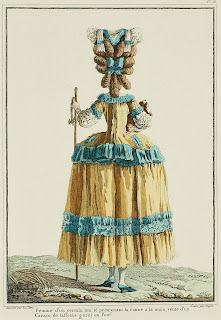
Galerie des Modes, 34e Cahier bis, 6e Figure

Simple robe à la sultane, such as is actually worn without a grand parure.  This gown is open in front and allows the whole petticoat to be seen; in the back it has the form of an untied polonaise and descends almost to the ground like the Lévite.  Hat coiffure with a cap of Gauze invented by Mlle Bertin. (1782)


This plate is from the Museum of Fine Arts Boston, 44.1525.

Thursday, May 16, 2013

Galerie des Modes, 34e Cahier bis, 5e Figure

Young Lady performing a dance; she is dressed in a Carmelite* morning Lévite, the Trim of the same fabric, the Collar gathered muslin with a large hem, petticoat of pale pink silk trimmed with the same, white Belt with colored fringe. (1782)


Dance. - "One dances no more at the Opera ball; one no longer runs there; one only looks for confusion there: one walks on one's feet; one is smothered: here is the great pleasure: but no contre-danses.

"Dancing is so perfected today that it is necessary to dance with a marked superiority to participate.  When Marcel, his head supported on one of his hands, wrote: What things in a minuet! did he himself anticipate that soon it would no longer be permitted to dance for one's own pleasure, that the man of the world would become an actor in a bal paré,** and that he would dance for applause?"

Sébastien MERCIER, Tableau de Paris, ed. 1785

* The Carmelites are a Catholic order dating back to the 13th century, who traditionally wear brown.
** I'm not quite sure how to translate this one - I know that paré frequently means "dressed" in the sense of "fully-dressed" or "dressed to be seen". The women in the print below are dressed well, but not in robes parées

Le Bal Paré, Antoine Jean Duclos, 1774; MMA 33.56.33

Wednesday, May 15, 2013

Galerie des Modes, 34e Cahier bis, 4e Figure

Morning robe à l'Anglaise with amadis sleeves, coupé petticoat with a large volant of muslin, kerchief with double row of trimming.  This woman is coiffed with a hat of long-haired Vicuna with a ribbon around it. (1782)

This plate is from the Museum of Fine Arts Boston, 44.1547.


Tuesday, May 14, 2013

Actual Sewing!

So, I spent the past week engaged in making a Regency day dress for myself.  Fastest thing I've ever fully put together!  Albany's TulipFest is not really intended as a costumed event, but the Empire State Costumers (join us!) can turn any party into a dress-up party.

(I'm the second from the right.)

To start, I used the pattern I took from an evening dress in the Albany Institute's collection (combined with some Janet Arnold sleeves) and striped cotton from Renaissance Fabrics.  As usual with extant pieces, I am not quite as dainty, so I knew I would have to enlarge it.  Unfortunately, I chose to widen it from the center front, which made the straps set at the wrong angle and there were just all sorts of issues.  Think I'll definitely take another go at it, raising the waistline and fitting it better, but for now I need to move on.

l'original

Next up: I'll be doing a talk at Clermont on women's fashion in the 1920s in June, and I would really like to be dressed up for that.  My dilemma is that I can't tell if it'd be better to do a very plain ca. 1923 day dress, long and straight, with a pattern in my size - or to shatter expectations with what fashion/pattern magazines would refer to as "an afternoon dress with a bouffant skirt".  The bouffant dress would probably be more flattering to me than the straight one, but I'm concerned that it would go beyond "whoa, I didn't think the 1920s included things like that!" to "why is she wearing a '50s cocktail dress?" to an audience.  Thoughts?

 Union Hotel stereograph, ca. 1875; NYPL MFY Dennis Coll 91-F149 g91f149_025f

After that on the list: this year is the Saratoga Racetrack's 150th anniversary.  There are several military reenactment events on the official calendar, and maybe I'll visit them, but I think it would be lovely to
have an 1873 picnic at some point.  I do have a couple of 1860s patterns of my own, but nothing this late, so I'll likely use the ca. 1871 Janet Arnold pattern with the day bodice (probably including the neckline fill-in because I always seem to have a very hard time keeping chemises from showing there).  I'd love to make it out of lawn, along these lines.

Advertisement from Every Saturday, March 18, 1871; NYPL PC COSTU-Cor 818149

Of course, what does this mean?  NEW UNDERGARMENTS NEEDED.  I am a big fan of corsetry for its controversy and aesthetic appeal, but I have to admit that I really, really dislike sewing it.  Fitting is not my specialty, and in a corset the fit is the most important aspect.  I also have a bad track record for finishing corsets, although in this case the lack of straps and gussets means there is a better chance that I could Do This and move on to the bustle.

Galerie des Modes, 34e Cahier bis, 3e Figure

Robe à l'Anglaise, rétroussé to give ease in dancing. (1782)

"In 1768, in its December issue, the Courrier de la Mode recommended as particularly favorable for balls, "English dress", with fitted sleeves, sabot cuffs trimmed with gauze, with a gauze apron without a bib* and bows on the shoes: such is still the costume of our dancer who has simply replaced the 'little English hat trimmed with flowers with a postilion**' with a tuft of plumes, an aigrette, and a bouquet."

* Bibbed aprons being mainly a Continental style.
** I believe this means a turned-up brim in the back.

Monday, May 13, 2013

Galerie des Modes, 34e Cahier bis, 2e Figure

I don't entirely understand this section, nor the next - the 34th, 38th, and 39th books are listed as having second versions that fit in, date-wise, after the 40th.  But as they are here, I will still show them.  (Except the ones which I can't find anywhere, such as the first in this section.)


Full robe a la Sultane, closed in the front of the bodice and pulled up in drapery on the side with bows and tassels; it has mancherons* like the Circassiennes; it differs from the ordinary robe a la sultane, which is open in front and without mancherons* like a Polonaise, the petticoat is coupé, the Coiffure is a turban. (1782)


"There was a very appreciated gown trimming in the winter, of fur bands.  But outside of cloaks and mantelets (see plates 25, 59, 70, for example), they could hardly be applied on the surface of court gowns (plate 46).  The preference was for marten, black fox; squirrel, beaver; ermine had as much success, and in 1768, for the half-mourning imposed for the death of the queen, the Courrier de la Mode taught that one used ermine skins 'colored with large and small stripes and in other patterns for different tastes'."


*Technically, the text says "manchon", which is a muff, so I believe this is a typo.

Friday, May 10, 2013

Galerie des Modes, 40e Cahier, 6e Figure

Deshabille a l'Anglaise of taffeta, trimmed flat with a band of gauze edged with a gauze frill; the Camisole is made with basques, edged in the same manner, as is the turned-down collar.  The Coiffure is a peasant cap. (1782)


This plate is from the Museum of Fine Arts Boston, 44.1543.  There is a duplicate in green, 44.1544.